
Yes, you can almost always cancel a booked clean, and whether it costs you anything comes down to timing. Send written notice as early as possible, ideally before the 24 to 72 hour window most providers set, and ask for confirmation in writing. The exact figures live in your service agreement, so check that first before you assume the worst.
TL;DR:
- Cancelling a cleaning service late in the notice period or on the same day usually incurs a fee or is treated as a no-show, costing full service charges.
- Most providers require between 24 to 72 hours' written notice, with stricter policies for same-day cancellations and larger or commercial jobs.
- Refunds for pre-paid bookings are uncommon; deposits are often forfeited or credited toward reschedules if cancellations occur within notice periods.
- Disputes over cancellation fees are best resolved by referencing the contract, providing clear evidence of notice, and following specific communication procedures.
- Clear, upfront terms and proper documentation minimize fee disputes and make cancellation processes smoother for both clients and providers.
Table of Contents
- What are typical notice periods for cancelling a cleaning service?
- What fees can you be charged for cancelling a cleaning booking?
- How do you cancel a cleaning service the right way?
- Ending a recurring cleaning arrangement is different from skipping one visit
- Can you dispute a cancellation fee, and how do refunds work?
- How illness, lockouts and public holidays affect cancellation fees
- How ACT Cleaning by Demand handles booking changes
- Why clear terms matter more than strict ones
- Book cleaning with terms you can actually understand
- Sources
- FAQ
What are typical notice periods for cancelling a cleaning service?
Every provider sets its own clock, but the industry has settled into a handful of common windows. The most cautious operators want 24 hours notice minimum for a straight cancellation, and treat anything inside that window as chargeable. Others stretch that to 48 or 72 hours, particularly for larger jobs like end of lease cleans that involve booking a whole crew.
Here's what the common windows actually mean in practice:
- Same-day cancellation: almost never fee-free. Treated as a lost booking the cleaner can't fill.
- 24-hour notice: the baseline most residential cleaners ask for. Cancel by this morning for tomorrow's visit.
- 48-hour notice: common for teams or multi-hour jobs where staff scheduling takes longer to rearrange.
- 72-hour or 1 business day notice: typical for commercial contracts or specialty jobs like carpet steam cleaning that need equipment booked ahead.
Business days matter more than people realise. A "1 business day" clause cancelled on a Friday for a Monday job usually doesn't count, because the provider's office isn't open over the weekend to process it. Cut off times bite too. If notice is due by 5pm the day before and you email at 6:30pm, you've missed it, even though it's still technically the day before.
Pre-paid bookings and deposits behave differently again. Most providers will hold a deposit against a rebooked date rather than refund it outright, especially for larger jobs. If you've paid for a full end of lease clean upfront and cancel within the notice window, expect the deposit to be forfeited or converted to a rescheduling credit rather than returned to your account.

What fees can you be charged for cancelling a cleaning booking?
Cancellation fees generally fall into four buckets, and most providers combine two or three of them in their terms.
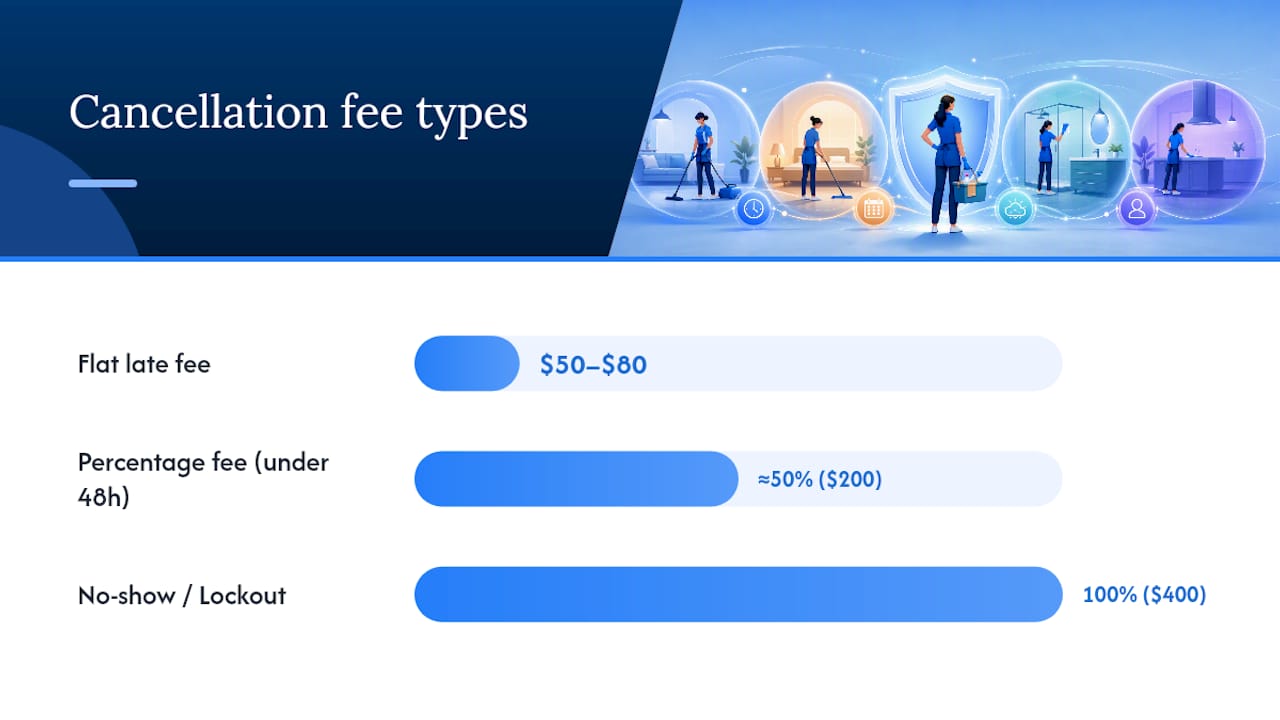
- Late cancellation fee: charged when you cancel inside the notice window but still give some warning. Often a flat rate around $50 to $80, or a percentage of the job price.
- No-show fee: charged when a cleaner turns up and nobody cancelled at all. Usually the full service price, since the time slot is a total write-off.
- Lockout fee: charged when the cleaner arrives but can't get in. Functionally identical to a no-show for billing purposes.
- Rescheduling fee: smaller than a cancellation charge, sometimes waived entirely if you're moving the booking rather than cutting it.
Sample terms pages across the industry commonly use one of two models: a flat dollar fee for late cancellations, or a percentage of the job cost, often around 50% for notice given under 48 hours, scaling to the full amount for same-day cancellations or lockouts.
Pro Tip: Ask upfront whether the fee is calculated on the quoted job price or a fixed rate. Percentage-based fees on a $400 deep clean sting a lot more than a flat $50 charge.
Fees are commonly waived, or at least reduced, when you can show a genuine reason: a medical certificate for sudden illness, an agreed reschedule made in good time, or clear evidence the provider actually failed to give you proper notice of its own terms.
How do you cancel a cleaning service the right way?
A clean cancellation, no pun intended, comes down to following the process your contract actually asks for and keeping proof at every step.
- Check the contract first. Look for the accepted cancellation method (email, phone, SMS, or a written notice) and the exact number of hours or days required.
- Send written notice, even if you've already called. Include your booking reference, the service date, and the date you're giving notice.
- Keep the wording simple. Something like: "I'm cancelling my booking (Ref #1234) scheduled for 14 March. This notice is being sent on 11 March, giving 72 hours' notice as per your terms."
- Ask for written confirmation in the same message, so there's no ambiguity about whether your cancellation was received on time.
- Save everything, including timestamps on emails and screenshots of SMS threads, in case a fee dispute comes up later.
Following up a written notice with a quick SMS or phone call doesn't hurt either. It's belt and braces, but a provider is far more likely to waive a borderline late fee when you can show you tried multiple channels before the deadline than when the only evidence is a phone call nobody logged.
Ending a recurring cleaning arrangement is different from skipping one visit
Cancelling next Tuesday's clean and terminating an ongoing weekly or fortnightly service are two different processes, and treating them the same is where most disputes start. A single skipped visit is governed by the notice windows above. Ending the whole arrangement usually sits under separate contract terms.
- Many recurring agreements require 30 days' notice to terminate the whole service, not just the next visit.
- Watch for auto-renewal clauses that quietly extend the contract for another term if you don't cancel by a set date.
- Some contracts include an early-termination fee if you cancel before a minimum commitment period ends.
Time your notice to line up with your billing cycle, not the calendar month, and ask for a final or pro rata invoice if you're cancelling mid-cycle. That single step avoids paying for a service period you'll never actually receive.
Can you dispute a cancellation fee, and how do refunds work?
A calm, factual email referencing the specific contract clause resolves most fee disputes without anyone needing lawyers involved. Ask for an itemised invoice showing exactly how the fee was calculated, then compare it against your own timestamped notice.
- Write the dispute email referencing the exact notice clause and the date/time you sent your cancellation.
- Attach evidence: your original booking confirmation, the cancellation email, and any reply you received.
- Give the provider a reasonable window, around five to seven business days, to respond before following up.
- Treat small claims or a mediation service as the last step, not the first, and only for genuinely low-value amounts worth the hassle.
Documentation carries almost all the weight here. Providers waive far more fees than people expect when the client can actually prove they gave notice on time.
How illness, lockouts and public holidays affect cancellation fees
Special circumstances get judged case by case, but a few patterns hold across most providers.
- Illness or emergencies: a medical certificate or a simple written explanation is often enough to get a fee waived, especially for a first occurrence.
- Lockouts and access problems: these are routinely billed as same-day cancellations, because the cleaner has already lost that time slot. Clear access instructions left in advance prevent this entirely.
- Public holidays and severe weather: policy varies widely, so ask directly whether an exception applies rather than assuming one.
How ACT Cleaning by Demand handles booking changes
We built our booking portal so cancellations and reschedules go through the same system as the original booking, meaning there's a written record and a confirmation on file automatically, not something you have to chase down after the fact. Customised packages mean the terms attached to a one-off deep clean look different from an ongoing office contract, so what applies to your booking is clear from the start rather than buried in generic fine print.
Every job runs on eco-friendly products and police-checked staff, and our focus stays on the kind of local relationships that make clients comfortable calling us directly when a date needs to shift. If you're weighing up why residential cleaning standards differ between providers, the same logic applies to their cancellation terms: clearer terms upfront generally mean fewer disputes later.
Why clear terms matter more than strict ones
The instinct among a lot of cleaning businesses is to write the toughest possible cancellation clause and assume that protects revenue. It doesn't, not really. What protects revenue is a client who understands the rule well enough to follow it, which means the real failure point in most disputes isn't a rude client or an unreasonable business, it's a policy nobody read properly until money was already on the line.
The conventional advice, "always read the fine print," is technically correct and practically useless. Nobody reads fine print before they need a cleaner on Thursday. What actually works is providers stating fees plainly at the point of booking, and clients treating written confirmation as a habit rather than an afterthought. That single habit, sending notice in writing and asking for a reply, resolves more fee disputes than any amount of policy-reading ever will.
If you take one thing from this: stop trying to memorise notice windows in the abstract. Find your own contract's specific number, write it somewhere you'll see it, and treat that written confirmation step as non-optional every single time.
— Deng
Book cleaning with terms you can actually understand
If the fee tables and notice clauses above made you wonder whether your own cleaner's terms are this clear, that's worth checking before your next booking rather than after a dispute. ACT Cleaning by Demand posts straightforward cancellation terms through the same portal you use to book, so you know the notice window and any charge before you ever need to worry about it.

There's no lock-in contract pushing you toward an early-termination fee, and packages are built around what your property actually needs rather than a one-size template. Whether you're after a regular house cleaning arrangement or a one-off end of lease clean timed against a move-out date, check availability and see the cancellation terms before you book, so timing your notice is never a guessing game.
Sources
For readers wanting the full detail behind the figures above: Jobber Academy's cancellation policy guide covers standard notice windows and fee structures, LegalClarity's termination guide explains recurring contract notice and dispute pathways, and the Ai Group's guidance on respectful termination covers how to keep the process professional on both sides.
- Cleaning service cancellation policy: what you need to know | Jobber Academy
- How to terminate cleaning services: notice and contract | LegalClarity
FAQ
How do you cancel a cleaning service politely?
Give as much notice as your contract allows, explain the reason briefly without over-justifying, and thank the cleaner for their work so far. A short, direct written message beats a long apologetic one every time.
How do I cancel a cleaning contract?
Check your agreement for the required notice period, commonly 30 days for recurring services, then send written notice referencing your contract or booking reference and ask for confirmation.
Is a 30-day cancellation policy legal?
Yes, a 30-day notice clause is a standard and enforceable contract term for recurring service agreements, provided it was disclosed to you when you signed up.
Should I pay my cleaner if I cancel?
If you cancel outside the required notice window, generally no fee applies. If you cancel late, expect a partial or full late fee depending on how close to the appointment you cancelled and what the contract states.