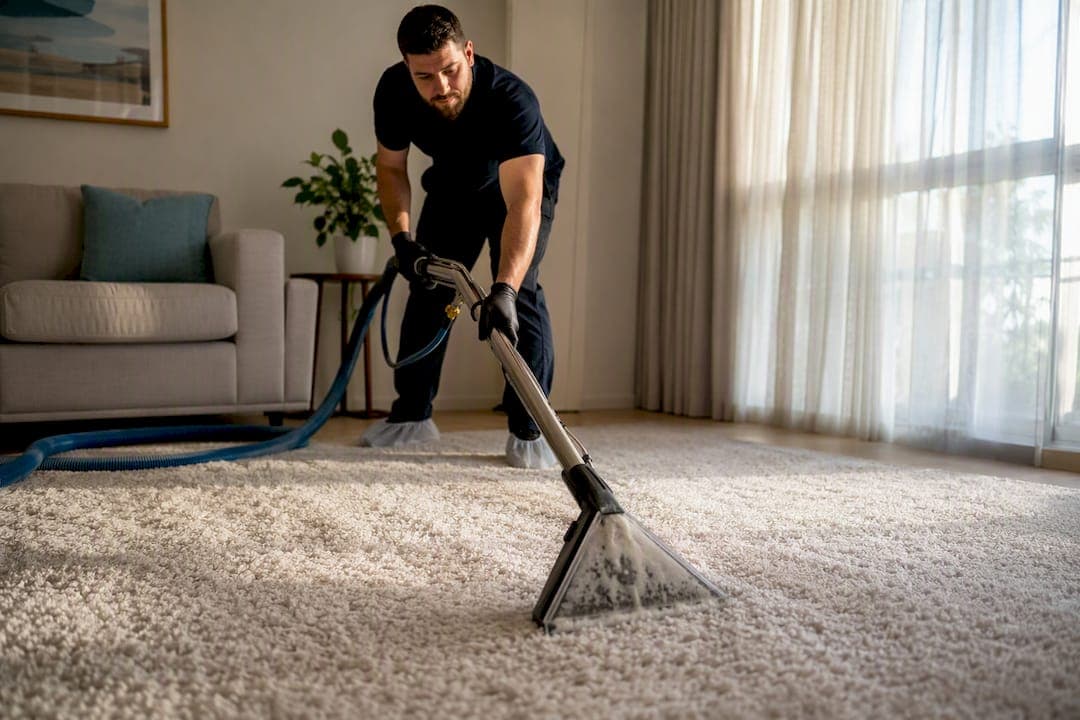
Most professionally cleaned carpets dry within 6 to 12 hours under normal indoor conditions, and two levers do most of the work: the cleaning method your technician uses and how much air is moving through the room afterward. Hot water extraction sits at the higher end of that range because it pushes more moisture into the pile to lift deep soil. Low-moisture methods finish in a fraction of the time because there's simply less water to remove.
If you want carpet dry sooner rather than later, act on these the moment cleaning finishes.
- Switch your HVAC to fan or cooling mode to pull humidity out of the air.
- Position at least one fan directly across the damp area, angled low.
- Keep foot traffic off the carpet for the first few hours, even if it feels dry on top.
Quick fact: according to operator-focused drying guides, hot water extraction typically dries in 6 to 12 hours under good conditions, while low-moisture and encapsulation methods can be dry in under an hour to a few hours.
Key Takeaways
Carpet drying time depends primarily on cleaning method and airflow, with hot water extraction taking 6 to 12 hours and low-moisture methods finishing in under a few hours.
| Point | Details |
|---|---|
| Typical drying range | Hot water extraction dries in 6 to 12 hours; low-moisture methods finish in under an hour to a few hours. |
| Two fastest levers | Choosing a low-moisture method and increasing air movement cut drying time the most. |
| Surface dry isn't backing dry | Carpet can feel dry on top within hours while the pad stays wet for a day or more. |
| Watch for drying failure | Dampness past 24 hours, musty odour, or discolouration signals a problem needing professional remediation. |
| Book with a written dry-time range | ACT Cleaning by Demand quotes a realistic dry-time estimate and brings air movers as standard on extraction jobs. |
Table of Contents
- What affects carpet drying speed
- Carpet drying time by cleaning method
- How to speed up carpet drying
- When it's safe to walk on carpet or put furniture back
- Troubleshooting slow-drying carpet
- How ACT Cleaning by Demand manages carpet drying time
- Get carpet cleaned with a dry time you can actually plan around
- Sources
- FAQ
What affects carpet drying speed
Drying speed comes down to how much water went in and how fast it can get out. Hot water extraction injects more moisture than encapsulation or dry compound cleaning, so it naturally takes longer to release, even with excellent equipment.
Extraction quality matters just as much as the method itself. A truck-mounted unit generates far stronger suction than a portable machine, which pulls more water out during the clean rather than leaving it for the air to handle. Technicians who run multiple dry passes with the extraction wand rather than extra wet passes remove significantly more residual moisture before they've even packed up.
Environmental conditions decide the rest. Warm, dry, well-ventilated rooms dry carpet in a fraction of the time that cold, humid, sealed rooms do, according to Carpet and Rug Institute maintenance guidance. Carpet construction also plays its part:
- Thick, high-pile carpet holds more moisture than a flat, low-pile weave.
- Dense synthetic backing dries slower than a more breathable natural fibre blend.
- A thick foam underlay can trap water long after the surface feels fine.
- Basements and apartments with limited HVAC return airflow are consistently the slowest rooms to dry.
Pro Tip: Ask your cleaner which extraction pass count they use on heavily soiled carpet. More dry passes at the end of the job usually means less waiting for you.
Carpet drying time by cleaning method
Not every clean carries the same wait. The method your technician chooses sets the baseline, and humidity or pile height can push that baseline in either direction.
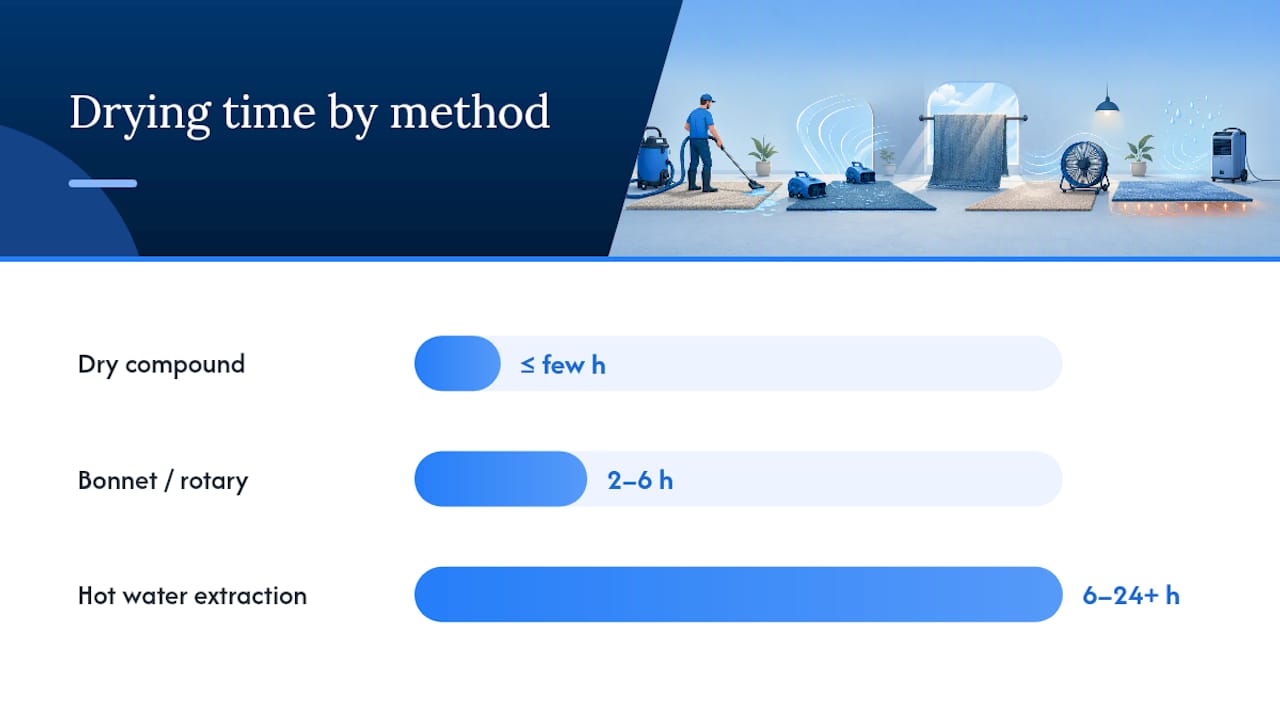
| Cleaning method | Typical drying time | Best suited for |
|---|---|---|
| Dry compound / encapsulation | Under 1 hour to a few hours | Low-moisture jobs, offices, time-sensitive turnarounds |
| Bonnet / rotary | 2 to 6 hours | Light surface refreshes, commercial foot-traffic areas |
| Hot water extraction (steam) | 6 to 12 hours, up to 24+ in poor conditions | Deep soil removal, allergen and dust mite reduction |
A humid, closed-up room can push hot water extraction past 24 hours, which is well beyond what a normal clean should need. High pile carpet with thick underlay behaves the same way, holding water at the base long after the top feels dry.
That gap between "surface dry" and "backing dry" is the one detail most homeowners miss. Carpet can feel dry to a bare foot within a few hours while the pad underneath stays wet for a day or more, which is exactly why furniture and rugs shouldn't go straight back down just because the top of the pile feels fine.
How to speed up carpet drying
Cutting drying time isn't about one big trick. It's about removing moisture from several directions at once, and doing it in the right order.
- Set your HVAC to dehumidify or cool, not heat. Heat alone can raise humidity in an unventilated room rather than lowering it.
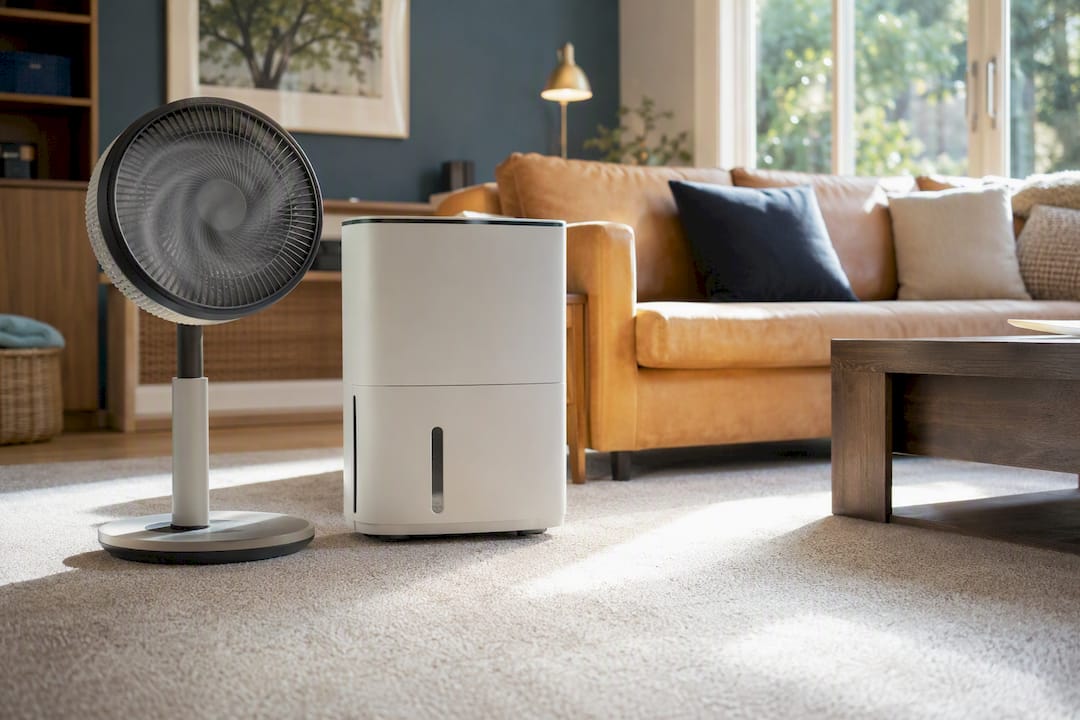
- Place fans to cross the room, not just blow at one wall. Two air movers positioned diagonally across a room, paired with HVAC running, are reported to cut drying time by roughly 50 to 65%, with dehumidifiers improving results further on humid days.
- Run a dehumidifier if indoor relative humidity sits above 60%, particularly in basements or rooms with limited airflow.
- Blot, don't scrub, any lingering damp patches with a clean dry towel, pressing firmly rather than rubbing.
- Lift furniture legs onto blocks or pads and remove rugs so air can reach the full carpet surface, not just the exposed strip around the edges.
Pro Tip: Never point a space heater directly at wet carpet. High heat with no airflow just cooks moisture into the pad instead of pulling it out, and it can leave a faint scorch smell in synthetic fibres.
Avoid running a second wet cleaning pass to "fix" a damp patch. It only adds more water on top of moisture that hasn't left yet. And don't seal windows shut on a humid day. Outside air that's cooler and drier than the room can help, even for a short burst.
When it's safe to walk on carpet or put furniture back
Light foot traffic in socks is usually fine after 3 to 4 hours on a low-moisture clean, but hot water extraction deserves a longer wait, closer to 6 hours minimum before anyone walks on it regularly.
- Keep shoes off the carpet entirely until it's fully dry, not just surface dry.
- Run the white-towel test: press a clean white towel firmly into the pile for 10 seconds. Dry towel means dry carpet; damp or discoloured means wait longer.
- Hold off on furniture for at least 24 hours, and use furniture pads or foil squares under legs in the meantime to stop moisture wicking up from a still-damp pad.
- If you're unsure either way, the safer move is always to wait longer and keep the fans and dehumidifier running rather than risk re-soiling or staining.
Troubleshooting slow-drying carpet
Carpet that's still damp after 24 hours isn't just inconvenient. It's usually a sign something went wrong during the clean, according to industry guidance on drying failures, whether that's over-wetting, weak extraction, or poor environmental control. A musty smell, visible mould, or discolouration at the base of the pile are the clearest red flags that it's time to call someone rather than wait it out.
While you arrange help, increase air movement in the room and close it off from the rest of the house to stop moisture spreading. Excess residual moisture is a recognised contributor to microbial growth under IICRC standards, which is exactly why professionals treat prolonged dampness as a problem to fix quickly rather than something to ride out.
A remediation technician will typically bring in an LGR (low grain refrigerant) dehumidifier, map moisture levels across the room with a meter, and either fully dry the pad and backing or replace them if they've been sitting wet too long. When you're booking that follow-up job, ask a few pointed questions:
- What equipment are you bringing, and how many air movers?
- Can you give me a moisture-meter reading before and after?
- What's your written estimate for full dry time, not just surface dry?
How ACT Cleaning by Demand manages carpet drying time
Predictable drying starts with the right equipment on the day, not guesswork afterward. Technicians pair strong extraction technique with air movers positioned across the room, which keeps quoted dry times realistic rather than optimistic.
- Air movers and extraction settings are matched to carpet type and soil level on the day, not applied as a one-size-fits-all setting.
- Products used throughout are eco-friendly and non-toxic, which matters for households with kids, pets, or anyone sensitive to strong chemical residue.
- For end-of-lease jobs, cleans are scheduled with enough buffer before final inspection so carpet isn't still damp when the agent walks through.
- Every job sheet includes a quoted dry-time range and any precautions specific to that room, such as furniture pads or restricted access windows.
A quick word on realistic expectations
We'd rather quote a conservative dry-time range and have you pleasantly surprised than promise a fast turnaround and leave you with a damp carpet and a mould problem three days later. If you take one habit from this article, make it the white-towel test. Press, wait ten seconds, check. It costs nothing and it's the difference between confidence and a guess.
Get carpet cleaned with a dry time you can actually plan around
Booking a carpet clean shouldn't mean crossing your fingers on how long the room will be out of action. ACT Cleaning by Demand quotes a realistic dry-time range upfront, based on the method, room conditions, and carpet type on the day, so you can plan furniture moves and foot traffic without guessing.

If bond inspection timing is the pressure point, our end-of-lease cleaning service factors drying time into the schedule itself, not as an afterthought. For general carpet and floor jobs, our floor cleaning team brings air movers as standard on hot water extraction jobs, and every quote includes a written dry-time estimate and the specifics of the equipment we're bringing. When you book, ask us directly about air mover count and moisture-meter checks. If you're in the Inner South, you can check availability now on our Inner South cleaning services page and lock in a time that suits your schedule.
Sources
- IICRC
- Carpet Drying Time: A Pro Operator Guide (CarpetCleaningDigital)
- Carpet-rug
- Carpet cleaning drying time guide (Carpet Cleaning Authority)
FAQ
How can I speed up carpet drying time?
Run your HVAC on cool or dehumidify mode, position fans across the room rather than at one wall, and add a dehumidifier if indoor humidity is above 60%. Two air movers plus HVAC can cut drying time by roughly 50 to 65% according to operator guides.
Does carpet dry faster in heat or cold?
Warm, dry air with good ventilation dries carpet faster than cold air, but heat without airflow can trap humidity in a closed room and slow things down. Pointing a space heater directly at wet carpet is worse than doing nothing, since it heats moisture without moving it out.
Will wet carpet eventually dry on its own?
Yes, but leaving it to dry passively risks mould growth and pad damage if it takes longer than 24 hours, which IICRC standards flag as a genuine risk. Active airflow and dehumidification are far safer than waiting it out.
How do I tell if carpet is dry after cleaning?
Press a clean white towel firmly into the pile for 10 seconds. If it comes away dry, the carpet and pad underneath are dry; any dampness or discolouration on the towel means it needs more time.
How long should I wait before walking on cleaned carpet?
Light foot traffic is usually fine after 3 to 4 hours for low-moisture cleans, but hot water extraction needs closer to 6 hours minimum before regular walking, and furniture should generally wait 24 hours.
What should I ask a cleaner about drying time before booking?
Ask what equipment they bring, how many air movers they'll use, and for a written dry-time estimate rather than a vague guess. Our guide on how cleaning quotes work covers what a fair quote should include.