When you book a cleaning service, you and the cleaner may have very different ideas about what that actually covers. Understanding what is a cleaning service scope before signing any agreement can save you from disputes, unexpected costs, and the frustration of a job that falls short of expectations. A scope defines exactly what gets cleaned, how often, and to what standard. Without it, you are essentially relying on assumptions. This guide breaks down what cleaning scopes include, how they vary by service type, and how you can use this knowledge to make smarter decisions.
Table of Contents
- Key takeaways
- What a cleaning service scope actually means
- Types of cleaning services and their scope components
- What a strong scope of work should include
- How to assess and negotiate a cleaning scope
- How scopes vary between providers and service tiers
- My take on why scope clarity changes everything
- Get cleaning you can rely on with ACT Cleaning by Demand
- Common questions
Key takeaways
| Point | Details |
|---|---|
| A scope prevents disputes | Clearly defined scopes set measurable expectations for both property owners and cleaners. |
| Scopes vary by service type | Residential, commercial, and specialised cleaning each carry distinct task lists and frequencies. |
| Exclusions matter as much as inclusions | What is NOT covered in a scope is just as critical to understand as what is included. |
| Written scopes protect your budget | Pricing clarity tied to scope specifics prevents unexpected charges for out-of-scope work. |
| Vague promises are a red flag | Providers who offer to "do it all" without a written task list often create confusion and inconsistency. |
What a cleaning service scope actually means
At its core, a cleaning service scope is a structured description of the tasks a cleaner will perform, the areas they will cover, how frequently each task occurs, and the standard of cleanliness expected. It answers the question: what does this cleaning service actually include? That clarity matters more than most clients realise until something goes wrong.
People often use "scope" and "scope of work" interchangeably, but there is a meaningful difference. A general scope is an informal overview of services, the kind you might see in a brochure or a quote. A scope of work document is a legal and operational tool that drives professional service delivery by defining not just tasks, but also communication and escalation protocols. It becomes part of a contract, binding both parties to specific obligations.
For property owners and tenants, this distinction is practical. If you are booking a one-off clean and relying on verbal agreements, you have very limited recourse if the job does not meet your expectations. A written scope of work gives you something concrete to refer back to.
Here is what a well-structured cleaning scope typically covers:
- A list of specific rooms or areas included in the service
- A breakdown of tasks for each area (for example, wiping benchtops versus scrubbing grout)
- The frequency for each task, whether daily, weekly, monthly, or on request
- The cleaning products or methods to be used, especially if eco-friendly options are preferred
- Explicit exclusions, meaning tasks or areas the cleaner will NOT address
- A contact person or protocol for raising concerns or requesting changes
Pro Tip: Ask any prospective cleaner to show you their standard task checklist before you sign anything. If they cannot produce one, that tells you something important about how they operate.
Vague cleaning contracts are a primary cause of disputes and client dissatisfaction in the cleaning industry. Getting the scope in writing is not pedantic. It is simply good practice.
Types of cleaning services and their scope components
Not all cleaning services are created equal, and the scope of a standard maintenance clean looks nothing like the scope for a commercial office or an end-of-lease property. Understanding the cleaning services overview across residential and commercial contexts helps you identify which service category fits your situation.

Residential cleaning scopes
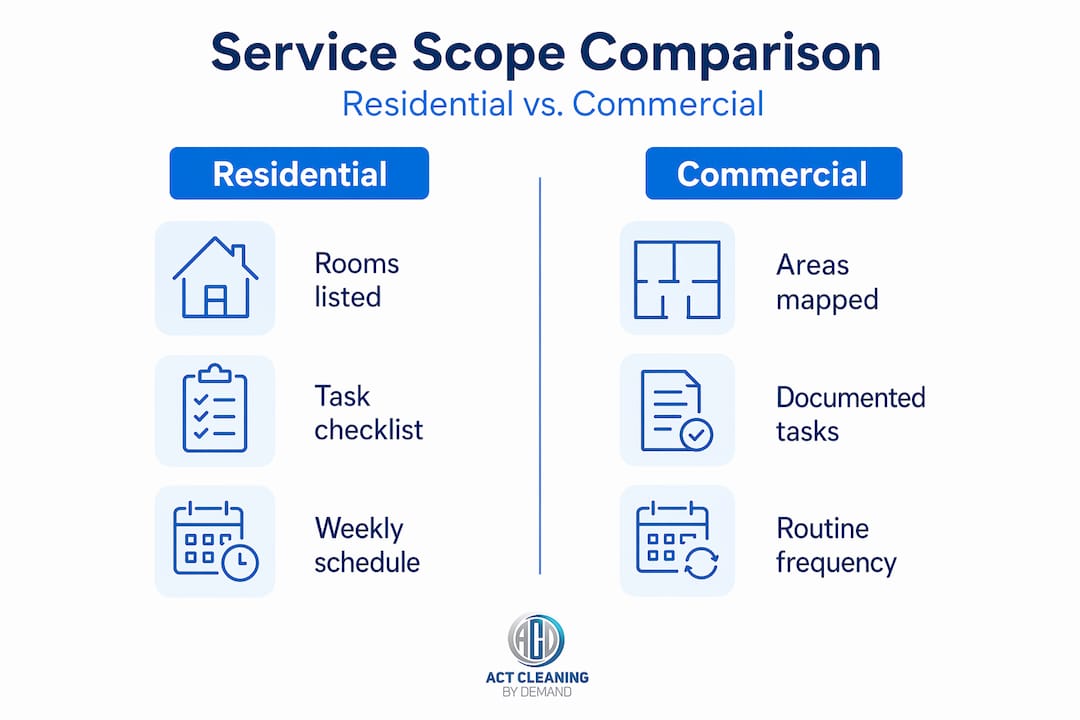
Typical residential cleaning includes dusting reachable surfaces, wiping counters, cleaning sinks and toilets, vacuuming carpets, and mopping common area floors. Tasks like oven cleaning or window cleaning are usually treated as add-ons, not included by default.
Residential cleaning generally splits into three levels:
- Standard maintenance clean: Regular, recurring service covering general tidying, surface cleaning, vacuuming, and bathroom sanitation in lived-in spaces
- Deep clean: A more thorough service addressing areas typically skipped in routine cleans, such as inside appliances, behind furniture, and inside cupboards
- Move-in or move-out clean: A scope designed to restore a property to a condition suitable for a new occupant, often aligned with real estate inspection requirements
Commercial cleaning scopes
Commercial cleaning often requires routine, documented tasks across office spaces, retail environments, healthcare facilities, and educational settings, with specific protocols for each. The scope is generally more rigorous and tied to compliance standards.
Here is a comparison of typical scope components across service types:
| Service type | Core tasks included | Common exclusions | Frequency |
|---|---|---|---|
| Residential maintenance | Dusting, vacuuming, mopping, bathroom and kitchen clean | Inside oven, window cleaning, carpet steam | Weekly or fortnightly |
| Residential deep clean | All of the above plus inside appliances and cupboards | Exterior windows, pest control | Monthly or seasonal |
| Move-in/out clean | Full internal clean, oven, range hood, skirting boards | Outdoor areas, garage, window exteriors | Once-off |
| Office/commercial clean | Hard floors, bins, toilets, kitchen, desks | Specialist equipment, roof spaces | Daily or weekly |
| Specialised services | Windows, carpets, post-construction clean | Other rooms or surfaces unless specified | As required |
Understanding where your property or situation fits in this table helps you ask the right questions when requesting a quote.
What a strong scope of work should include
A well-defined cleaning scope of work protects your interests as a client and gives the cleaner a clear standard to meet. This is not just about listing rooms. It is about removing every ambiguity that could lead to a disagreement later.
Here are the core elements to look for or request in any cleaning scope of work:
-
Specific locations and surfaces. The scope should name each room and identify exactly which surfaces are included. "Kitchen" is not enough. The scope should specify benchtops, splashbacks, sink, stove top, and whether the inside of the microwave or oven is included.
-
Explicit exclusions. This is often overlooked. A scope that says what is NOT included is just as useful as one that lists what is. Common exclusions include exterior windows, roof spaces, inside fridges, and balconies.
-
Task frequency. Explicit schedules prevent ambiguity about when tasks should be performed. A scope should distinguish between weekly tasks, monthly tasks, and seasonal or as-needed tasks.
-
Cleanliness standards. Describe the expected result, not just the action. "Vacuumed" is less useful than "all carpet areas vacuumed and visibly free of debris." Standards make it easier to identify when the scope has been met.
-
Communication protocols. The scope should specify a point of contact, a method for raising quality concerns, and a process for requesting additional tasks. A professional scope always addresses how access is arranged and who to call when issues arise.
-
Pricing tied to specific tasks. Pricing clarity prevents disputes and ensures fair compensation when additional tasks are requested. The scope should spell out what costs extra and how change requests are handled.
Pro Tip: If you manage rental properties, use your cleaning scope as an attachment to your tenancy agreement. It sets expectations for both tenants and cleaning providers from day one.
How to assess and negotiate a cleaning scope
Whether you are a homeowner booking a regular house clean or a tenant organising an end-of-lease service, knowing how to evaluate and negotiate a cleaning scope gives you real control over the outcome.
Start by asking these questions before you commit:
- What specific tasks are included in your standard service for a property of this size?
- Can you provide a written checklist or task list for this service type?
- What is and is not included in the quoted price?
- How do you handle requests for additional tasks not covered in the standard scope?
- How often do you perform each task, and is that documented?
Cleaning businesses that package services into clear categories see less client confusion and more consistent pricing. If a provider cannot give you a structured task list, that is a sign they may be relying on vague promises rather than consistent standards.
When comparing quotes, look at what the scope includes, not just the price. A quote that seems cheap may exclude tasks like oven cleaning, skirting boards, or window tracks. These exclusions are common in standard cleaning packages, and knowing about them upfront prevents unpleasant surprises.
You can also negotiate scope. Ask the provider if they offer tiered packages. For example, you might want a standard weekly clean but add oven cleaning once a month. A professional provider should be able to accommodate this and document it clearly in your agreement.
A few red flags to watch for: providers who cannot explain what is excluded from their service, refusal to provide anything in writing, and overly broad descriptions like "full house clean" with no task list attached. These patterns often lead to the disputes that unclear scopes are known to cause.
How scopes vary between providers and service tiers
Even within the same category of service, scope details can vary considerably between providers. Two companies offering a "standard residential clean" may include completely different task lists. This is why residential cleaning standards differ more than most clients expect.
Geographic location, property size, and service frequency all affect what a scope covers and what it costs. A scope for a four-bedroom house in a regional area will look different from one covering a compact apartment in the city, even if both are described as "weekly maintenance cleans."
The table below illustrates typical scope and pricing variations across service tiers:
| Service tier | Scope depth | Typical inclusions | Price signal |
|---|---|---|---|
| Budget provider | Minimal, often verbal | Basic surfaces, floors, bathrooms | Lowest price, higher risk of disputes |
| Mid-range provider | Moderate, sometimes written | Room-by-room task list, some add-ons | Balanced price, reasonable clarity |
| Professional provider | Detailed written scope of work | Full task lists, exclusions stated, frequency documented | Reflects true scope, fewer surprises |
Unlicensed or under-qualified providers often offer very broad verbal descriptions with no task breakdown. This may look attractive on price, but it creates ambiguity that tends to cost more in the long run through disputes, redone work, or missed tasks. Separating core services from add-ons in cleaning packages creates transparency and prevents scope creep, which is what happens when expectations expand beyond what was agreed without a corresponding change to pricing.
Industry best practice is for any provider to document scope details before work begins, provide a mechanism for clients to flag concerns, and include a clear process for adding tasks via a formal change request.
My take on why scope clarity changes everything
I've seen properties left in a state of confusion after cleaning services that sounded comprehensive but turned out to cover almost nothing beyond a surface wipe. In my experience, the gap between what clients expect and what actually happens almost always traces back to a poorly defined scope.
What I've learned is that the clients who have the smoothest experiences are those who asked for documentation upfront. Not because they were difficult. Because they were clear. A written scope protects your budget, protects the relationship, and protects the cleaner from being blamed for tasks they never agreed to perform.
The uncomfortable truth is that many providers avoid written scopes because vagueness gives them flexibility. Flexibility benefits the provider, not the client. When I evaluate any cleaning agreement, the first thing I look for is whether the scope names specific rooms, specific tasks, and specific exclusions. If those three things are present, everything else tends to follow.
My advice: treat a written cleaning scope the same way you would treat any other service contract. Read it, query anything unclear, and keep a copy. It is the single most effective thing you can do to get consistent, fair value from any cleaning service.
— Deng
Get cleaning you can rely on with ACT Cleaning by Demand
If this article has you rethinking your current cleaning arrangement or shopping around for a new provider, ACT Cleaning by Demand makes the scope process straightforward. Every service comes with clearly documented inclusions and exclusions, so you know exactly what you are getting before anyone sets foot in your property.
Whether you need a regular house cleaning service with a consistent weekly scope, a detailed office cleaning plan for your Canberra workplace, or a thorough end of lease clean that meets real estate standards, ACT Cleaning by Demand has a package that fits. Customised residential and commercial options mean your scope reflects your actual property. No guesswork, no vague promises. Request a quote today and see the difference a properly scoped service makes.
Common questions
What does a cleaning service scope include?
A cleaning service scope lists the specific rooms, surfaces, tasks, frequencies, and exclusions covered by a cleaning agreement. It sets measurable standards and defines what is and is not part of the service so both client and provider are aligned before work begins.
What is the difference between a scope and a scope of work?
A general scope is an informal summary of services, while a scope of work is a formal document with legal weight, covering tasks, standards, communication protocols, and pricing. A scope of work forms part of a binding service contract.
Why do cleaning service scopes differ between providers?
Scope inclusions vary based on the provider's service structure, property size, location, and service tier. Even services with similar names can carry different task lists, which is why requesting written documentation before signing is critical.
What should I ask a cleaning provider about their scope?
Ask for a written task checklist, confirmation of what is excluded, frequency details for each task, and how additional tasks are priced. Providers who can answer these clearly are generally more reliable and consistent.
How does scope affect the price of a cleaning service?
Pricing is directly tied to the scope. More rooms, more tasks, and greater frequency all increase cost. Clear scopes also allow providers to charge fairly for additional work rather than absorbing it silently or creating disputes over expectations.