Commercial cleaning tasks are specific, frequency-based activities that maintain hygiene, appearance, and safety across business facilities. The industry term for this structured approach is a janitorial scope of work, and it organises cleaning tasks by area and frequency with task-level specificity. Whether you manage an office tower in Sydney or a small retail space in Canberra, the examples of commercial cleaning tasks you assign will directly determine the hygiene standard your facility achieves. This guide breaks down every major category, from daily restroom sanitation to monthly floor refinishing, so you can build or audit a cleaning programme that actually works.
1. Daily commercial cleaning tasks every business needs
Daily tasks form the non-negotiable baseline of any commercial cleaning services programme. These are the activities that prevent hygiene failures, control odour, and maintain the professional appearance clients and staff expect every single day.
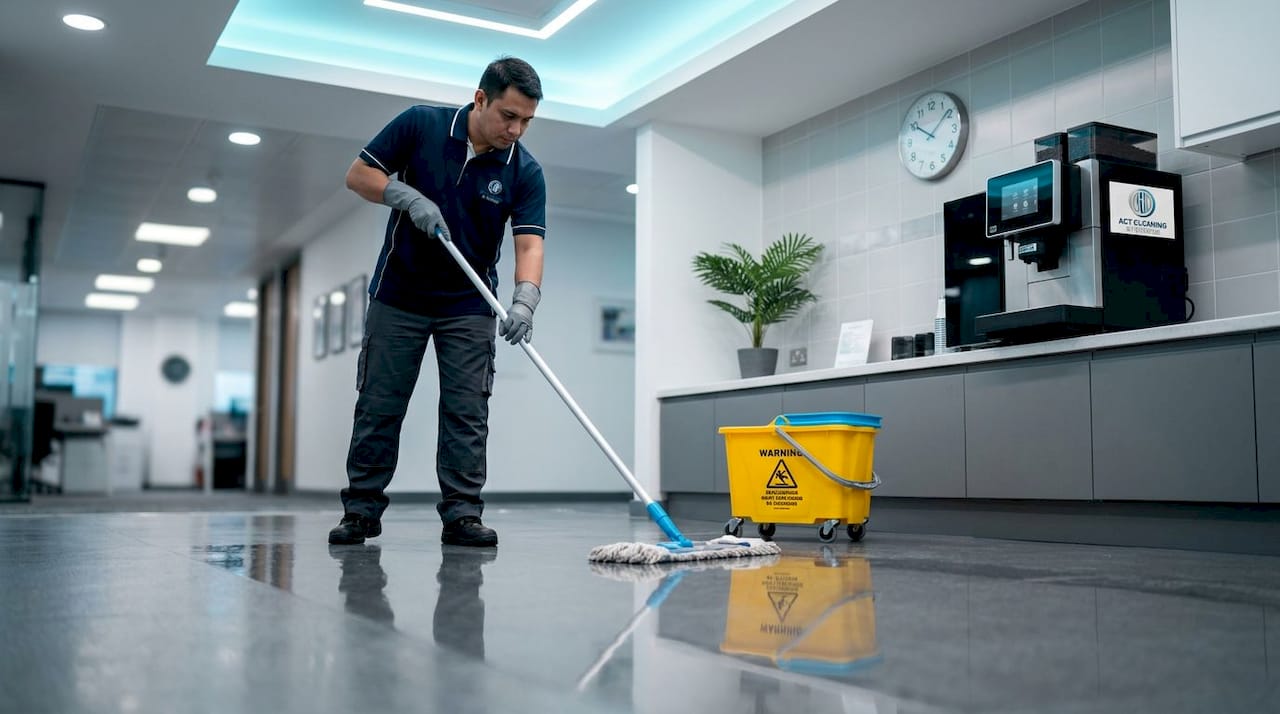
Restroom sanitation sits at the top of every daily checklist for good reason. Tasks include disinfecting toilets, urinals, sinks, counters, and mirrors, removing bin liners and replacing them, and restocking soap and paper products. Nightly disinfection of toilets and sinks is a standard inclusion in professional janitorial scopes of work, and skipping even one cycle creates compounding hygiene risk.
Floor care is the second pillar of daily cleaning. Vacuuming carpeted areas, dust mopping hard floors, and spot mopping spills prevents soil from embedding into surfaces and reduces slip hazards. High-traffic corridors and entry points accumulate grit fastest and should be prioritised.
High-touch surface wiping covers door handles, lift buttons, light switches, phones, and shared equipment. Shared equipment requires disinfection every two to four hours or at least once per shift in office environments. This frequency is not arbitrary. It reflects the rate at which pathogens accumulate on frequently contacted surfaces.
Break room and kitchen surfaces round out the daily list. Wipe down countertops, appliance exteriors, sinks, and tables after each use period. Empty food waste bins to prevent odour and pest attraction.
Pro Tip: Disinfectants must remain visibly wet on a surface for one to ten minutes to kill pathogens effectively. Wiping too soon is one of the most common field failures in commercial cleaning. Train your team to apply, wait, then wipe.
2. Weekly cleaning tasks that deepen facility hygiene
Weekly tasks go beyond surface maintenance to address areas that accumulate soil more slowly but still require regular attention. These office cleaning examples represent the intermediate layer of any well-structured cleaning task checklist.
- Full interior glass cleaning, including partitions, sidelights, and internal windows
- Detailed dusting of horizontal surfaces: shelving, window sills, baseboards, and ledges
- Deep vacuuming of carpets, including edges and under furniture where possible
- Thorough mopping of all hard floor areas with a disinfectant solution
- Disinfecting all high-touch hardware throughout the facility, including door handles, handrails, and shared equipment
- Deep cleaning of kitchen equipment exteriors, including ovens, microwaves, and refrigerator fronts
- Sanitising break rooms and shared-use spaces more thoroughly than daily wipe-downs allow
The rationale for weekly frequency is accumulation rate. Dust on window sills does not pose an immediate hygiene risk, but after seven days it becomes visible and affects air quality. Weekly full interior glass cleaning and baseboard dusting is a consistent feature of professional janitorial scopes because it keeps facilities looking maintained without over-servicing low-risk areas.
Pro Tip: Some surfaces, such as stainless steel appliances and tinted glass, require specific cleaning products to avoid streaking or surface damage. Always check product compatibility before applying a new disinfectant or degreaser to specialty surfaces.
3. Monthly cleaning tasks for long-term asset care
Monthly tasks address the deeper maintenance work that protects your facility's assets and prevents the slow accumulation of soil that daily and weekly cleaning cannot reach. These are the types of cleaning jobs that often get skipped without a formal schedule, and their absence shows within a quarter.
Key monthly tasks include:
- High dusting of air vents, light fixture tops, cabinet tops, and ceiling corners
- Detailed cleaning of commercial kitchen exhaust hoods, oven interiors, and ventilation filters
- Floor stripping, waxing, or refinishing on hard floor surfaces to restore protection and appearance
- Deep cleaning behind and under heavy equipment such as refrigerators, ovens, and storage shelving
- Inspection and written reporting of visible maintenance issues, including grout deterioration, sealant gaps, and fixture damage
- Reorganising storage areas and conducting a full restocking audit of cleaning supplies
Monthly hood filter cleaning and deep behind-equipment cleaning is a non-negotiable in commercial kitchen environments. Grease accumulation in exhaust systems is a direct fire risk, not just a hygiene concern.
The table below summarises how daily, weekly, and monthly tasks compare across the three frequency tiers.
| Frequency | Focus area | Example tasks |
|---|---|---|
| Daily | High-touch surfaces, floors, restrooms | Disinfect toilets, wipe handles, vacuum, empty bins |
| Weekly | Intermediate surfaces, glass, equipment | Clean windows, deep mop, sanitise kitchen equipment |
| Monthly | Deep maintenance, assets, infrastructure | Strip floors, clean exhaust hoods, high dust vents |
4. How cleaning tasks vary by facility area
Not all spaces in a commercial facility carry the same hygiene risk, and the best commercial cleaning practices reflect this. Cleaning frequency should be driven by usage risk rather than fixed calendar schedules alone. A boardroom used twice a week needs a different approach to a staff kitchen used by 40 people daily.
The table below provides a cleaning task checklist segmented by facility area and frequency.
| Area | Daily tasks | Weekly tasks | Monthly tasks |
|---|---|---|---|
| Office | Wipe desks, phones, keyboards; empty bins; vacuum | Clean internal glass; dust shelves and sills | Deep clean under furniture; inspect fixtures |
| Commercial kitchen | Sanitise prep tables, utensils, warewashing stations; mop floors | Degrease ranges and ovens; clean refrigerator interiors | Clean exhaust hoods; deep clean behind equipment |
| Restroom | Disinfect toilets, sinks, mirrors; restock supplies; empty bins | Scrub grout; clean dispensers thoroughly | Inspect sealant; descale fixtures |
| Meeting rooms | Wipe table, chairs, AV equipment; vacuum | Clean glass walls and whiteboards thoroughly | Deep vacuum upholstered seating |
| Reception and entry | Wipe reception desk; mop entry floor; clean door glass | Dust signage and light fittings | Polish hard floors; clean entry mats |
Office cleaning requires particular attention to keyboards, phones, and shared AV equipment. These surfaces carry high germ transmission risk and are frequently overlooked in basic cleaning routines. A professional office cleaning service will include these in a defined scope rather than leaving them to ad hoc wiping.
Commercial kitchen cleaning follows the most structured schedule of any facility area. Daily sanitising of prep tables, knives, and utensils is a food safety requirement, not just a hygiene preference. Weekly degreasing of ranges and ovens, and monthly exhaust hood cleaning, complete the cycle. A professional kitchen cleaning programme ties these tasks to compliance requirements, not just appearance.
Restroom cleaning is the area most visible to clients and visitors. Disinfecting toilets, sinks, mirrors, soap dispensers, and bins daily is the minimum standard. For high-traffic facilities, a mid-day service cycle is justified by usage volume alone.
Pro Tip: For facilities with pest control obligations, integrating your cleaning schedule with a commercial pest control checklist reduces the conditions that attract pests. Grease residue, food waste, and moisture are the three primary attractants, and all three are addressed through consistent cleaning task execution.
5. Building a cleaning task checklist that actually holds up
A cleaning task checklist is only as effective as the specificity behind it. Standard operating procedures for commercial cleaning break tasks into ordered steps, timed operations, and tools used, which improves both consistency and training outcomes. A kitchen deep-clean SOP, for example, can contain 22 discrete steps with time estimates and quality assurance checks. That level of detail is what separates a professional scope from a generic list.
The most common failure point in commercial cleaning programmes is insufficient task definition. "Clean the kitchen" is not a task. "Sanitise prep tables with a food-safe disinfectant, allow one to two minute dwell time, then wipe dry" is a task. The difference in outcome is significant, and it is the difference between a facility that passes a hygiene audit and one that does not.
Common commercial cleaning tasks across all business types include floor care, surface cleaning, restroom sanitation, and waste removal at defined frequencies. The most effective checklists assign each task a responsible party, a frequency, a product, and a completion sign-off. This structure makes accountability visible and gaps easy to identify.
Floor care deserves its own mention within any checklist. Vacuuming, mopping, and periodic floor stripping and polishing protect the surface investment and maintain slip resistance. Hard floors that are not periodically stripped and refinished accumulate wax build-up that dulls appearance and traps soil.
Key takeaways
Effective commercial cleaning requires frequency-based task categories, area-specific checklists, and strict adherence to disinfectant dwell times to achieve consistent hygiene outcomes.
| Point | Details |
|---|---|
| Daily tasks are non-negotiable | Restroom sanitation, floor care, and high-touch wiping must occur every service cycle without exception. |
| Dwell time determines disinfection | Disinfectants need one to ten minutes of wet contact time to kill pathogens. Wiping early negates the product. |
| Monthly tasks protect assets | Floor refinishing, exhaust hood cleaning, and high dusting prevent long-term damage and compliance failures. |
| Risk drives frequency | High-traffic and high-touch areas need more frequent attention than calendar-based schedules alone provide. |
| Specificity makes checklists work | Tasks defined with product, method, and dwell time produce measurably better outcomes than vague instructions. |
Why most commercial cleaning programmes fall short
I have reviewed a lot of cleaning scopes over the years, and the pattern is consistent. The list looks thorough on paper, and the execution falls apart in the field. The two most common reasons are vague task definitions and ignored dwell times.
When a checklist says "disinfect surfaces," the person holding the spray bottle decides what that means. In practice, it usually means a quick spray and an immediate wipe. That is not disinfection. That is surface wetting. The science is clear: disinfection requires a pre-clean phase to remove visible soil, followed by full wet contact for the label-specified dwell time. Skipping either step produces a surface that looks clean but is not.
The other issue I see constantly is calendar-driven scheduling that ignores actual usage. A meeting room used once a week does not need daily deep cleaning. A staff kitchen used by 60 people needs more than a once-daily wipe. Matching frequency to exposure risk is the single most effective adjustment most facilities can make without spending more money.
My honest recommendation is to treat your cleaning task checklist as a living document. Review it quarterly, walk the facility with your cleaning team, and ask where the gaps are. The best commercial cleaning programmes I have seen are the ones where the client and the cleaning provider have an ongoing conversation, not a set-and-forget contract.
— Deng
Tailored commercial cleaning for your facility
ACT Cleaning by Demand provides customised commercial cleaning packages for offices, kitchens, restrooms, and shared spaces across the ACT region. Every scope is built around frequency-based task categories and hygiene best practices, so your facility meets the standard your clients and staff expect. Whether you need a structured daily programme or a periodic deep clean, the team at ACT Cleaning by Demand tailors the scope to your facility type and usage patterns. Their professional window cleaning service is one example of a specialised task that benefits from expert execution and the right equipment. Request a quote today and get a cleaning programme built around your actual needs.
FAQ
What are the most common examples of commercial cleaning tasks?
The most common commercial cleaning tasks include vacuuming and mopping floors, disinfecting restrooms, wiping high-touch surfaces, emptying bins, and cleaning kitchen equipment. These tasks are organised by daily, weekly, and monthly frequency in a professional janitorial scope of work.
How often should high-touch surfaces be cleaned in an office?
High-touch surfaces in offices should be disinfected at least once per shift, with shared equipment cleaned every two to four hours in higher-traffic environments. The disinfectant must remain wet on the surface for one to ten minutes to be effective.
What is included in a commercial kitchen cleaning checklist?
A commercial kitchen cleaning checklist covers daily sanitising of prep tables, utensils, and warewashing stations, weekly degreasing of ovens and ranges, and monthly exhaust hood and ventilation cleaning. These tasks address both food safety compliance and fire risk.
How do janitorial tasks differ from industrial cleaning activities?
Janitorial tasks cover routine facility maintenance such as vacuuming, restroom cleaning, and surface wiping in commercial buildings. Industrial cleaning activities involve heavier-duty work such as pressure washing, chemical degreasing, and machinery cleaning in manufacturing or processing environments.
Why does my cleaning checklist need task-level specificity?
Generic instructions like "clean the kitchen" produce inconsistent results because each person interprets them differently. A task defined with a product, method, and dwell time produces measurable, repeatable outcomes and makes quality assurance straightforward.