Green cleaning cuts chemical exposure and greenhouse gas impact without sacrificing hygiene, provided the products and protocols are right. Lifecycle studies show Global Warming Potential reductions between 30% and 53%, while microbiological trials confirm bacteria reduction on par with conventional methods. The one caveat: some "natural" products still emit reactive compounds, so ventilation and product selection still matter.
TL;DR:
- Using green cleaning products can reduce lifecycle greenhouse gas emissions by up to 53 percent, mainly through concentrated formulations and lower energy use.
- Fragrance-heavy natural cleaners may emit higher indoor monoterpene levels, which can react with ozone to form harmful secondary pollutants like formaldehyde.
- Proper ventilation during and after cleaning with any product significantly cuts the risk of indoor air quality issues related to secondary pollutants.
- Green cleaning protocols with trained staff, controlled dilution, and certified products can achieve microbial reduction rates comparable to conventional methods.
- Certification labels like Safer Choice or Green Seal, along with full ingredient transparency, are better indicators of safety and environment friendliness than vague "eco" branding.
Table of Contents
- Health and wellbeing: fewer chemicals, fewer triggers
- The indoor air story: VOCs, monoterpenes and secondary pollutants
- How green cleaning lowers greenhouse gases, waste and other environmental impacts
- Where green cleaning saves money and when it might cost more
- Microbiological evidence: does green cleaning actually disinfect as well?
- How to choose green cleaning products without falling for greenwash
- How a professional cleaning service puts green cleaning benefits into practice
- What the research actually tells you to prioritise
- Book a green clean that's backed by evidence, not just a label
- Sources
- FAQ
Health and wellbeing: fewer chemicals, fewer triggers
Every time you spray a conventional cleaner, some of it ends up in your lungs, on your skin, or on a surface a toddler later touches. Green formulations cut that exposure at the source by removing the chlorine bleach, ammonia, and synthetic fragrance compounds most linked to irritation.
Case studies collected by Rutgers' Green Building Manual found that facilities switching to green cleaning programs saw drops in employee respiratory complaints and workplace incidents. Cleaning staff, who handle these products daily and in concentrated form, benefit most, followed closely by anyone with asthma, young children, and pregnant people, since all three groups tend to react more strongly to airborne irritants.
Quick stat: Institutional green cleaning rollouts are consistently associated with fewer reported respiratory complaints and injury incidents than traditional chemical-based programs.
That said, "green" is not a synonym for "harmless." Plant-derived fragrances can still cause skin or respiratory reactions in sensitive people, which is why ingredient transparency matters more than the word "natural" on the label.
To protect vulnerable occupants:
- Choose fragrance-free or low-fragrance options where anyone in the space has asthma or allergies
- Check for full ingredient disclosure, not just a "green" logo
- Keep cleaning schedules away from occupied hours when possible
- Store concentrates safely, since undiluted product is still an irritant risk
The indoor air story: VOCs, monoterpenes and secondary pollutants
Indoor air quality is where green cleaning gets complicated, and where a lot of marketing oversimplifies. Research analysing headspace emissions found some green cleaners released average monoterpene concentrations of 25.0 mg/L compared to 8.6 mg/L for regular cleaners, largely from citrus and pine-derived fragrance oils used to signal "natural" appeal.
Monoterpenes themselves aren't the main worry. The problem is what happens after: these compounds react with ozone indoors to form secondary pollutants like formaldehyde, with some models showing formaldehyde increases of up to 7% following a cleaning event. Practitioners studying indoor air chemistry note that fragrance-heavy natural formulas can be more reactive than their synthetic-scent counterparts, which flips the usual assumption on its head.
Pro Tip: Open windows or run exhaust ventilation during and for 30 minutes after cleaning with any fragranced product, green or conventional. This window covers the peak period for secondary pollutant formation.
A quick safer-use checklist:
- Ventilate during and after cleaning, especially with citrus or pine-scented products
- Dilute exactly per label instructions, never freehand
- Favour products with disclosed active ingredients over vague "plant-based" claims
- Clean occupied spaces earlier in the day, giving pollutants time to disperse before people return
How green cleaning lowers greenhouse gases, waste and other environmental impacts
The environmental case for green cleaning isn't guesswork. Lifecycle assessments of green versus traditional protocols in commercial buildings recorded GWP reductions of 30% to 53.3%, with one pilot site saving the equivalent of 2,008 kg of CO2e annually. That's roughly the emissions from driving a mid-sized petrol car for several months.
Three factors drive most of that saving:
- Concentrated products, which cut shipping volume and packaging waste substantially compared with ready-to-use bottles
- Lower laundry wash temperatures, since energy use for heating water is one of the biggest hidden costs in commercial cleaning
- Efficient equipment, particularly microfiber systems that need less water and fewer chemical passes
Concentrated cleaning products and dilution systems alone account for much of the packaging reduction, since one bottle of concentrate can replace a dozen ready-to-use containers.
When you see an environmental claim on a bottle, check what it's actually measuring. A credible claim references a defined LCA scope (cradle-to-gate versus full lifecycle), cites recognised standards, and states a specific percentage rather than a vague "eco-friendly" label. Biodegradability claims should point to a recognised test method such as OECD Test No. 301 rather than sitting unsupported on the packaging.
Where green cleaning saves money and when it might cost more
Green cleaning's financial case rests less on the sticker price of a bottle and more on what you buy over a year. Concentrates need less packaging and less freight, laundering at lower temperatures cuts energy bills, and fewer hazardous chemicals in storage means lower compliance and liability costs for businesses handling workplace safety obligations.
A facility switching to concentrated dilution systems typically buys and stores far less product volume than one running exclusively ready-to-use bottles, which shows up directly in procurement spend.
For a simple payback calculation, weigh:
- Chemical spend per year (concentrate cost versus ready-to-use cost)
- Laundry and hot water energy use
- Hazardous waste disposal and compliance fees
- Staff training time, which is a real but usually one-off cost
Specialised eco-certified products or third-party-verified systems can carry a higher upfront price than budget alternatives. That premium tends to pay for itself within a year or two through lower usage volumes and reduced waste handling, though the exact break-even point depends on your cleaning frequency and current chemical spend.
Microbiological evidence: does green cleaning actually disinfect as well?
This is the question that stops a lot of facility managers from switching, and the data answers it directly. A comparative trial measuring bacterial reduction found green protocols achieved 96.1% microbial abatement compared to 94.2% for traditional methods, a result that holds up because the hygiene outcome depends on the whole protocol, not just the chemical.
Three factors decide whether green cleaning matches or beats conventional results:
- Microfiber mechanical removal, which physically lifts bacteria and debris rather than relying purely on chemical kill
- Standardised dilution, since under-diluted product underperforms and over-diluted product wastes money
- Staff training, covering contact time, application order, and cross-contamination prevention
There are limits. High-risk clinical zones, such as operating theatres or isolation wards, still need stronger disinfectants that green formulations can't always match. For household cleaning and most commercial facilities, though, a well-run green protocol delivers hygiene outcomes that hold up against traditional chemistry.
How to choose green cleaning products without falling for greenwash
Not every bottle labelled "eco" or "natural" earns the claim. The EPA's guidance on greener cleaning products points to third-party ecolabels as the fastest way to cut through marketing: Safer Choice, Green Seal, and GREENGUARD each certify against defined ingredient and emissions criteria, unlike a self-applied "eco-friendly" sticker.
Pro Tip: If a product won't disclose its full ingredient list on request, treat that as a red flag regardless of what's on the front label.
A quick checklist for choosing products or vetting a cleaner:
- Look for Safer Choice, Green Seal, or GREENGUARD certification on the label
- Ask for the full ingredient list, not just "active ingredients"
- Check biodegradability claims reference a recognised test standard
- Confirm dilution instructions are specific, not vague
- For a hired cleaner, ask about dilution control, staff training, and whether they can show any lifecycle or third-party verification for the products they use
How a professional cleaning service puts green cleaning benefits into practice
Reading about green cleaning is one thing. Running it consistently across dozens of properties is another, and that's where dilution control and training stop being theory. Com builds customised eco-friendly cleaning packages around concentrated products, controlled dilution systems, and staff trained specifically in dosing accuracy, which is the same combination the lifecycle and microbiological research points to as the difference between green cleaning that works and green cleaning that's just a label.
That approach shows up in practical detail on non-toxic carpet cleaning methods and in an explainer on why professional cleaners choose specific chemicals rather than defaulting to the strongest option on the shelf.
- Customised packages for residential, end-of-lease, and commercial clients
- Concentrated, dilution-controlled products over generic ready-to-use bottles
- Trained staff following standardised protocols, not improvised routines
What the research actually tells you to prioritise
The evidence here doesn't support the version of green cleaning sold in most marketing, where a plant-based logo automatically means safer and cleaner. It supports something more specific: the health, environmental, and hygiene benefits show up when the whole protocol is right, not when you swap one bottle for another with a leaf on the label.
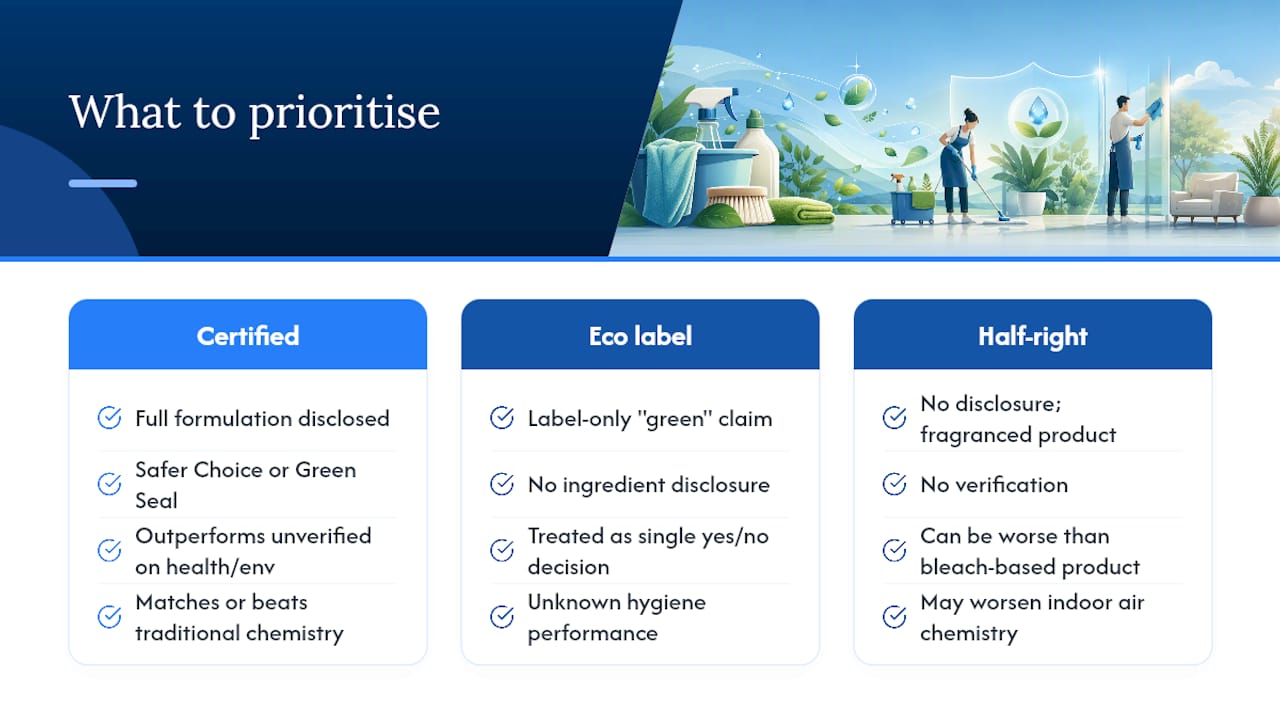
Conventional advice treats "green" as a single yes or no decision. The research treats it as a stack of separate choices: which ingredients, what dilution, how much ventilation, which certification. Get the stack right and you get real GWP reductions and hygiene outcomes that match or beat traditional chemistry. Get it half right, buying a fragranced "natural" spray with no ingredient disclosure, and you can end up with worse indoor air chemistry than the bleach-based product it replaced.
If you take one thing from this, prioritise ingredient transparency and certification over the word "green" itself. A product that discloses its full formulation and carries Safer Choice or Green Seal certification will outperform an unverified "eco" claim every time, on both health and environmental measures.
— Deng
Book a green clean that's backed by evidence, not just a label
Com is the practical alternative to guessing whether a bottle's "eco" claim holds up: house, end-of-lease, and office cleans run on concentrated products, controlled dilution, and staff trained to the same standards this article has walked through.
Every job draws on the same protocol, whatever the property type:
- House cleaning with eco-friendly products and consistent dilution control (book a house clean)
- End-of-lease cleaning for tenants and landlords who need a verifiable, thorough result (see end-of-lease options)
- Office cleaning for businesses wanting a sustainable contract without the guesswork (explore office cleaning)
If you're weighing up broader sustainability commitments alongside your cleaning choices, it's worth comparing notes with resources like LookDeVis Services' environmental policy for how organisations formalise these standards. Get a quote through the house cleaning page above, or check available dates for your suburb and book in a few minutes.
Sources
- Life cycle and hygienic evaluation of green vs. traditional cleaning protocols in civil buildings
- Indoor air chemistry from green and conventional cleaning products (headspace analysis and models)
- Identifying greener cleaning products | US EPA
FAQ
What are the benefits of green cleaning?
Green cleaning reduces exposure to chemical irritants, cuts greenhouse gas emissions by 30% to 53% according to lifecycle studies, and can match traditional cleaning for hygiene when protocols include proper dilution and training.
What are common green cleaning mistakes?
The biggest mistake is assuming "natural" means low-risk. Fragranced green products can emit higher monoterpene levels than conventional cleaners, which increases the formation of secondary indoor pollutants without proper ventilation.
Is vinegar a good green cleaner?
Vinegar works well on mineral deposits and some grease but isn't a registered disinfectant and won't reliably kill bacteria or viruses on its own, so it suits everyday surface wiping rather than jobs needing verified hygiene outcomes.
Are green cleaning products really safe?
Most are lower risk than conventional chemical cleaners, but "green" doesn't guarantee zero reactivity. Checking for Safer Choice, Green Seal, or GREENGUARD certification and full ingredient disclosure is the reliable way to confirm safety rather than relying on the word "natural" alone.