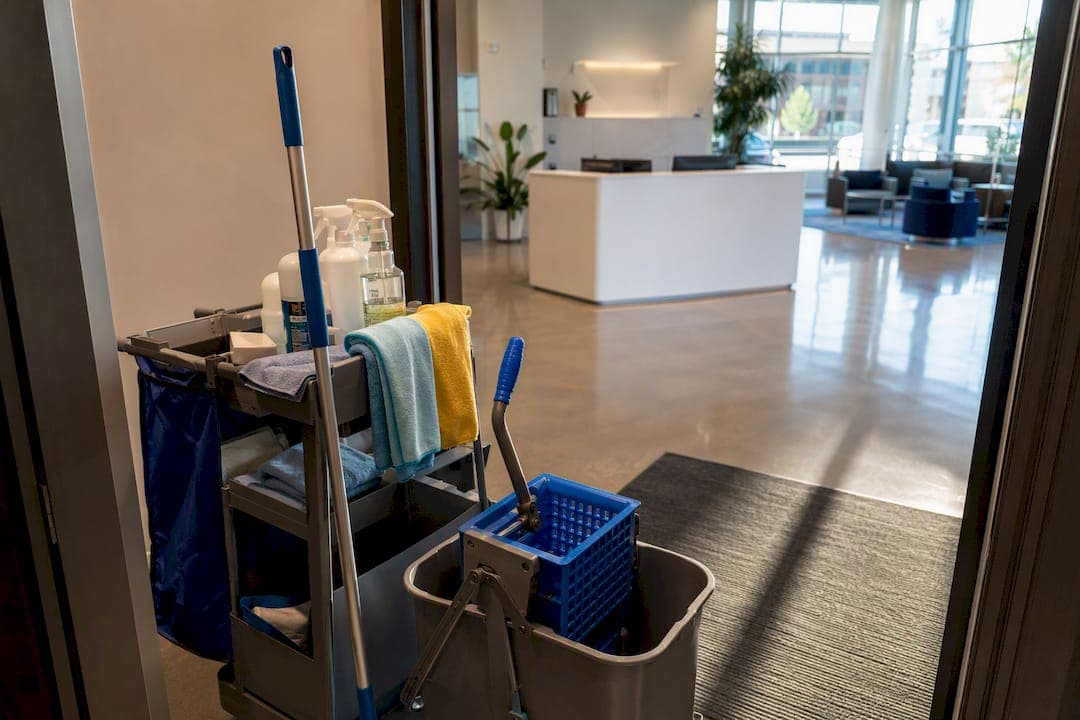
Use this rule of thumb: small offices need a full clean 1 to 2 times a week, mid-sized offices need professional cleaning several times per week, and large or high-traffic offices need daily professional cleaning. That's the starting point, not the finish line.
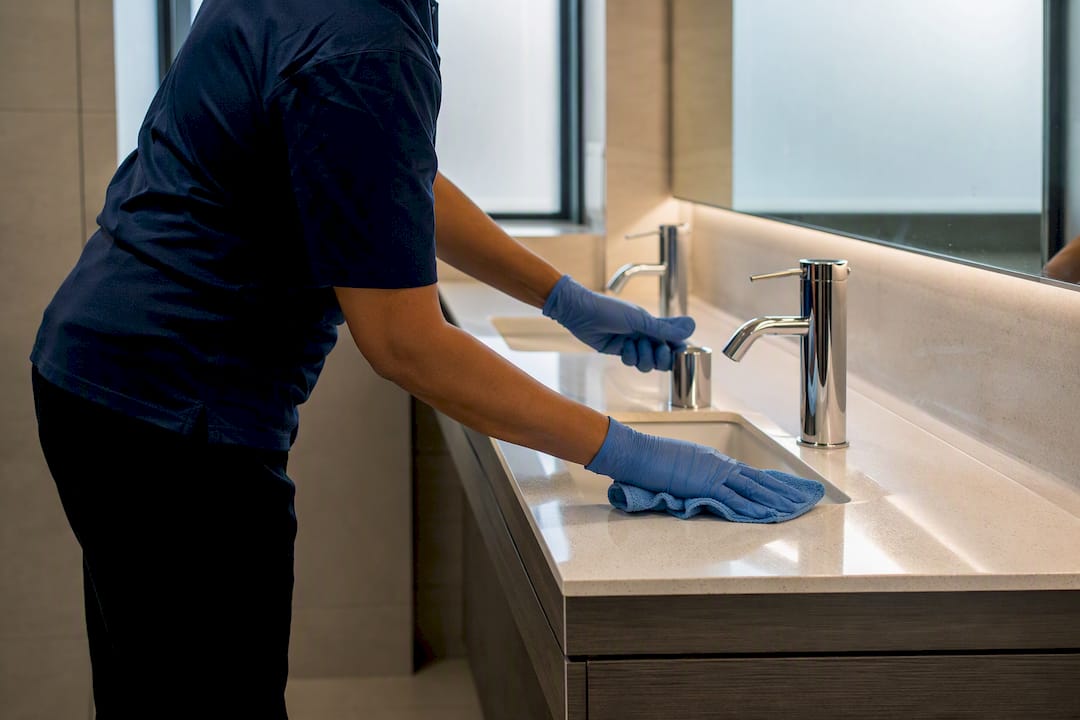
Regardless of size, some tasks can't wait for the scheduled visit. Restrooms, kitchens, and high-touch surfaces need attention every single working day.
- Restrooms and kitchens: cleaned and restocked daily, no exceptions
- High-touch surfaces: door handles, light switches, lift buttons wiped daily
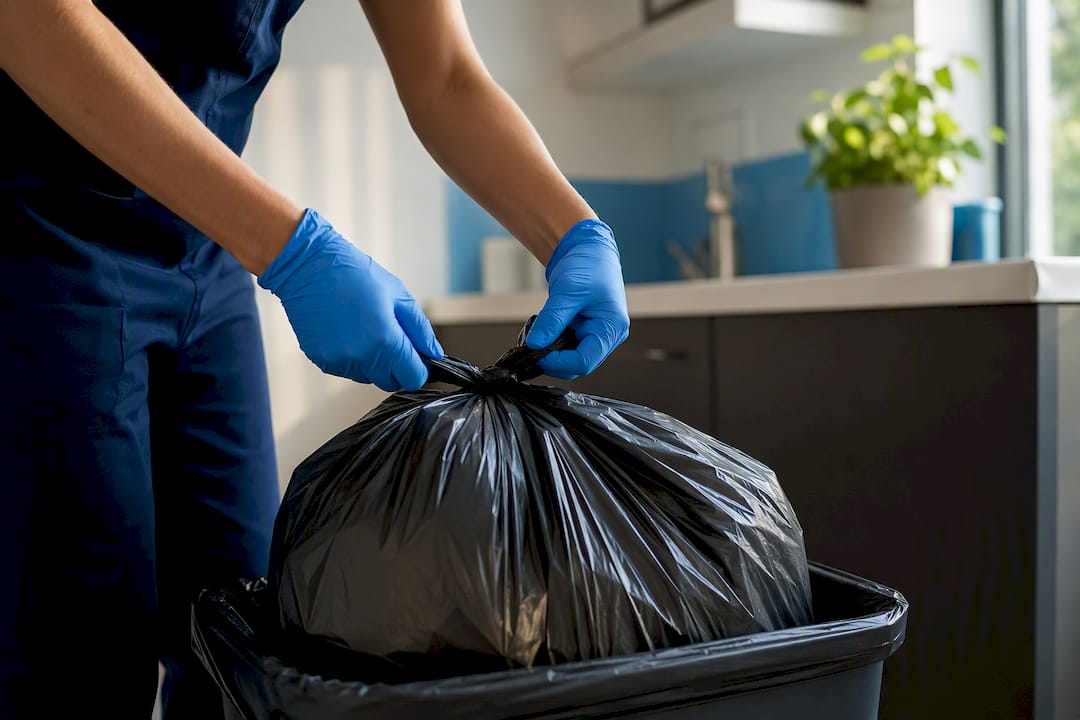
- Bins: emptied daily in kitchens and restrooms, every 2 to 3 days at desks
- Floors: spot-cleaned daily in entryways, vacuumed or mopped on a schedule matched to foot traffic
Pro Tip: If your office regularly sees many people or includes clinical or food-prep areas, daily cleaning should be considered the minimum standard. Regulated or high-traffic settings often need spot cleaning multiple times within a single shift.
Key Takeaways
Office cleaning frequency should be set by occupancy and area risk, not headcount alone, with restrooms, kitchens and high-touch surfaces cleaned daily regardless of office size.
| Point | Details |
|---|---|
| Match cadence to size | Small offices need 1 to 2 full cleans weekly, medium offices 2 to 3, large or high-traffic offices daily servicing. |
| Never skip daily non-negotiables | Restrooms, kitchens and high-touch surfaces need daily attention no matter how small the office is. |
| Split the budget smartly | Pair a short daily high-touch visit with 2 to 3 full-service cleans a week for cost-effective mid-range coverage. |
| Test before you commit | Run a 4 to 8 week trial tracking complaints and supply use before locking in a final schedule. |
| Deep cleans run on their own cycle | Carpet, HVAC vents and floor polishing need quarterly or twice-yearly attention separate from daily tasks. |
| Work with a flexible local provider | Com tailors cleaning packages to office size and usage, with no lock-in contracts and eco-friendly products throughout. |
Table of Contents
- Why office cleaning frequency actually matters
- Recommended office cleaning frequency by size
- Cleaning frequency by area: what needs attention and how often
- Monthly and quarterly deep cleaning tasks your schedule shouldn't skip
- How to build and test your own office cleaning schedule
- What backs these recommendations
- The conventional advice on cleaning frequency is too rigid
- Get a cleaning schedule built around your actual office
- Sources
- FAQ
Why office cleaning frequency actually matters
Cleaning frequency isn't a box-ticking exercise. It's a lever that touches health, reputation, and the lifespan of everything from carpet to computer chairs.
Start with health. Comcare's guidance on bathroom hygiene treats regular facility cleaning as a baseline safety obligation, not a nice-to-have. WorkSafe Victoria's advice on general office health and safety folds routine cleaning into standard hazard control alongside things like ventilation and ergonomics. That places cleaning frequency in the same category as fire exits and first aid kits: a control measure, not a housekeeping preference.
There's a reputational cost too. Reception areas, meeting rooms, and shared kitchens are the first thing a client or job candidate notices. A sticky boardroom table or an overflowing bin near the front door does more damage to a pitch than a shaky slide deck ever could.
Then there's the asset side, which gets ignored until the invoice for carpet replacement lands on someone's desk. Carpet fibres act like tiny sponges for grit, and that grit works like sandpaper on the pile every time someone walks across it. Skip the periodic deep clean and you're not saving money, you're deferring a bigger bill.
- Daily hygiene tasks reduce the spread of common illnesses through shared surfaces and facilities
- Clean client-facing spaces influence first impressions and, over time, conversion and retention
- Scheduled deep cleans extend the working life of carpet, upholstery, and flooring finishes
During outbreaks or seasonal illness spikes, Safe Work Australia's control measures guidance is explicit that cleaning frequency should scale up temporarily rather than stay fixed. A schedule built for a normal week isn't the same schedule you want during flu season.
Recommended office cleaning frequency by size
Office size drives most of the cadence decision, but it's headcount and traffic, not square metres, that really sets the pace. A quiet 40-person back office behaves differently to a 40-person space that hosts client meetings every day.
1. Small offices (1 to 10 people)
A full clean once or twice a week covers most small teams comfortably. Vacuuming, dusting, and general tidying don't need daily attention when there simply aren't enough people generating mess to justify it.
Restrooms and kitchens break that rule. Even with five staff, a shared bathroom needs daily attention, and the kitchen bin needs emptying before it starts smelling by Wednesday afternoon.
2. Small to medium offices (11 to 25 people)
This band starts to strain a twice-weekly schedule, especially if the space includes a client meeting room or a busy kitchen. Two to three visits a week, paired with daily restroom and kitchen servicing, tends to hold the line.
3. Medium offices (25 to 50 people)
At this headcount, three visits a week is often the practical minimum, with daily coverage for restrooms, kitchens, and any reception area. This is also where a split model starts to earn its keep: a short daily visit for high-touch zones, backed by a fuller service two or three times a week.
4. Large offices (50+ people) and high-traffic sites
Daily cleaning becomes the norm once you cross 50 people, and client-facing zones (reception, boardrooms, lifts) usually need touch-ups during the day, not just after hours. Some large sites run a day porter alongside the standard evening clean, someone on-site during business hours to handle spills, restock supplies, and manage the kitchen between formal cleans. Professional cleaning guidance broadly supports this pattern, recommending daily cleaning for high-traffic and large workplaces, 2 to 3 times weekly for mid-range sites, with monthly and quarterly cycles for deeper work.
None of these bands are fixed contracts carved in stone. A layered cleaning model that pairs a short daily visit to high-touch zones with a fuller service two or three times a week is often cheaper than daily full-service cleaning, and it holds up just as well in practice for most mid-sized offices. Whether that split is the right call for your office comes down to real usage patterns, which is exactly what the next two sections cover.
Budget-driven choices are fine, as long as they're deliberate. Choosing 2 visits a week over 3 because that's what the budget allows is a legitimate call. Choosing it because nobody checked what the office actually needs is how mould finds its way behind the office fridge.
Cleaning frequency by area: what needs attention and how often
Not every part of an office wears out at the same rate, so a single site-wide frequency almost always wastes money somewhere. Breaking the schedule down by area lets you spend where it matters and pull back where it doesn't.
Restrooms sit at the top of the list regardless of office size. Comcare's bathroom hygiene guidance treats daily cleaning as standard practice, and busy sites often need a midday check on top of the main service to restock paper and soap before someone notices it's gone.
Kitchens and break rooms need a daily clean at minimum, and a midday reset if the space sees heavy use over lunch. Shared appliances like microwaves and fridges are worth a specific hygiene rule: whoever uses it last wipes it down, because a communal microwave is one of the fastest ways to turn "someone else's problem" into a smell nobody can trace.
Desks and workstations split into two categories. Dedicated desks can get by with a weekly wipe-down as part of the standard service, since the same person uses the same surfaces every day. Hot-desking is different: shared workstations need a wipe between users, ideally as a five-minute habit rather than something that waits for the cleaning crew.
- Bins in kitchens and restrooms: emptied daily to control odour
- Desk-side bins: emptied every 2 to 3 days depending on volume
- Entry floors and high-traffic corridors: vacuumed or mopped daily if there's outdoor dirt ingress
- Low-traffic internal floors: vacuumed 2 to 3 times weekly is usually sufficient
- Meeting rooms: a quick check between back-to-back bookings, plus a scheduled clean
High-traffic zones like restrooms, break rooms, and reception areas need daily attention no matter how big or small the office is, because they're the primary vectors for germs and the first thing visitors judge. A 12-person startup with a scruffy front desk sends the same signal as a 200-person firm with the same problem.
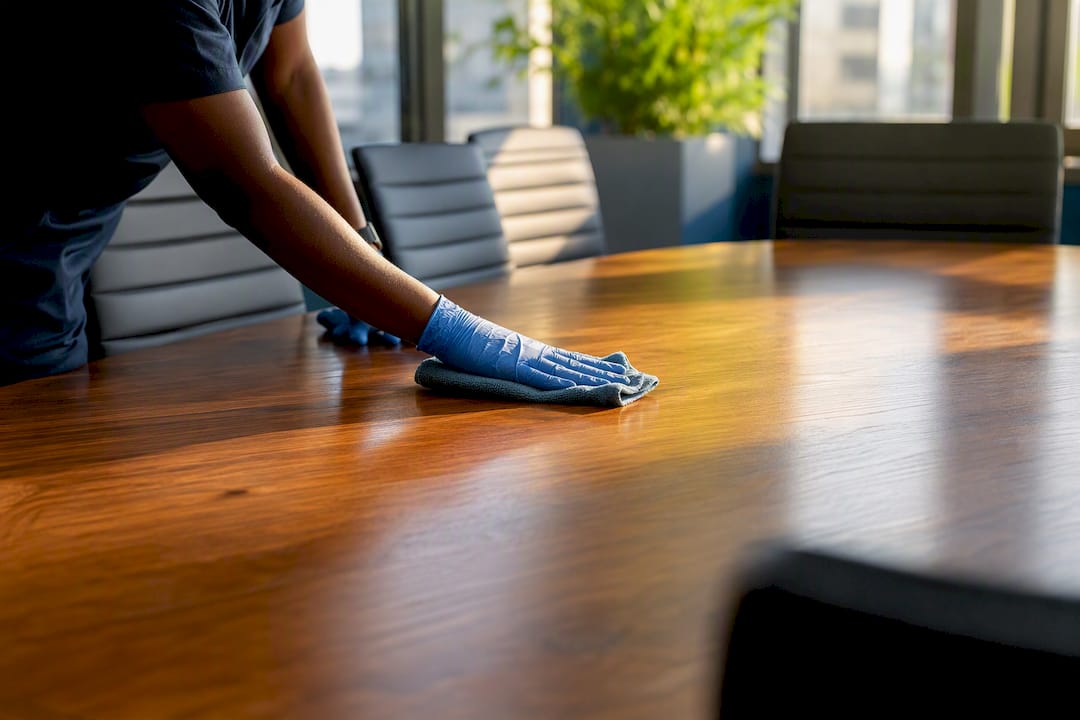
Meeting rooms need a different rhythm to open-plan areas. Between-meeting checks (wiping the table, straightening chairs, clearing cups) matter more for a room booked six times a day than the scheduled evening clean does, because nobody wants to walk into a room still smelling like the previous meeting's coffee order.
Monthly and quarterly deep cleaning tasks your schedule shouldn't skip
Deep cleaning is a different job to daily janitorial work, and treating the two as interchangeable is how offices end up with either wasted spend or neglected assets. Deep cleans target the build-up that daily and weekly tasks simply can't reach.
- Carpet extraction and upholstery cleaning. Schedule this quarterly for most offices, monthly for high-traffic carpet near entrances. Visible flattening, dulled colour, or a musty smell after rain are the signs you've waited too long.
- HVAC vents and high dusting. Ceiling-height surfaces, vents, and light fittings collect dust that daily cleaning never touches. A quarterly check keeps air quality reasonable and stops dust bunnies from becoming a visible problem above eye level.
- Floor stripping and polishing. Hard floors need this on a longer cycle, typically twice yearly for standard traffic, more often for entrances and corridors that take a beating from foot traffic and outdoor grit.
- Exterior window cleaning. Quarterly to twice yearly depending on the building's exposure to dust, pollen, or coastal salt. Ground-floor windows facing a busy street usually need more frequent attention than upper-floor glass.
- Specialist remediation. Water damage, mould outbreaks, or biohazard incidents fall outside standard scheduling entirely and call for specialist contractors, not an extra visit from the regular crew.
Most professional guidance groups these tasks into monthly and quarterly cycles sitting alongside daily and weekly work, and broader industry recommendations support treating deep cleaning as its own layer rather than folding it into the regular contract.
How to build and test your own office cleaning schedule
Guessing at a cleaning cadence and hoping it's roughly right is how most offices end up either overpaying or under-cleaning. A better method treats the schedule as something you test, not something you inherit from a template.
Start with occupancy data you probably already have. Badge swipes, desk-booking software, and visitor sign-in logs all tell you when the office is actually busy, not when you assume it is. A hybrid office that looks full on the roster might genuinely have 15 people in on a Wednesday and 60 on a Tuesday, and a flat daily schedule ignores that swing entirely.
Next, map the high-impact zones and lock in mandatory frequencies for them regardless of overall occupancy: restrooms, kitchens, and reception don't get to flex down just because Wednesday is quiet.
- Set non-negotiable daily tasks first, then layer discretionary full-service visits on top
- Run a trial of 4 to 8 weeks before locking in a final cadence
- Track simple signals: cleaning complaints, supply usage (soap, paper towel), and any odour reports
- Adjust the cadence based on what those signals show, not on a fixed contract term
Pro Tip: When negotiating with a cleaning provider, ask for a trial clause and KPI-based reviews instead of a rigid annual contract. It gives both sides room to adjust the cadence once real data comes in, rather than guessing upfront and living with it for twelve months.
Employee habits do real work here too. A quick staff policy asking people to wipe down hot-desks and clear their own dishes can meaningfully cut the load on full-site cleans, especially in hybrid offices where nobody's desk is really "theirs" anymore.
Contract terms matter as much as the cadence itself. Ask for after-hours scheduling options so cleaning doesn't disrupt the workday, and build in an escalation path for when an outbreak or a big client event means you need to scale up fast. Safe Work Australia's industry cleaning guidance is a useful reference point for what "scaling up" should look like when illness is circulating through the office. Scaling back down is just as legitimate a move when occupancy data shows sustained low numbers, as long as the non-negotiables stay in place.
What backs these recommendations
Getting office cleaning cadence right isn't guesswork dressed up as expertise. It comes down to matching Australian workplace hygiene standards against how a given office actually gets used day to day.
Com, trading as ACT Cleaning by Demand, builds its commercial cleaning packages around exactly this kind of assessment rather than a one-size-fits-all contract. Every office cleaning arrangement starts with a look at headcount, traffic patterns, and which zones carry the most risk, then gets tailored from there.
- Packages are customised to office size and usage rather than sold as a fixed tier
- All cleaning uses eco-friendly products, relevant where shared kitchens and restrooms see daily chemical use
- Staff are police-checked, which matters for offices granting after-hours access
- Scheduling is flexible, including after-hours options that avoid disrupting the workday
- No lock-in contracts, which suits the trial-and-adjust approach this guide recommends
For readers wanting a task-by-task reference to hand to staff or a supplier, the full office cleaning checklist breaks daily, weekly, and periodic tasks down by area. The after-hours scheduling guide covers how to time cleaning around business hours without losing coverage on the non-negotiables.
The conventional advice on cleaning frequency is too rigid
Most guidance on this topic hands you a fixed table (small office, this many visits; large office, that many) and stops there. That's a reasonable starting point, but it treats cleaning cadence as fixed when it should be treated as a variable you measure and adjust.
The single biggest thing conventional advice gets wrong is assuming headcount alone predicts need. Two 30-person offices can have wildly different cleaning demands: one runs client meetings daily and has a kitchen full of dishes by 11am, the other is a quiet back office where half the desks are empty on any given day. A schedule built for headcount alone misses that entirely.
If you take one thing from this guide, prioritise the 4 to 8 week trial over the perfect upfront schedule. Non-negotiables like restrooms and kitchens stay fixed. Everything else should flex based on what your occupancy data and complaint logs actually tell you, not what a generic size chart assumes about an office that isn't yours.
— Deng
Get a cleaning schedule built around your actual office
Com is the practical alternative to locking into a rigid annual cleaning contract you can't adjust once you realise it's wrong for your office. A site assessment looks at your headcount, traffic patterns, and high-risk zones, then comes back with a suggested cadence and a straightforward estimate, not a generic tier pulled off a price list.
Because there's no lock-in contract, you can trial a cadence for a few weeks and adjust it once you see how it holds up against real usage, exactly the approach this guide recommends. Every clean uses eco-friendly products, every staff member is police-checked, and booking or rescheduling takes a few minutes through the online system rather than a phone tag with an account manager. If you're ready to see what a tailored schedule looks like for your office, explore the custom cleaning service packages and request an assessment to get a suggested cadence and quote.
Sources
- Comcare — Bathroom hygiene
- WorkSafe Victoria — Office health and safety
- Safe Work Australia — COVID-19 control measures
- VanguardsV — Office cleaning frequency (2026)
FAQ
What is the 20/10 rule for cleaning?
The 20/10 rule suggests spending brief periods tidying for every bit of daily mess left behind, a habit-building trick more suited to homes than offices with dedicated cleaning schedules. In an office, the equivalent is a quick daily wipe-down of shared surfaces so mess never accumulates enough to need a big catch-up clean.
What are the signs of a poorly cleaned office?
Overflowing bins, sticky or dusty desks, a smelly kitchen, and grimy restrooms are the clearest signs, along with visible carpet staining and a build-up of dust on shelves or vents. Rising staff sick days and client complaints about presentation are the less obvious but more costly signs.
How do I tell employees to keep the office clean?
Set a simple written policy covering hot-desk wipe-downs, clearing dishes after use, and reporting spills promptly, then reinforce it through visible signage in kitchens and bathrooms. Employee micro-tasks like these genuinely reduce how often a full-site clean is needed.
What is the 20-minute rule in cleaning?
This rule is a time-boxing technique where a specific cleaning task is limited to a fixed short duration to keep it from dragging on, commonly used for quick tidy-ups rather than deep cleaning. It's more relevant to a household routine than a scheduled commercial service.
How often should an office be cleaned if it's a hybrid workplace?
Base the cadence on actual occupancy data rather than headcount, since a hybrid office might only be half full on any given day, and adjust the split-model schedule to match the busiest days rather than the average. Restrooms and kitchens still need daily servicing regardless of how many people are in that day.