Onboarding new cleaning staff is a structured induction process that moves a new hire from orientation to independent productivity within a single month. The industry term for this is "structured onboarding," and it is the difference between a cleaner who performs confidently on day 30 and one who is still guessing at week eight. A structured 30-day blueprint helps new hires reach 80–90% productivity, cutting onboarding time in half compared to traditional 90-day methods. That figure matters because every week a cleaner operates below full capacity costs you in client satisfaction and rework. This guide gives cleaning business owners and managers a repeatable system to build reliable teams fast.
What do you need before you onboard new cleaning staff?
Preparation is the foundation of every successful cleaning staff induction. Managers who skip this phase create confusion on day one, which compounds into slow productivity and early turnover. Checklists and structured daily schedules clarify responsibilities and reduce the time trainers spend answering the same questions repeatedly.
Before your new cleaner walks through the door, gather the following:
- Onboarding checklist: A written list of every task, document, and sign-off required across the first 30 days.
- Job description: A clear, one-page summary of duties, hours, client expectations, and performance standards.
- Safety data sheets (SDS): Mandatory documentation for every chemical product used on the job, as required under Safe Work Australia guidelines.
- Personal protective equipment (PPE): Gloves, masks, and eye protection ready and labelled for the new hire.
- Training schedule: A day-by-day calendar covering orientation, product training, supervised fieldwork, and evaluation checkpoints.
- Evaluation forms: Written assessments used at the end of weeks one, two, three, and four to track progress objectively.
- Emergency protocols: Written procedures for chemical spills, injuries, and client complaints.
Detailed onboarding documentation including evaluation forms and emergency protocols empowers trainers and protects business continuity. Without these documents, trainers improvise, and improvised training produces inconsistent results.
| Document or resource | Purpose | When to use |
|---|---|---|
| Onboarding checklist | Tracks task completion across 30 days | Days 1–30 |
| Safety data sheets | Chemical safety compliance | Before any product use |
| PPE kit | Protects new hire during fieldwork | From day one |
| Training schedule | Sets daily expectations for trainer and trainee | Days 1–30 |
| Evaluation forms | Measures skill progression objectively | End of each week |
| Emergency protocols | Guides response to incidents | As needed |
Pro Tip: Laminate a one-page version of the cleaning checklist and attach it to the trainee's kit bag. New cleaners refer to it constantly in the first two weeks, and having it on hand reduces trainer interruptions by a significant margin.
What does a 30-day cleaning staff orientation schedule look like?
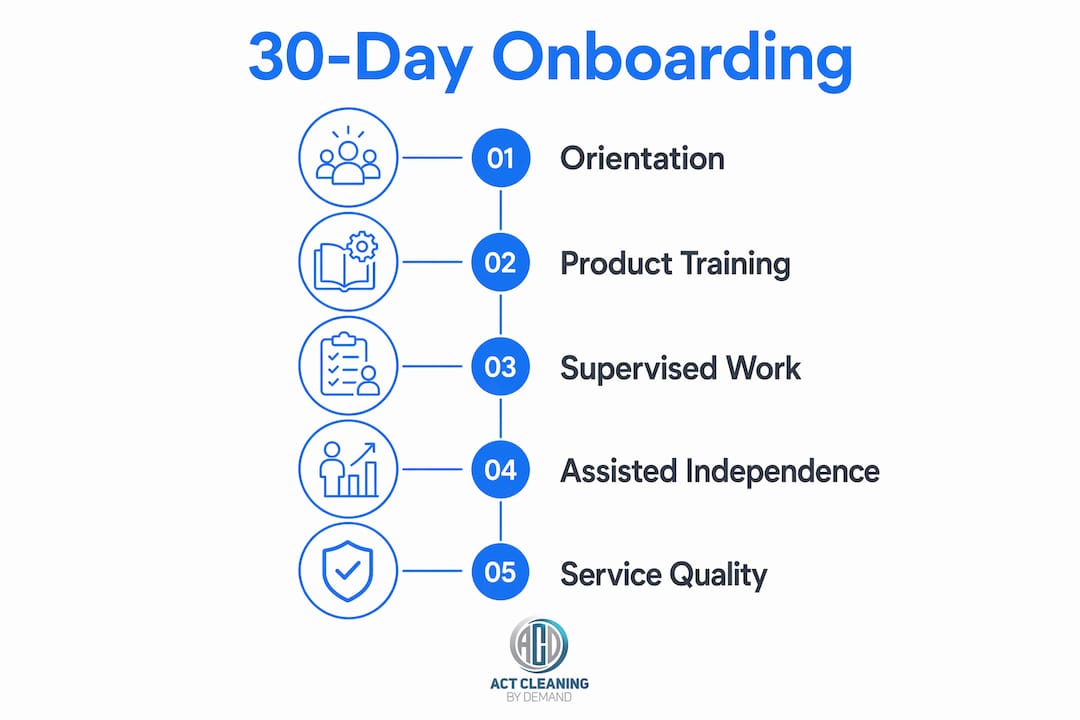
A structured four-week schedule is the core of any effective cleaning team onboarding process. Each stage builds on the last, moving the new cleaner from classroom knowledge to confident, independent fieldwork.
Day 1: Orientation and safety
Day one sets the tone for everything that follows. A 6-hour orientation reduces overwhelm for new hires and sets clearer expectations before they enter a client's home. Cover company values, communication expectations, uniform standards, and the chain of command. Walk through every SDS document and demonstrate correct PPE use. A well-structured orientation eases new hire stress and sets up stronger performance from day one.
Days 2–5: Product training and quality standards
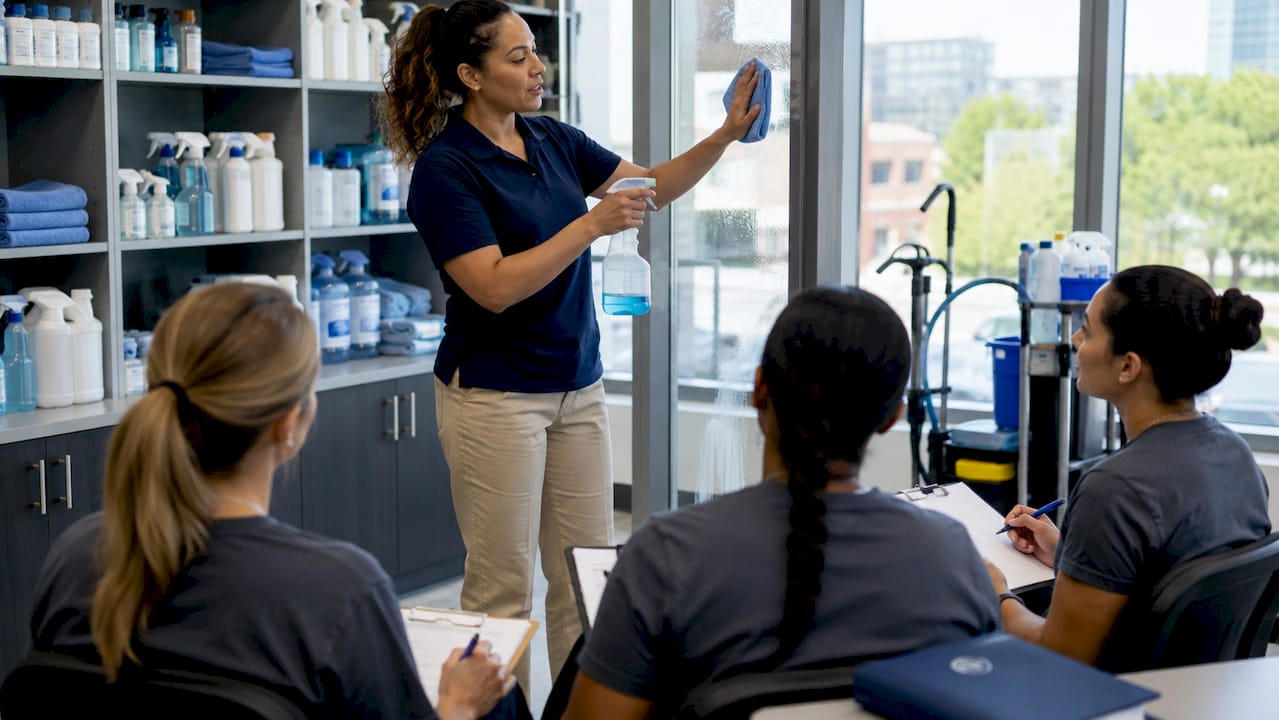
Product knowledge is a non-negotiable skill for any cleaner. Half-day product training and shadowing improves skill acquisition and quality outcomes measurably. Introduce each cleaning product, its correct dilution ratio, its approved surfaces, and its risks. Pair product knowledge with your quality standards: what a finished bathroom looks like, how to check a floor for streaks, and what "client-ready" means in your business. Use a living room cleaning checklist as a practical reference to show new cleaners exactly what a completed space should look like room by room.
Week 2: Supervised fieldwork
The new cleaner works alongside an experienced trainer on real jobs. The trainer demonstrates each task, then observes the trainee completing it. Early correction during supervised practice prevents bad habits from becoming permanent. This is the most critical phase of the entire programme. Trainers must give specific, immediate feedback rather than waiting until the end of a shift.
Week 3: Assisted independence
The trainee completes jobs with the trainer present but not directing. The trainer observes, takes notes, and provides feedback at the end of each job rather than during it. This stage builds the cleaner's confidence and decision-making. It also reveals any skill gaps that need targeted coaching before week four.
Week 4: Speed, client interaction, and service quality
The final week focuses on efficiency and professionalism. A cleaner who produces excellent results slowly is not yet commercially viable. Set time targets for each room type and track completion against them. Introduce client interaction skills: how to greet a client, how to handle a complaint on the spot, and how to mention additional services without pressure. By the end of week four, the cleaner should operate independently on standard residential jobs.
Pro Tip: Run a mock client walkthrough at the end of week three. Have a colleague play the role of a client inspecting the finished job. This low-stakes rehearsal builds confidence and surfaces issues before the cleaner faces a real client alone.
| Week | Focus | Trainer involvement |
|---|---|---|
| Week 1 | Orientation, safety, product training | Full direction and demonstration |
| Week 2 | Supervised fieldwork | Active observation and immediate feedback |
| Week 3 | Assisted independence | Observation only, end-of-job feedback |
| Week 4 | Speed, client skills, service quality | Minimal, performance review only |
How do you maintain quality after the initial training period?
Onboarding does not end at day 30. Consistent quality requires ongoing systems that catch problems early and reward good performance. Ongoing coaching and regular audits reduce workforce turnover and improve cleaning consistency over time.
The most effective post-onboarding quality controls are:
- Digital quality checklists with photo documentation. Photo evidence after each job increases accountability and catches cleaning details that verbal reports miss. Require cleaners to submit photos of key areas before leaving a job.
- Periodic unannounced audits. A manager or senior cleaner visits a job in progress without prior notice. This is the fastest way to identify whether training standards are being applied in the field.
- Client feedback surveys. Send a short survey after each job. Three questions are enough: overall satisfaction, any missed areas, and likelihood to rebook. Track responses by cleaner to identify patterns.
- Scheduled retraining sessions. Run a 60-minute group session monthly. Use real examples from client feedback to address recurring issues without singling out individuals.
- Performance tracking linked to recognition. Measure each cleaner's client satisfaction scores, rebook rates, and audit results. Recognise top performers publicly and use data to guide coaching conversations.
Transparent communication is the single most underrated quality control tool in a cleaning business. Employees who report mistakes rather than stay silent protect client relationships and give managers the chance to fix problems before they escalate. Build a culture where raising an issue is rewarded, not punished.
Pro Tip: Create a private group chat for your cleaning team where staff can flag issues, share photos of tricky jobs, and ask questions in real time. This keeps communication open between formal check-ins and reduces the chance of small problems becoming client complaints.
What are the most common onboarding problems and how do you fix them?
Even well-prepared managers hit obstacles during the cleaning staff induction process. Knowing what to expect makes the difference between a recoverable setback and a failed hire.
-
New hire overwhelm on day one. Too much information delivered too fast causes new cleaners to shut down. Fix this by spreading orientation content across the first three days rather than cramming it into a single session. Prioritise safety and job expectations first, and save product training for day two.
-
Slow productivity in week two. If a cleaner is significantly behind pace during supervised fieldwork, the cause is almost always unclear instructions rather than poor ability. Review your training materials and check whether the trainer is demonstrating tasks or only describing them.
-
Trainers who are not trained to train. Selecting your best cleaner as a trainer is a common mistake. Cleaning skill and teaching skill are different. Give your trainer a written guide on how to give feedback, how to demonstrate tasks, and how to document trainee progress.
-
New cleaners staying silent about problems. A cleaner who does not report a missed area or a client complaint is a liability. Employees who report mistakes rather than staying silent protect business reputation. Address this directly in orientation: make clear that raising issues is expected and valued.
-
No system for tracking progress. Without written evaluation forms, managers rely on gut feel. Gut feel misses skill gaps and creates unfair assessments. Use the same evaluation form at the end of every week so progress is measurable and defensible.
Pro Tip: If onboarding consistently takes longer than 30 days to reach target productivity, the problem is your system, not your hires. Audit your training materials, your trainer's methods, and your documentation before concluding that a new cleaner is underperforming.
Clear standard operating procedures combined with practical training build institutional knowledge that survives staff changes. This means your business does not start from scratch every time someone leaves.
Key takeaways
A structured 30-day onboarding programme is the most reliable way to bring new cleaning staff to full productivity while protecting client satisfaction and reducing turnover.
| Point | Details |
|---|---|
| Prepare before day one | Gather checklists, SDS documents, PPE, and evaluation forms before the new hire arrives. |
| Follow a four-week schedule | Move from orientation to supervised fieldwork to assisted independence in a structured sequence. |
| Correct early and specifically | Give immediate, task-level feedback during week two to prevent bad habits from forming. |
| Use photo documentation | Require post-job photos to maintain accountability and catch missed areas before clients notice. |
| Audit your system, not your hires | Slow productivity beyond 30 days signals a training system problem, not a hiring problem. |
What I have learned from watching cleaning teams onboard
Deng here. After working closely with cleaning teams across residential and commercial settings, the pattern I see most often is this: managers blame the hire when onboarding fails, but the hire is rarely the problem. The system is.
The businesses that build reliable cleaning teams fast are the ones that treat onboarding as a product they design and refine, not a process they wing. They have written checklists, trained trainers, and weekly evaluation forms. They also build a culture where new cleaners feel safe to ask questions and report problems on day two, not day twenty.
The other thing I have noticed is that orientation is consistently underinvested. Managers want to get new cleaners onto jobs as fast as possible, which is understandable. But a cleaner who enters a client's home without a clear picture of your standards will create problems that take far longer to fix than a thorough orientation would have taken. Spending six hours on day one is not a cost. It is an insurance policy.
If you manage multiple cleaning crews, a documented onboarding system also protects you from the chaos that comes when a key trainer leaves. The system carries the knowledge, not the individual.
— Deng
Building reliable cleaning teams with Com
Com (ACT Cleaning by Demand) is a Canberra-based professional cleaning service built around the principle that well-trained staff and clear systems produce consistently satisfied clients. Every cleaner on the Com team goes through a structured induction process before working independently, which is why clients rebook with confidence.
If you are a cleaning business owner looking to raise your service standards, Com's approach to staff training and quality management offers a practical model. Explore the custom cleaning packages Com offers for residential and commercial clients across Canberra, or learn more about residential cleaning standards that your new staff need to understand and meet from day one.
FAQ
How long does it take to onboard new cleaning staff?
A structured 30-day onboarding programme brings new cleaners to 80–90% productivity, which is significantly faster than the traditional 90-day approach. If it takes longer, the training system needs reviewing.
What should be included in a cleaning staff orientation?
A cleaning staff orientation should cover company values, safety procedures, SDS documents, PPE use, job expectations, and communication protocols. A 6-hour first-day orientation reduces early turnover and sets clearer performance expectations.
How do you maintain cleaning quality after onboarding ends?
Use digital checklists with photo documentation, periodic unannounced audits, and monthly retraining sessions based on client feedback. Ongoing coaching linked to measurable performance data reduces turnover and keeps standards consistent.
What is the biggest mistake managers make when training new cleaners?
The most common mistake is selecting the best cleaner as the trainer without giving them any guidance on how to teach. Cleaning skill and training skill are different, and untrained trainers produce inconsistent results.
How do you use certified cleaning techniques in staff training?
Certified cleaning techniques give trainers a defined, repeatable method to demonstrate to new hires. Teaching to a recognised standard rather than personal preference produces consistent results across your entire team.