Getting a clear, fair quote on a commercial cleaning contract shouldn't feel like decoding a legal document. Yet many business owners and property managers end up with vague proposals, unexpected add-on costs, and no way to compare one cleaning services quote against another. Understanding how cleaning contract pricing works, what belongs in a proper scope of work, and how to benchmark quotes against industry rates gives you the control to make confident, cost-effective decisions. This guide walks you through every step.
Table of Contents
- Key takeaways
- What a quote for a commercial cleaning contract should include
- How cleaning contract pricing is calculated
- How to request and evaluate quotes fairly
- Key contract terms to review before signing
- Verifying performance and managing contract quality
- My honest take on commercial cleaning contract quotes
- Get a transparent commercial cleaning quote from Com
- FAQ
Key takeaways
| Point | Details |
|---|---|
| Pricing needs a baseline | Convert all quotes to cost per square metre to compare them fairly across vendors. |
| Scope defines the price | Vague scopes invite hidden costs. Request itemised task lists with defined frequency. |
| Contract terms protect you | Review cancellation periods, make-good clauses, and CPI escalations before signing. |
| Lowest bid isn't always best | A cheap quote without a clear scope often costs more to fix later. |
| Performance needs monitoring | Use your agreed scope to hold vendors accountable and trigger renegotiation when needed. |
What a quote for a commercial cleaning contract should include
When you request a commercial cleaning contract quote, you are not just asking for a price. You are asking a vendor to describe exactly what they will do, how often, and under what conditions. The industry term for this document is a janitorial bid or cleaning proposal, and understanding its components is what separates a useful document from a vague promise.
Standard commercial cleaning services typically cover:
- Vacuuming and mopping of all floor surfaces
- Dusting of desks, shelves, and horizontal surfaces
- Restroom cleaning and restocking of consumables
- Kitchen and breakroom cleaning, including bench wipe-downs
- Bin emptying and rubbish removal
- Glass and window spot-cleaning at entry points
- Sanitising of high-touch surfaces such as door handles and light switches
The scope of a commercial office cleaning contract will vary considerably by property type. A medical clinic requires higher-grade disinfection protocols than a standard office. An industrial warehouse will need specialised floor treatment rather than routine vacuuming. Getting the scope right from the outset directly shapes what you pay.
Frequency matters just as much as the task list. A quote that says "regular cleaning" without specifying daily, three times per week, or fortnightly is not a quote worth accepting. A professional proposal should include service tasks, pricing breakdowns, payment terms, and contract elements so there is no ambiguity after signing.
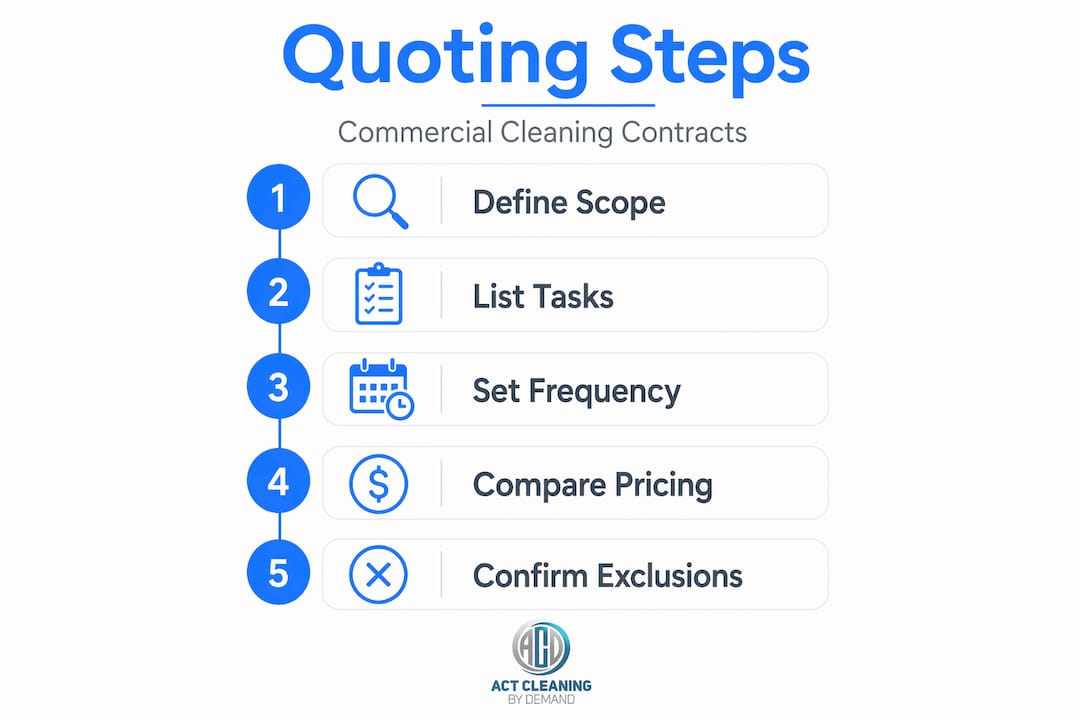
Watch for common exclusions that can inflate your real costs later. Deep carpet cleaning, external window washing, post-event cleaning, and pest-related sanitisation are frequently excluded from base quotes and charged as add-ons. Ask every vendor to list exclusions explicitly.
Pro Tip: Request a sample scope checklist before the site walkthrough. Vendors who arrive with a prepared list are far more likely to deliver consistent results than those quoting from memory.
How cleaning contract pricing is calculated
The cost of commercial cleaning is built on a few core pricing models, and knowing them stops you from comparing figures that were never calculated the same way.

Per square metre (or per square foot)
This is the most widely used benchmarking method. Commercial cleaning rates per square foot are used to enable apples-to-apples proposal comparisons. The formula is straightforward:
Total Monthly Cost ÷ Total Cleanable Area = Cost per Square Metre (or Square Foot)
For example, a quote of $12,000 per month for a 100,000 square foot building works out to $0.12 per square foot. In Australian terms, that translates to roughly $1.29 per square metre. Typical 2026 pricing ranges from $0.07 to $0.17 per square foot for standard offices, and up to $0.29 per square foot for medical or high-complexity environments.
Hourly and flat-rate models
Hourly pricing suits smaller or irregular contracts where task volume changes week to week. Office cleaning hourly rates commonly sit between $30 and $75 per hour depending on location, scope, and market conditions. Flat-rate pricing works best when the scope is fully defined and consistent, because both parties know exactly what is being delivered at what cost.
| Pricing model | Best suited for | Typical 2026 range |
|---|---|---|
| Per sq ft / sq m | Large offices, retail, commercial buildings | $0.07–$0.29/sq ft (offices to medical) |
| Hourly rate | Smaller premises, variable scope | $30–$75/hour |
| Flat monthly rate | Defined scope, multi-visit contracts | Varies by scope and frequency |
The key trap to avoid: per-square-foot cost alone should never be treated as a universal market price but as a benchmark against stated scope and quality agreement. A quote at $0.10/sq ft covering five visits per week is not the same value as one at $0.10/sq ft covering two visits per week.
Pro Tip: Always ask each vendor what cleanable area they have used in their calculation. Inconsistent area bases across vendors can skew your comparisons significantly.
How to request and evaluate quotes fairly
A well-run quote process protects you from price surprises and vendor disputes. It also signals to vendors that you take the contract seriously, which tends to attract higher-quality bids.
Follow this process when you request a cleaning service quote:
- Prepare a written scope brief. Before reaching out to vendors, document your facility size, property type, required frequency, and any specialist tasks. This becomes your baseline for comparison.
- Invite vendors for a site walkthrough. A vendor who quotes without walking your premises is guessing. Walkthroughs allow them to assess floor surfaces, restroom count, waste volumes, and access requirements accurately.
- Request itemised proposals. Ask each vendor to break their quote into line items by task and frequency. A strong commercial cleaning bid should include detailed pricing tables, exclusions, terms, and a signature block.
- Standardise for comparison. Convert all quotes to a per-square-metre cost using the formula above. This single step removes most of the confusion from comparing proposals.
- Ask clarifying questions. Specifically ask each vendor: What labour hours have you assumed? Are consumables included? What happens if a scheduled clean is missed?
When you evaluate vendor quotes side by side, verify that the per-square-foot price aligns with the cleanable area defined and the assumed labour hours, to avoid misleading figures.
| Evaluation factor | What to check |
|---|---|
| Scope detail | Are all tasks and areas explicitly listed? |
| Frequency | Is the visit schedule clearly defined? |
| Exclusions | Are add-ons and excluded tasks listed? |
| Cost per sq m | Does it align with 2026 market ranges? |
| Insurance and compliance | Is public liability insurance confirmed? |
| Contract length | Is the term and renewal process explained? |
Avoid the common mistake of choosing the lowest bid without checking what it does and does not cover. A quote missing floor stripping, consumable restocking, or after-hours access arrangements will cost you more to fill those gaps than a slightly higher all-in price would have.
Key contract terms to review before signing
Once you have selected a vendor, the commercial cleaning contract itself deserves careful attention. Several standard terms appear in professional contracts, and knowing them helps you negotiate from an informed position.
Standard janitorial contract terms include:
- Bid validity period: Usually 30 days. Confirms the quoted price is locked for a set period while you decide.
- Cancellation notice: Typically 30 to 60 days written notice required by either party. Shorter periods favour you but are harder to negotiate.
- Make-good clause: Obliges the vendor to re-clean or correct any missed or substandard service within 48 hours at no additional cost.
- CPI adjustment on renewal: Annual price increases tied to the Consumer Price Index. Predictable but worth capping.
- Payment terms: Office cleaning contracts commonly use monthly invoicing with net 15 or net 30 payment terms, and include late fees for overdue accounts.
Longer contract terms (12 months or more) often give you negotiating leverage for lower rates or free add-ons such as a quarterly deep clean. Vendors prefer the certainty of a longer commitment and will frequently trade price for it.
Understanding complex invoicing structures before you sign is well worth the time. Knowing how charges are split across service types prevents billing disputes down the track.
Verifying performance and managing contract quality
Signing a contract is not the end of the process. Your agreed scope document is the tool you use to verify that what you are paying for is actually being delivered.
Set up a simple monthly check using the scope checklist from your original quote. Walk your facility or have a building manager do it, and note any recurring misses. Most professional vendors welcome this feedback because it allows them to correct issues before they escalate into formal disputes.
Retaining a good cleaning contractor is genuinely valuable. Switching vendors mid-lease or mid-tenancy disrupts your team and often resets the onboarding process. Address problems early and keep a written record of all communications.
Signs that you may need to rebid your contract: consistent task omissions, unresponsive account management, unexplained price increases outside CPI, or a vendor who subcontracts work without your knowledge. If two or more of these appear, begin a new quote process at least 60 days before your cancellation notice window opens.
Pro Tip: Schedule a formal quarterly review with your cleaning vendor. It creates an accountability rhythm and gives you documented evidence if you ever need to invoke your make-good clause or exit the contract.
My honest take on commercial cleaning contract quotes
I have worked with enough business owners who signed cleaning contracts under pressure to know the pattern. They get three quotes, they pick the middle price because it feels safe, and six months later they are fielding complaints from staff about dirty restrooms and sticky floors.
The problem is almost never the price. It is the scope. Vague quotes are a red flag, not a starting point. When a vendor cannot or will not describe their methodology in writing, that is the information you need.
What I have found actually works is treating the quote process like any other procurement exercise. You write the brief, you own the comparison, and you do not let a charming sales pitch substitute for a detailed itemised proposal. The how cleaning quotes work conversation is one worth having before you ever call a vendor.
My strongest advice: do not sign a contract without a make-good clause and a defined cancellation period. Those two terms alone have saved more business owners from protracted disputes than any other contractual protection I have seen in practice.
The cost of commercial cleaning is not excessive when the scope is right. What is expensive is paying for a service that was never clearly defined, and then arguing about it.
— Deng
Get a transparent commercial cleaning quote from Com
If you are ready to move past vague proposals and get a quote that actually tells you what you are paying for, Com is here to help.
ACT Cleaning by Demand provides commercial clients across Australia with customised cleaning packages, fully itemised quotes, and contracts written in plain language. Whether you need a recurring office cleaning service with a clear scope and defined visit schedule, or a one-off end of lease clean before a property handover, the team works around your specific requirements. Every quote includes task breakdowns, pricing assumptions, and contract terms up front. No surprises, no vague scopes. Contact Com today to request your tailored commercial cleaning proposal.
FAQ
What should a commercial cleaning contract quote include?
A complete commercial cleaning services quote should include an itemised task list with visit frequency, cost per service, exclusions, consumables policy, payment terms, and contract length. Proposals missing any of these details make fair comparison difficult.
How is the cost of commercial cleaning typically calculated?
Most vendors calculate pricing using a per-square-metre or per-square-foot rate based on total cleanable area and required frequency. Typical 2026 rates range from $0.07 to $0.29 per square foot depending on facility type and complexity.
How many quotes should I get for a commercial cleaning contract?
Request at least three quotes using the same written scope brief so you are comparing equivalent proposals. Standardise each quote to a per-square-metre cost before making any final decision.
What contract terms should I negotiate before signing?
Focus on the cancellation notice period (aim for 30 days), a make-good clause for missed cleans, and a CPI cap on annual price increases. Standard cleaning contracts also include payment terms of net 15 to net 30 days, which are worth confirming before you commit.
When should I rebid my commercial cleaning contract?
Rebid when you experience repeated unresolved service failures, unexplained price increases, or a change in your facility's size or cleaning complexity. Begin the new quote process at least 60 days before your current cancellation notice window opens.