Running out of disinfectant mid-shift or drowning in surplus stock you'll never use are two sides of the same costly problem. If you manage cleaning supplies inventory without a structured system, you're leaving money on the table every single week. Supply costs represent 8–12% of total cleaning company revenue, which makes inventory one of the most controllable cost levers in your business. This guide walks you through exactly how to set up, run, and continuously improve your cleaning inventory management from the ground up.
Table of Contents
- Key takeaways
- How to manage cleaning supplies inventory: the foundations
- Tracking and controlling stock day to day
- Linking inventory to cost control and job pricing
- Common inventory challenges and how to fix them
- Auditing and improving your system over time
- What I've learnt after years of watching inventory go wrong
- How ACT Cleaning by Demand keeps supply management tight
- FAQ
Key takeaways
| Point | Details |
|---|---|
| Set par levels early | Establish minimum stock thresholds based on real consumption data and seasonal shifts to prevent shortages. |
| Link supply costs to job pricing | Track supply usage per job type and build those costs directly into quotes to protect your margins. |
| Automate where you can | Use digital tools or AI-driven tracking to replace manual counts and trigger reorder alerts automatically. |
| Standardise supply kits | Assign consistent kits by job type to simplify tracking, reduce waste, and improve cost predictability. |
| Audit regularly | Reconcile physical stock against digital records at least monthly to catch discrepancies before they become expensive. |
How to manage cleaning supplies inventory: the foundations
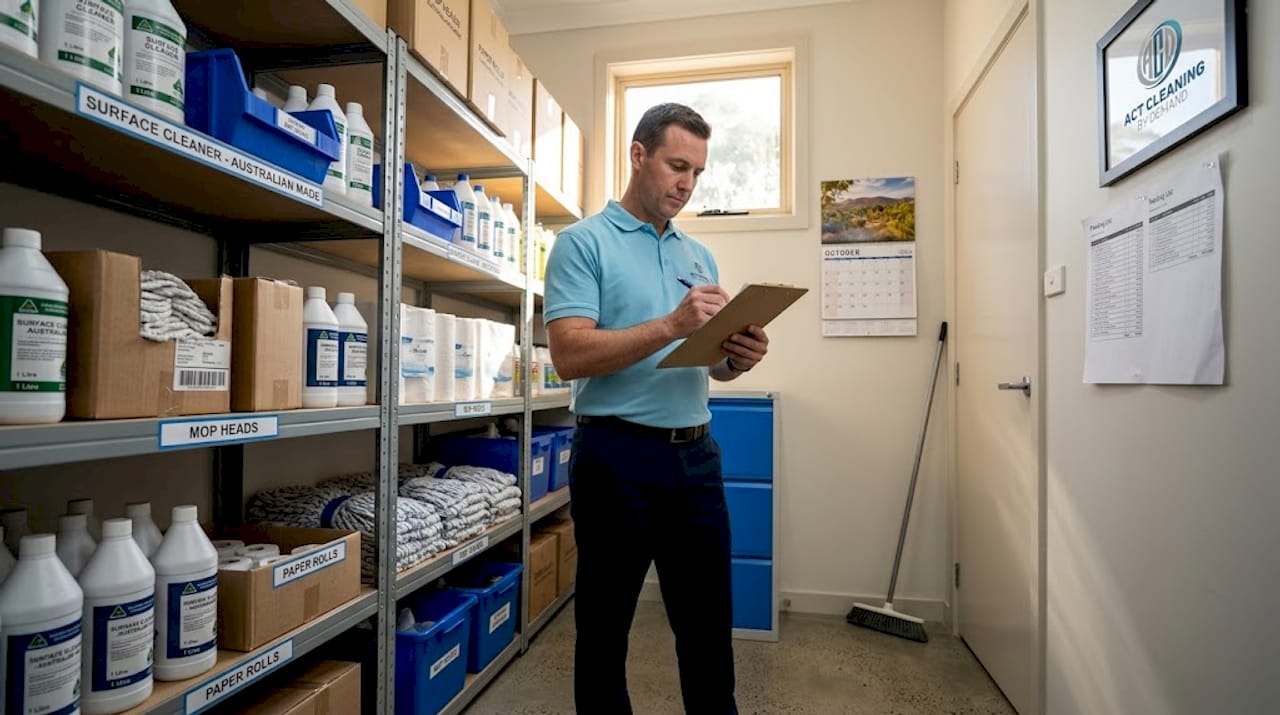
Before you can track anything accurately, you need to know what you actually stock. This sounds obvious, but most facilities have a chaotic mix of part-used bottles, duplicate products, and items nobody can identify. Start by doing a full stocktake and grouping your supplies into logical categories: surface cleaners, disinfectants, floor care products, bathroom chemicals, microfibre cloths and mop heads, disposable supplies like gloves and bin liners, and equipment consumables.
Once categorised, assign every product a unique SKU or product code. Each item needs a unique identifier to allow precise usage tracking, especially when you stock multiple sizes or concentrations of the same product. Without this step, your counts will always be approximate.
Manual versus automated tracking
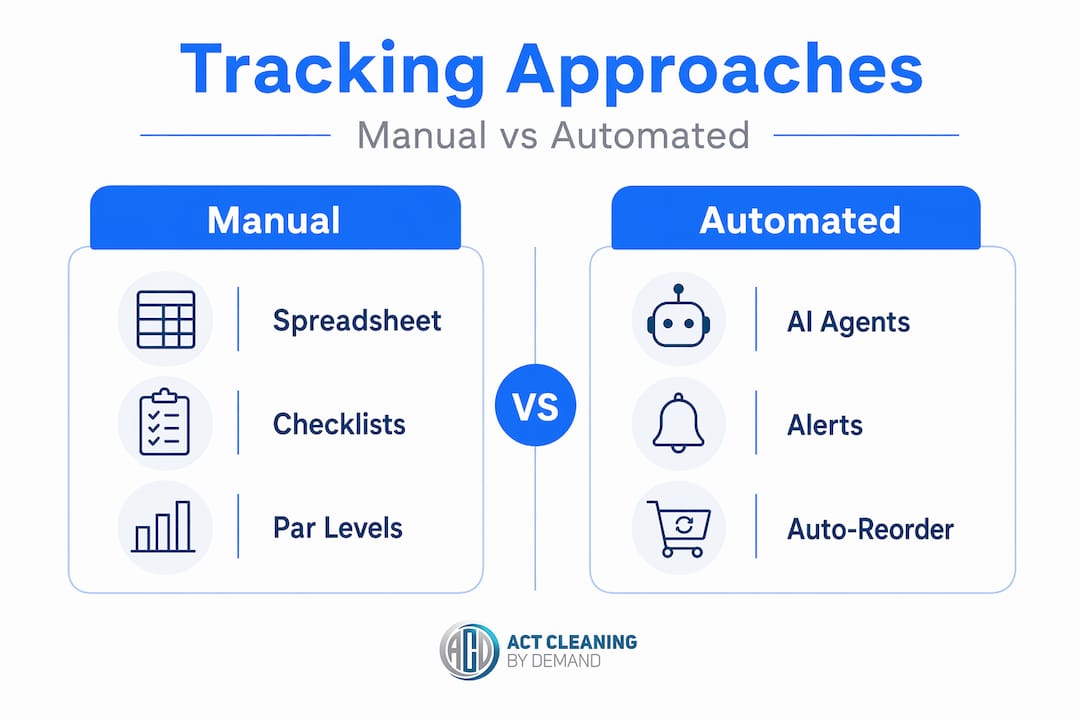
Choosing the right tool shapes how much time you spend managing inventory versus running your business. Here is a practical comparison:
| Approach | Pros | Cons |
|---|---|---|
| Manual spreadsheet | Low cost, easy to start, no software licence | Prone to human error, time-consuming at scale, no automatic alerts |
| Inventory template (Google Sheets or Excel) | Pre-built formulas, shareable, accessible remotely | Still requires manual data entry, limited automation |
| Dedicated inventory software | Automated counts, reorder alerts, reporting dashboards | Upfront cost, staff training required |
| AI-driven inventory agents | Detects usage anomalies, automates reorders, integrates with scheduling | Higher investment, requires reliable data input to function well |
For smaller operations with one or two crews, a well-structured spreadsheet template will cover you. Once you're managing multiple cleaning crews, the manual approach costs more in lost time than any software subscription would.
Setting par levels is the other non-negotiable. A par level is simply the minimum quantity of a product you need on hand before you reorder. Par levels adjusted seasonally prevent both stockouts during peak periods and dead stock during quieter months. Calculate yours by looking at average weekly consumption, then multiply by your supplier's lead time and add a buffer of around 20 to 30 per cent.
Pro Tip: If you don't have reliable consumption history yet, estimate usage over 30 to 60 days for your top 10 consumables. These items usually dominate your spend and give you the baseline you need to set accurate par levels.
Tracking and controlling stock day to day
Getting the system set up is one thing. Keeping it accurate is where most businesses fall short. The process below works for facilities of any size.
-
Receive stock correctly. When a delivery arrives, count every item before signing off and log it immediately in your inventory system. This is the single most common point of error. A rushed receiving process creates inaccurate records that compound over time.
-
Assign a location for every product. Shelves should be clearly labelled. Products should always return to the same spot. This makes counts faster and reduces the chance of staff pulling from the wrong item.
-
Run weekly or cycle counts. Rather than counting everything at once, cycle counts divide your inventory into sections and rotate which section you count each week. This keeps records current without requiring a full shutdown for stocktaking.
-
Log every withdrawal. Whether it's a staff member grabbing a bottle of glass cleaner or loading up a job kit, that usage needs to be recorded. A simple sign-out sheet works at small scale. At larger scale, automated stock tracking triggered by barcode scan is faster and more reliable.
-
Set automatic reorder alerts. In any spreadsheet or software system, configure an alert when stock drops to your par level. This removes the mental load of monitoring levels manually and prevents the reactive emergency purchases that cost you a premium.
-
Review your data weekly. Look for any items consistently running low before the reorder point or, conversely, items building up without being used. Both signals indicate your par levels or ordering quantities need adjustment.
Pro Tip: Standardised supply kits by job type make tracking far simpler. When every office clean uses the same kit, you can calculate consumption per job automatically and restock by the kit rather than by individual item.
AI-driven inventory agents take this further by monitoring purchase orders, flagging anomalies in usage patterns, and automating reorders without manual intervention. For businesses scaling past ten crews, that shift from clerical inventory work to automated oversight is significant.
Linking inventory to cost control and job pricing
Managing stock levels accurately is only half the job. The other half is using that data to price your work correctly and protect your margins. This is where most cleaning business owners leave money behind.
Start by calculating your supply cost per job type. A standard office clean might use a predictable quantity of surface spray, disinfectant, microfibre cloths, and bin liners. Once you know the average consumption per job, you can assign a supply cost figure to every quote you send. Supply costs must be explicitly included in job pricing to prevent margin erosion as your business grows.
Here is a simple framework for tracking cost per job category:
| Job type | Avg. supply cost | Labour cost | Total cost | Recommended margin |
|---|---|---|---|---|
| Standard office clean | $8.50 | $45.00 | $53.50 | 30% |
| End of lease clean | $22.00 | $120.00 | $142.00 | 35% |
| After builders clean | $35.00 | $180.00 | $215.00 | 35% |
| Regular house clean | $6.00 | $55.00 | $61.00 | 28% |
Review these figures quarterly. If your supply costs are creeping up, your quotes need to reflect that. Understanding how cleaning quotes work and basing them on actual consumption data is what separates profitable businesses from ones that wonder where the margin went.
Key things to watch across your cost data:
- Supply cost as a percentage of revenue. For most cleaning businesses, this should sit between 8 and 12 per cent. Residential work can run as low as 2 to 6 per cent. If your percentage is drifting higher, dig into which products or job types are driving it.
- Overuse by individual staff members. Standardised kits help here because overuse becomes visible when one crew consistently returns kits missing items others do not.
- Emergency purchasing costs. If you're regularly buying products at convenience store prices because you've run out, that signals a systemic par level problem, not a one-off issue.
Common inventory challenges and how to fix them
Even well-organised facilities run into the same recurring issues. Knowing what to expect means you can address problems before they become habits.
- Relying on purchase history instead of actual consumption. What you ordered last year tells you what you thought you needed. What you actually used tells you what you need. These two numbers are often different, especially if your business has grown or changed service mix.
- Decanting without labelling. Bulk chemicals transferred into smaller bottles must be labelled immediately with the product name and dilution ratio. Unlabelled bottles are a chemical safety risk and lead to cleaning errors when staff guess at concentrations.
- Ignoring seasonal fluctuations. A facility servicing commercial offices will see demand drop during school holidays and peak during post-event cleanups. Treating your par levels as fixed year-round means you're either overstocked or underprepared for roughly four months of the year.
- Staff not logging usage. This is a culture and process issue as much as a systems issue. Make the logging step as simple as possible and build it into the normal workflow. If it requires extra effort, it won't happen consistently.
- Stockouts triggering emergency purchases. Manual inventory management at scale consistently results in lost hours and premium emergency purchasing costs. Cleaning companies with ten or more crews lose an estimated two to four hours weekly to supply delays. Automated reorder alerts eliminate this almost entirely.
"Treating inventory as a dynamic consumption model, with par levels adjusted for seasonality, is what separates a reactive supply system from a genuinely controlled one." — adapted from inventory management best practices
Auditing and improving your system over time
A system that was accurate six months ago may not reflect your current operation. Regular audits keep your records honest and reveal where your processes need updating.
-
Conduct a full physical count monthly. Compare what you physically have on the shelf against what your records say you should have. Discrepancies signal either a logging failure or a theft issue, both of which need to be addressed.
-
Analyse usage trends quarterly. Look at which products are being used more or less than expected. This data should directly inform your par level settings and your supplier negotiations.
-
Review supplier performance. Track lead times, delivery accuracy, and price changes. If a supplier is consistently late, your buffer stock needs to be higher for their products until the situation is resolved.
-
Update staff training after every audit. If the audit reveals that staff are not following the sign-out process, that's a training gap. Document the correct procedure, retrain briefly, and monitor for the next cycle.
-
Add automation incrementally. You don't need to implement every technology feature at once. Start with automated reorder alerts, then add usage reporting, then consider integration with your scheduling or job management software as your data quality improves.
Pro Tip: Use your quarterly usage analysis to negotiate better pricing with your suppliers. Showing a supplier that you purchase a consistent volume of a specific product each quarter puts you in a much stronger position to negotiate a discount or priority delivery terms.
What I've learnt after years of watching inventory go wrong
I've seen facility managers with excellent cleaning staff and solid client relationships still struggle financially, and nine times out of ten, the problem traces back to supply costs they weren't tracking properly. The assumption is that consumables are a minor, manageable expense. They're not. At scale, they're the difference between a healthy margin and a business that's always tight.
What shifted things in the operations I've observed most closely was connecting inventory directly to the job schedule. Once you can see what a specific job type actually consumes, the quote number stops being a guess. You stop relying on rough estimates from memory and start pricing from data. That alone changes how you think about growth, because you know exactly what each new client is going to cost you to service.
The other thing I'd push back on is the idea that proper inventory technology is a luxury. Many owners miss inventory's potential as a genuine operational tool because they think the upfront effort isn't worth it. In my experience, the cost of not having it, in emergency purchases, overstock write-offs, and pricing errors, almost always exceeds what a decent system would have cost. Start simple, but start deliberately.
— Deng
How ACT Cleaning by Demand keeps supply management tight
If you want to see what disciplined supply management looks like in practice, ACT Cleaning by Demand is a useful benchmark. The team manages everything from professional house cleaning through to commercial office cleaning and specialised end-of-lease cleans, with consistent service quality across every job type. That consistency doesn't happen by accident. It comes from standardised supply kits, structured processes, and a genuine commitment to eco-friendly products that work. If you're a business or facility manager looking for a reliable cleaning partner who understands cost control as well as clean results, explore the full range of cleaning services on offer at ACT Cleaning by Demand.
FAQ
What does it cost to manage cleaning supplies inventory?
The cost depends on the system you use. A spreadsheet costs nothing beyond staff time, while dedicated inventory software typically runs between $30 and $150 per month for small to mid-sized operations.
How often should I count cleaning stock?
Cycle counts weekly for fast-moving consumables and a full physical stocktake monthly is the most practical approach for most cleaning businesses.
What are par levels and why do they matter?
Par levels are the minimum stock quantities you need on hand before reordering. Setting par levels correctly prevents both stockouts and costly overstock, particularly when adjusted for seasonal demand shifts.
How do I track cleaning supplies across multiple sites?
Use a centralised inventory system where each site logs withdrawals against a shared digital record. Cloud-based spreadsheets or dedicated software both work well, provided staff follow the logging process consistently.
Should supply costs be included in client quotes?
Yes, every time. Supply costs built into contract pricing protect your margins as your business scales, and failing to include them is one of the most common reasons cleaning businesses struggle with profitability.