Yes, safe and effective non-toxic carpet cleaning is available in Australia — but "non-toxic" on a label means very little without verification. The two fastest checks: look for the National Asthma Council Australia's Sensitive Choice blue butterfly logo or a GECA (Good Environmental Choice Australia) certification, and scan the ingredient list for SLS/SLES and synthetic fragrances. If either of those is present, put it back on the shelf.
Your practical routes, in order of effort:
- Vetted professional eco services using soap-free, fragrance-free, certified solutions and low-moisture or steam methods
- Low-moisture or dry encapsulation professional cleaning for quick-dry situations (offices, rentals, households with young children)
- Safe DIY spot cleaning using pH-neutral, fragrance-free products or simple bicarb-and-water treatments for minor spills
Key takeaways
Non-toxic carpet cleaning in Australia works — provided you verify the certification, not just the label claim.
| Point | Details |
|---|---|
| Verify with certification | Look for Sensitive Choice or GECA logos; both have searchable online databases to confirm currency. |
| Avoid SLS and synthetic fragrances | These are the two most common irritants in carpet cleaning products and are present in many "natural" brands. |
| DIY has real limits | Spot-treat promptly with pH-neutral, fragrance-free solutions; stop and call a pro for pet urine in underlay, mould, or wool rugs. |
| Method matters as much as product | Soap-free extraction or low-moisture encapsulation leaves less residue and re-soils more slowly than conventional methods. |
| ACT Cleaning by Demand | Offers eco-friendly carpet and floor cleaning across Canberra and the ACT with customised, no-lock-in packages. |
Table of Contents
- What does 'non-toxic' carpet cleaning actually mean in Australia?
- How do professional non-toxic carpet cleaning methods actually work?
- What can non-toxic methods reliably clean, and when do you need a pro?
- How do you choose a trustworthy non-toxic carpet cleaner in Australia?
- Safe DIY non-toxic carpet cleaning: spot treatment and routine care
- Typical costs, drying time, and aftercare for non-toxic cleaning
- How do you verify eco and 'non-toxic' claims in Australia?
- The case for non-toxic cleaning is stronger than the industry admits
- ACT Cleaning by Demand: non-toxic carpet cleaning in Canberra and the ACT
- Sources
What does 'non-toxic' carpet cleaning actually mean in Australia?
The term "non-toxic" is not regulated in Australia, which means any brand can print it on a bottle. What actually matters is the formulation and the method, not the marketing claim.
A genuinely non-toxic carpet cleaning product avoids known irritants and leaves no harmful residues in carpet fibres after drying. That covers both what goes in (the formula) and what comes out (residue, off-gassing, wastewater). A service can use a technically "natural" product and still leave a sticky residue that re-soils the carpet within days, or use a fragrance that triggers asthma in sensitive households.
Ingredients and claims to treat with scepticism:
- SLS and SLES (sodium lauryl/laureth sulphate): common surfactants that can irritate skin and airways, and leave residue that attracts dirt
- Synthetic fragrances: a single "fragrance" ingredient can contain dozens of undisclosed chemicals, many of which are respiratory irritants
- Optical brighteners: chemical compounds that make fibres look cleaner under UV light without actually removing soil
- "Chemical-free" claims: physically impossible — water is a chemical. This phrase is pure marketing and signals nothing about safety
- "Natural" or "plant-based" without certification: these are unverified self-descriptions
Labels that carry genuine weight in Australia:
The National Asthma Council Australia's Sensitive Choice blue butterfly logo means an independent panel has reviewed the product and assessed it as potentially beneficial for people with asthma and allergies. It is one of the most reliable signals for allergy-friendly cleaning products in Australia.
GECA (Good Environmental Choice Australia) certification signals reduced environmental impact and a degree of ingredient transparency. Australian brands like Euclove, which explicitly avoids SLS/SLES and synthetic fragrances and offers refillable packaging, use this kind of certification as a practical signal of genuine environmental commitment rather than marketing language.
How do professional non-toxic carpet cleaning methods actually work?
Professional eco-friendly carpet cleaning is not one method. It is a family of approaches, each suited to different carpet types, contamination levels, and drying-time requirements. Here is how the main ones work and when each makes sense.
The general process across all methods:
- Assessment — fibre type, stain type, contamination level, and any areas of concern (mould, pet urine, delicate rugs)
- Pre-treatment — enzyme-based or spot treatment applied to targeted areas; dwell time allows biological action on organic stains
- Primary cleaning method — see below
- Extraction or drying — mechanical extraction of solution and loosened soil, or natural drying for dry methods
- Post-inspection — check for residual staining, odour, or fibre damage
Method comparison:
| Method | How it works | Best use | Limitation |
|---|---|---|---|
| Hot water extraction (HWE) with soap-free solution | Injects heated water and extracts immediately; no soap means no sticky residue | Heavily soiled carpets, deep allergen removal | Longer drying time |
| Low-moisture dry encapsulation | Polymer solution encapsulates soil particles; vacuumed out when dry | Commercial spaces, quick-turnaround rentals | Less effective on heavy soiling or set-in stains |
| Carbonated/dry foam | CO₂ bubbles lift soil to surface; low water use | Delicate fibres, areas prone to mould | Not suited to severe contamination |
| Enzymatic treatment | Biological enzymes break down organic matter (urine, food, blood) | Pet urine, food spills, biological stains | Needs dwell time; ineffective on non-organic stains |
| Steam (vapour) with fragrance-free formula | High-temperature vapour kills bacteria and dust mites; minimal chemical use | Allergen reduction, sanitising | Can damage some synthetic fibres if misapplied |
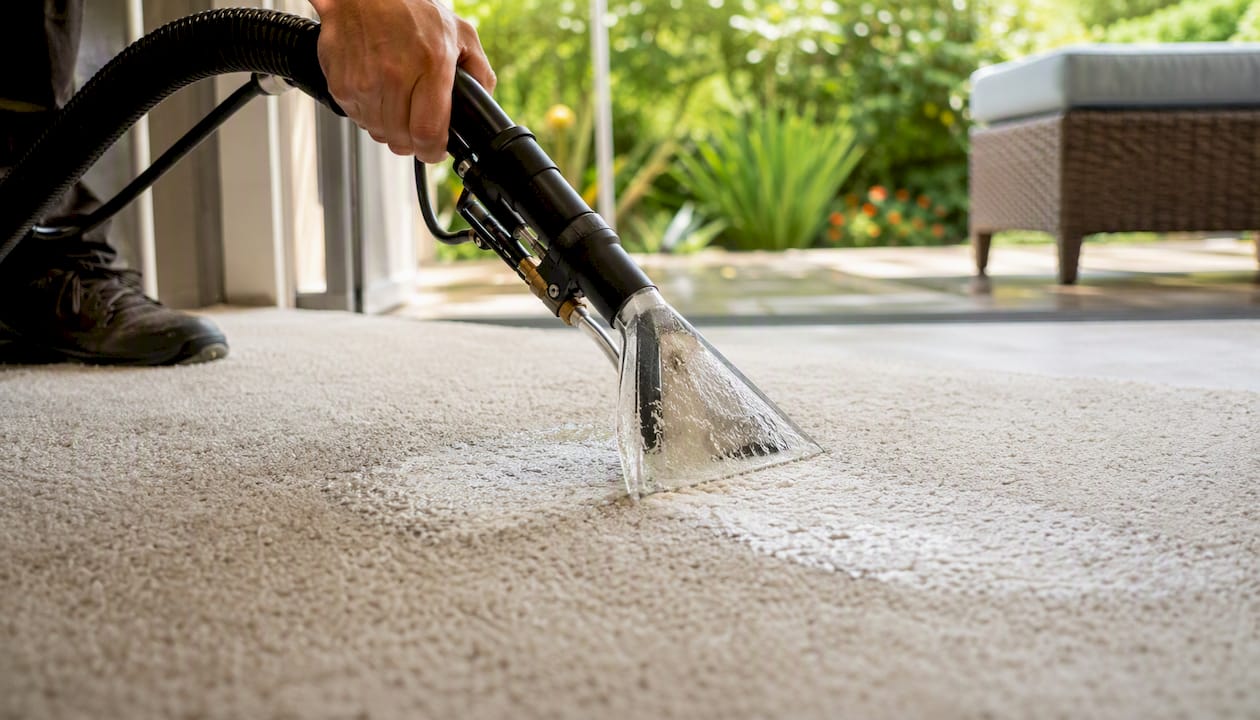
Soap-free professional methods reduce sticky residue that causes carpets to re-soil quickly after cleaning. Combining a soap-free pre-treatment with strong mechanical extraction or low-moisture encapsulation gives cleaner results with less residual irritation risk — a meaningful difference for households with asthma or young children.
What can non-toxic methods reliably clean, and when do you need a pro?
Non-toxic carpet cleaning handles more than most people expect, but it has real limits. Knowing where those limits sit saves you money and prevents fibre damage.
What non-toxic methods reliably treat:
- Surface dirt and general grime
- Many common stains: coffee, tea, wine (when treated promptly), food spills
- Dust mites and pet dander (with HEPA-filtered extraction — Consumer Reports guidance highlights filtration and method as the key variables for allergen control)
- Mild pet urine (recent, not set-in)
- General odour from everyday use
What usually needs specialist intervention:
- Old, set-in grease or oil stains
- Severe pet urine odour that has penetrated the underlay or subfloor
- Mould or mildew (requires containment, not just cleaning)
- Biohazard contamination
- Widespread staining across large areas
When to call a professional rather than DIY:
- Persistent odour after two DIY attempts
- Wool, silk, or antique rugs (pH sensitivity and fibre fragility make DIY high-risk)
- Any suspected mould under the carpet
- Carpet fibre damage risk from over-wetting
A short note on DIY limitations: many homemade mixes are not pH-balanced for carpet fibres. Straight white vinegar, for example, is acidic enough to weaken wool or alter dye colours. Allergy organisations recommend using certified asthma and allergy-friendly products rather than unverified home recipes, particularly in households with respiratory sensitivities.
How do you choose a trustworthy non-toxic carpet cleaner in Australia?
Greenwash is common in the cleaning industry. A credible eco-friendly carpet cleaner can answer specific questions about their products and process. One who cannot — or who deflects with vague language — is a red flag.
Step-by-step checklist for vetting a provider:
- Ask for the product name and brand they use for carpet cleaning, not just "eco-friendly products"
- Request the Safety Data Sheet (SDS) for that product — a legitimate cleaner will have one and share it without hesitation
- Check for independent certification: Sensitive Choice, GECA, or an equivalent third-party eco label
- Confirm the solution is pH-neutral for the fibre type in your home (especially important for wool or blended carpets)
- Ask about equipment: does their extraction machine use HEPA filtration? What is the extraction power?
- Confirm drying time and whether they use low-moisture methods if quick drying matters to you
- Check insurance: public liability cover protects you if a method damages your carpet
Key questions to ask directly:
- "What product do you use, and can I see the SDS?"
- "Is the solution fragrance-free and SLS/SLES-free?"
- "Do your products carry Sensitive Choice or GECA certification?"
- "How long will my carpet take to dry, and what method do you use?"
- "What do you do if a stain does not come out?"
Red flags: vague ingredient claims ("all-natural formula"), pressure to add expensive treatments at the door, no evidence of independent certification, and an inability to name the specific product they use.
Pro Tip: Ask for the product's GECA or Sensitive Choice listing number, not just the logo. Both programmes maintain searchable online databases — you can verify the claim in under two minutes before the cleaner arrives.
Safe DIY non-toxic carpet cleaning: spot treatment and routine care
For minor spills and routine maintenance, a careful DIY approach works well. The key is acting quickly, using the right solution for the fibre, and knowing when to stop.
Step-by-step spot cleaning process:
- Blot immediately — never rub. Use a clean white cloth and work from the outside of the spill inward to prevent spreading
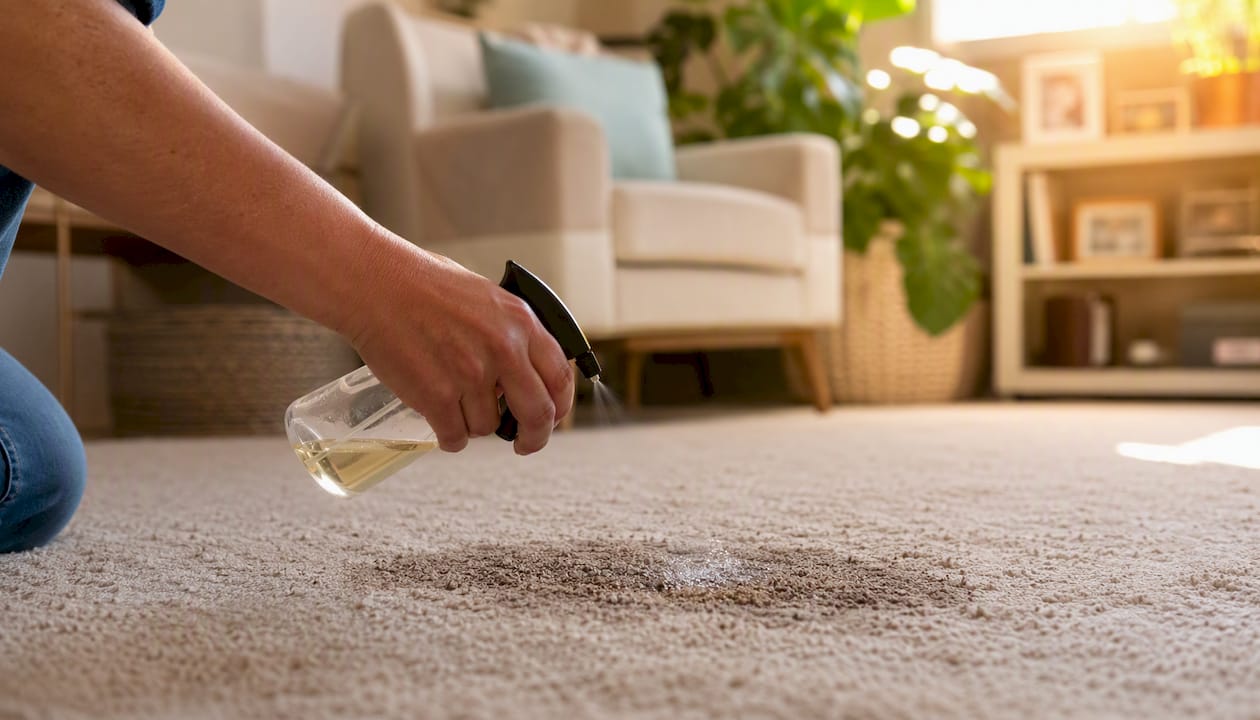
- Mix a pH-neutral solution — a small amount of fragrance-free, SLS/SLES-free dish liquid in warm water is a reasonable starting point for most synthetic carpets
- Spot-test first — apply a few drops to a hidden area (inside a wardrobe or under a piece of furniture) and wait 10 minutes. Check for colour change or fibre distortion
- Apply and blot — work from the edges of the stain inward, blotting rather than scrubbing
- Rinse with plain water — remove any product residue with a clean damp cloth
- Dry thoroughly — press dry towels onto the area and allow airflow; a fan speeds this up considerably
Product selection criteria for Australian households:
- Fragrance-free and SLS/SLES-free formulation
- pH-neutral claim (ideally verified, not just stated)
- GECA or Sensitive Choice certification where available
- Refillable or low-waste packaging as a secondary signal of genuine environmental commitment
Fibre-specific cautions and common stains:
- Wool and silk: avoid vinegar, lemon juice, or any acidic solution. Acidic DIY mixes can weaken wool fibres or alter dye colours — pH-neutral is non-negotiable for these fibres
- Wine: blot immediately, then cold water and a pH-neutral solution. Do not use hot water, which sets the stain
- Pet urine: blot, then an enzymatic cleaner with dwell time. If the odour persists after drying, the urine has likely reached the underlay — call a professional
- Grease: absorb with bicarb soda first (leave for 15 minutes, then vacuum), followed by a pH-neutral degreaser. Always spot-test any product on an inconspicuous area before wider application
- Stop and call a pro if: the stain spreads, the fibre texture changes, or the odour worsens after treatment
Typical costs, drying time, and aftercare for non-toxic cleaning
Ballpark cost ranges (Australian market, 2026):
- DIY fragrance-free, certified spot cleaner: $15–$40 per bottle (concentrate refills reduce this further)
- Professional non-toxic carpet clean: roughly $35–$60 per room for standard residential rooms, with whole-home packages often more cost-effective per room
- Specialist treatments (enzymatic for pet urine, mould remediation): priced separately and higher, depending on severity
Drying time by method:
| Method | Typical drying time | Practical note |
|---|---|---|
| Hot water extraction | 4–12 hours | Open windows and use fans; avoid foot traffic |
| Low-moisture encapsulation | 1–2 hours | Good for rentals or homes with pets and children |
| Dry foam / carbonated | 30–60 minutes | Quickest option; suits delicate fibres |
| Steam (vapour) | 2–4 hours | Depends on ventilation and humidity |
Aftercare to keep a non-toxic clean working longer:
- Vacuum at least twice a week with a HEPA-filtered vacuum — HEPA filtration is the key variable for allergen control in carpeted homes
- Spot-treat spills within minutes rather than hours
- Keep pets off freshly cleaned carpet until fully dry to prevent re-soiling and paw-print transfer
- Store any leftover cleaning product in a cool, dark place and check the expiry date — degraded solutions can leave unexpected residues
- Place doormats at all entries to reduce the volume of soil tracked onto carpet
How do you verify eco and 'non-toxic' claims in Australia?
The National Asthma Council Australia's Sensitive Choice programme reviews products against criteria relevant to asthma and allergy management. The GECA programme assesses environmental impact across the product lifecycle, including ingredient sourcing, biodegradability, and packaging. Both maintain searchable online databases.
Verification checklist:
- Request the product's SDS and check the hazard section — a genuinely low-risk product will have minimal hazard classifications
- Search the product name in the Sensitive Choice or GECA database to confirm the certification is current
- Ask for independent test reports if the cleaner makes specific performance claims (e.g. "removes 99% of allergens")
- Confirm pH documentation for the solution used on your specific fibre type
- Check packaging: refillable or concentrated formats suggest a brand thinking beyond the single-use bottle
Reading labels practically: "plant-based", "natural", and "eco" are self-declared and unverified. "Fragrance-free" is more meaningful than "unscented" (unscented products can still contain masking fragrances). Certified products for asthma and allergy management and those combining eco certification with refillable packaging offer the most reliable signals. Cleaning carpets also affects the broader indoor environment — removing allergens from ducts and soft furnishings together produces better air quality outcomes than treating carpets alone.
The case for non-toxic cleaning is stronger than the industry admits
The cleaning industry has a habit of treating "non-toxic" as a niche preference rather than a baseline standard. That framing suits manufacturers who profit from complex chemical formulations, but it does not serve households with children, pets, or anyone with respiratory sensitivities.
What the evidence actually shows is that soap-free, fragrance-free methods clean just as effectively as conventional approaches for the vast majority of residential soiling. The difference is in what they leave behind: no sticky surfactant residue, no synthetic fragrance off-gassing, no SLS irritation risk on skin that comes into contact with the carpet. For a household where a toddler or a dog spends time on the floor, that residue question is not trivial.
The one honest caveat: severe contamination — deep pet urine, mould, biohazard — genuinely requires professional-grade intervention. No DIY mix handles that safely or completely. The mistake is assuming that because non-toxic methods have limits, conventional chemical methods are the answer. They are not; they just add a different set of risks. The right answer for severe contamination is a professional with the right equipment and certified products, not a stronger chemical.
ACT Cleaning by Demand: non-toxic carpet cleaning in Canberra and the ACT
If you want the verification work done for you, ACT Cleaning by Demand handles carpet and floor cleaning across Canberra and the ACT using eco-friendly products, with customised packages built around your carpet type, household needs, and timeline.
The service covers steam cleaning and low-moisture options for residential clients, with police-checked staff and no lock-in contracts. Whether you are in Inner South, Tuggeranong, Woden, or surrounding suburbs, the team can advise on the right method for your fibre type and confirm the products used before the job starts.
For households with allergy or asthma concerns, the custom cleaning packages let you specify fragrance-free and certified-product requirements upfront. Book online or request a quote to confirm availability in your area.
Sources
- Universal Cleaner | Multipurpose Eco-Certified Cleaning Solution | Koh
- Consumer Reports — buying a carpet cleaner: things to know
- Certified cleaning products for a healthier home | Asthma & Allergy Friendly®
Recommended
- Why professional cleaners use chemicals: science, safety, results – ACT Cleaning by Demand
- How cleaning quotes work for Australian homeowners – ACT Cleaning by Demand
- Domestic cleaning explained: the Canberra homeowner’s guide – ACT Cleaning by Demand
- Custom cleaning service packages for every Canberra home – ACT Cleaning by Demand