A ready-to-use, printable office cleaning checklist covering daily, weekly, monthly, and periodic tasks is below. Copy it into a rota, assign initials against each task, and you have a working programme from day one.
What the full template includes:
- Daily room-by-room task list (reception, desks, meeting rooms, kitchen, bathrooms, floors, high-touch points)
- Weekly deeper-clean tasks organised by zone
- Monthly maintenance items (vents, appliances, carpet spot-work)
- Quarterly and annual schedule for floor restoration, upholstery, and exterior windows
- A simple audit/inspection form with pass/fail fields
- A sample weekly rota showing morning porter and nightly crew time blocks
How to use it: Print the relevant section, write staff initials in the "Assigned" column, tick tasks on completion, and file the signed sheet weekly. Store completed sheets for at least three months so you have an audit trail if a contractor or supervisor queries the record. According to SafetyCulture's daily office cleaning checklist template, standardising these fields across pantry, meeting rooms, and restrooms is what makes the form useful for audits, not just task tracking.
Quick-start action: Download or copy the checklist below, assign responsibilities today, and schedule your first verification walkthrough for the end of this week.
Key takeaways
A structured office cleaning checklist, split by daily, weekly, monthly, and periodic frequency, is the single most effective tool for maintaining hygiene standards and protecting your building's assets over time.
| Point | Details |
|---|---|
| Daily tasks by zone | Cover reception, desks, meeting rooms, kitchen, restrooms, and high-touch surfaces every day without exception. |
| Weekly deeper clean | Add full vacuuming, edge vacuuming, interior glass, and appliance wipe-downs each week to prevent build-up. |
| Monthly maintenance | Schedule vent cleaning, HVAC filter checks, deep appliance cleans, and carpet spot-extraction every month. |
| Audit with three KPIs | Track task completion rate, corrective actions logged, and response time to keep contractors accountable. |
| ACT Cleaning by Demand | Provides written scopes, QA logs, and flexible scheduling for offices across Canberra and the ACT. |
Table of Contents
- What does a daily office cleaning checklist cover?
- What should you tackle on a weekly cleaning schedule?
- What belongs on a monthly deep-clean checklist?
- How do you plan quarterly and annual office maintenance?
- How do you build an office cleaning schedule and rota?
- How do professionals approach safety and eco-friendly cleaning?
- How do you audit and verify office cleaning quality?
- Why does a regular cleaning programme actually matter?
- Our approach to office cleaning at ACT Cleaning by Demand
- Professional office cleaning in Canberra and the ACT
- Sources
- FAQ
What does a daily office cleaning checklist cover?
A daily office cleaning checklist is the backbone of any workplace hygiene programme. Allied Facility Care's commercial cleaning guide recommends organising daily tasks by zone so nothing slips between shifts. For a two-person nightly crew, a medium-to-large office typically takes a few hours to complete.
Daily tasks by area
Reception and lobby
- Wipe entry glass doors and handles
- Vacuum or mop entry mats and hard floors
- Dust reception desk and wipe surfaces
- Empty bins and replace liners
- Restock hand sanitiser
Workstations and desks
- Empty individual bins
- Wipe shared surfaces (printers, copiers, shared monitors)
- Spot-clean desks where food debris is visible
- Disinfect shared keyboards and mice if hot-desking applies
Meeting rooms
- Wipe table surfaces and chairs
- Disinfect remote controls, AV panels, and light switches
- Remove cups, glasses, and any leftover food
- Restock whiteboard markers and check projector area
Breakroom and kitchen
- Wipe benchtops, splashbacks, and sink
- Spot-clean microwave exterior and handle
- Empty bins and recycling
- Restock dish soap, paper towels, and hand soap
- Quick fridge check: remove obviously expired items
Restrooms
- Restock toilet paper, soap, and paper towels first
- Wipe and disinfect basins, taps, and mirrors
- Clean and disinfect toilet bowls, seats, and handles
- Mop floors
- Empty sanitary bins
Following the correct sequence matters. Modular Concepts' cleaning checklist explains that restroom cleaning should always run top-to-bottom: stock first, dust upper surfaces, then descend to fixtures, and mop the floor last. Reversing that order recontaminates surfaces you have already cleaned.
Corridors, lifts, and common areas
- Wipe lift buttons and handrails
- Spot-clean corridor walls at hand height
- Vacuum or mop hard floors
High-touch disinfection (every area, every day)
- Door handles and push plates
- Light switches
- Lift buttons
- Shared device surfaces
Pro Tip: Use a colour-coded microfibre system: red cloths for restrooms, green for food preparation areas, blue for general dusting and desks. This single habit prevents cross-contamination between zones and is one of the most cost-effective hygiene controls available.
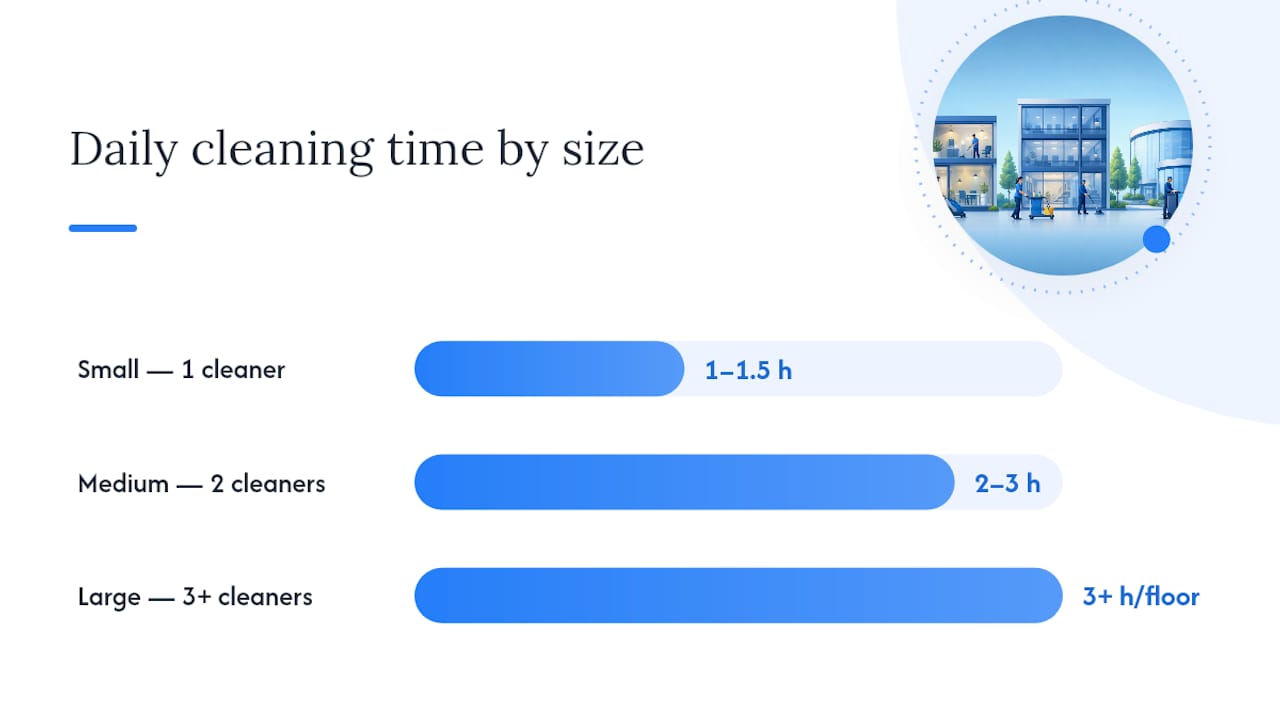
Daily time estimates by office size
| Office size | Staff required | Estimated daily time |
|---|---|---|
| Small (under 500 square metres) | 1 cleaner | 1 to 1.5 hours |
| Medium (500 to 2,000 square metres) | 2 cleaners | 2 to 3 hours |
| Large (2,000+ square metres) | 3+ cleaners | 3+ hours per floor |
What should you tackle on a weekly cleaning schedule?
Weekly tasks prevent the gradual build-up that daily work misses. Dust settles on vertical surfaces, grime accumulates along skirting boards, and interior glass picks up fingerprints that daily wiping rarely reaches. Allied Facility Care recommends including detailed dusting of high and low surfaces, edge vacuuming along baseboards, interior glass cleaning, and rotating disinfectant focus across restroom zones each week.
Weekly task list:
- Full vacuum of all carpeted areas, including under desks and chairs
- Edge vacuum along skirting boards and under furniture
- Dust high surfaces: tops of cabinets, shelving, and partition tops
- Dust low surfaces: chair bases, under-desk cable trays
- Clean interior glass partitions and windows
- Wipe kitchen appliance exteriors thoroughly (microwave, fridge door, dishwasher)
- Deep-wipe inside the microwave
- Launder or replace microfibre cloths used during the week
- Rotate disinfectant product in restrooms (alternating actives reduces resistance build-up)
- Spot-clean upholstered chairs and soft furnishings
Scheduling note: After-hours windows (6 PM–9 PM) work best for vacuuming and floor work. Daytime touch-ups, such as glass cleaning and surface dusting, can run during low-occupancy periods without disrupting staff.
Weekly checklist sign-off table
What belongs on a monthly deep-clean checklist?
Monthly tasks are the layer that protects your assets. Skip them for a quarter and you will notice it in carpet condition, air quality, and the state of appliance interiors. Allied Facility Care's quarterly guidance frames monthly and quarterly work as the "deep-reset layer" that preserves surface life and prevents compounding neglect.
Monthly task list:
- High-dust: ceiling corners, light fittings, and pendant fixtures
- Clean HVAC supply and return grilles (wipe or vacuum grille faces)
- Check and replace HVAC filters if due (typically every 1–3 months depending on occupancy and filter rating)
- Wipe walls and high partitions at shoulder height and above
- Deep-clean breakroom appliance interiors: fridge shelves and drawers, oven interior if applicable
- Wipe and sanitise bin exteriors
- Carpet spot-extraction: treat visible stains with an extraction machine or log them for professional extraction
- Clean behind and under large furniture where accessible
- Check and clean floor drains in kitchens and bathrooms
When to log a professional carpet extraction: If spot-extraction does not lift a stain in two passes, log it for a professional hot-water extraction service rather than over-treating with chemicals, which can damage carpet backing.
Monthly checklist table
How do you plan quarterly and annual office maintenance?
Heavier periodic tasks need to be planned, not improvised. ZBM Clean's office cleaning guide and Allied Facility Care both list quarterly carpet extraction and floor machine work as the tasks most commonly deferred, and most costly to defer.
Quarterly tasks:
- Hot-water carpet extraction (full floor, not spot-only)
- Strip and recoat hard floors (vinyl, timber, or polished concrete where applicable)
- Upholstery shampoo for fabric chairs and lounges
- Interior window detail clean (frames, sills, and glass)
- Pressure-wash building entries and car park areas if accessible
Annual and seasonal tasks:
- Exterior window cleaning (requires specialist access equipment for multi-storey buildings)
- Full HVAC service and duct inspection (coordinate with your building or facilities manager)
- Deep-clean of server room or comms room floor space
- Grout re-sealing in wet areas if needed
Linking these tasks to your facility preventive maintenance checklist keeps cleaning and building services aligned. HVAC servicing, for example, should precede duct cleaning, not follow it.
Periodic maintenance timeline
| Task | Frequency | Specialist required | Approx. lead time to book |
|---|---|---|---|
| Carpet hot-water extraction | Quarterly | Yes (commercial extractor) | 1–2 weeks |
| Hard floor strip and recoat | Quarterly | Yes | 2–3 weeks |
| Upholstery shampoo | Quarterly | Yes | 1–2 weeks |
| Interior window detail | Quarterly | No (in-house capable) | Same week |
| Exterior window clean | Annual | Yes (access equipment) | 4–6 weeks |
| Full HVAC service | Annual | Yes (licensed technician) | 4 weeks |
How do you build an office cleaning schedule and rota?
Turning a checklist into a working rota takes five steps. POPProbe's ISSA-aligned daily checklist estimates 45–60 minutes per floor for a standard daily scope, which is a useful starting point for allocating time blocks.
- Map your zones. List every area in the building: reception, open-plan floors, meeting rooms, kitchen, restrooms, corridors, stairwells, and external entries.
- List tasks per zone. Use the daily, weekly, and monthly checklists above as your source.
- Assign frequency. Mark each task D (daily), W (weekly), M (monthly), or Q (quarterly).
- Allocate staff and time. Use the time estimates in the daily section as a baseline. Add 15–20% buffer for larger sites or high-traffic days.
- Set verification and reporting. Decide who signs off each shift, how issues are logged, and when the supervisor walkthrough happens.
Sample weekly rota
Handover notes: The morning porter should leave a brief note (paper or digital) flagging any consumable shortages or damage spotted during their shift. The nightly crew picks this up and logs completion against the same form.
Pro Tip: Avoid duplicating tasks between your in-house day porter and an outsourced nightly team by assigning each a distinct scope in writing. The porter owns consumable restocking and daytime touch-ups; the nightly crew owns the full clean. Overlap creates gaps, not redundancy, because each team assumes the other has covered it.
For guidance on coordinating multiple crews, the ACT Cleaning by Demand crew management guide covers practical handover and scheduling approaches.
How do professionals approach safety and eco-friendly cleaning?
Professional cleaning is not just about what gets cleaned, it is about how. Equipment choice, chemical handling, and sequence all affect both hygiene outcomes and staff safety.
Safety priorities:
- Keep a Safety Data Sheet (SDS) folder on-site for every chemical product in use. Inspectors can request these at any time.
- Staff should wear appropriate PPE: gloves for all chemical contact, eye protection when using spray disinfectants, and non-slip footwear on wet floors.
- Never mix cleaning chemicals. Bleach and ammonia-based products produce toxic fumes.
Equipment standards:
- Use HEPA-filter vacuums to capture fine particulates rather than recirculating them
- Colour-coded microfibre cloths and mop heads (red/green/blue system described in the daily section) prevent zone cross-contamination
- EPA-registered disinfectants with correct dwell times are the standard: a product that is wiped off before its dwell time has elapsed has not disinfected the surface
Sustainability notes:
- Low-VOC (volatile organic compound) disinfectants improve indoor air quality, particularly in poorly ventilated spaces
- Concentrated dosing systems reduce plastic waste and chemical overuse compared to pre-diluted spray bottles
- Microfibre cloths, when laundered correctly, replace hundreds of single-use paper towels per year
What a supervisor checks in a QA walkthrough:
- Restroom: toilet bowl under-rim, behind cistern, floor grout condition
- Kitchen: inside microwave, fridge door seal, bin exterior
- Desks: under-desk cable areas, chair bases
- Entry: mat condition, glass streak-free, door handle shine
Pro Tip: Log every chemical product used on a simple register: product name, SDS location, dilution ratio, and date opened. This takes five minutes to set up and makes any WorkSafe or building management inspection straightforward.
How do you audit and verify office cleaning quality?
Checklists are performance documents, not just task lists. Modular Concepts frames them as tools for vendor accountability and KPI tracking. A short audit form used weekly or monthly turns subjective "looks clean" impressions into objective records.
Audit form fields:
- Date and time of inspection
- Zone inspected
- Tasks checked (list from the relevant checklist)
- Inspector initials
- Pass / Fail per item
- Corrective action required (describe the issue)
- Date corrective action completed
Three KPIs worth tracking:
- Task completion rate: percentage of scheduled tasks signed off as complete each week
- Corrective actions logged: number of fail items per audit period
- Corrective action response time: hours or days between logging an issue and resolving it
Photos taken during walkthroughs are the most defensible evidence when a contractor disputes a finding. A timestamped photo of a dirty restroom floor is clearer than any written description.
Sample audit table
Allied Facility Care's guidance notes that nightly logs and supervisor walkthroughs are the most effective way to prevent scope drift between client expectations and what a contractor actually delivers. A written scope of work, signed by both parties, is the starting point.
Why does a regular cleaning programme actually matter?
The practical case for a structured cleaning programme goes beyond appearances. Consistent cleaning reduces the spread of pathogens on shared surfaces, which directly affects sick-leave rates. Indoor air quality improves when dust, mould spores, and VOCs are removed regularly rather than allowed to accumulate. Carpets and hard floors last significantly longer when maintained on a scheduled basis rather than cleaned reactively.
For senior managers and building owners, there is also a brand dimension. A visibly clean office signals professionalism to clients and candidates visiting the space. A dirty one signals the opposite, regardless of how good the work happening inside it actually is.
Intangible benefits that matter to building users:
- Staff confidence that shared spaces are hygienic, particularly in post-pandemic workplaces
- Reduced odour complaints, especially in kitchens and restrooms
- Lower risk of pest activity, which is directly linked to food debris management
- Compliance with workplace health and safety obligations around cleanliness and hazard control
Common facility maintenance oversights, including deferred cleaning and HVAC neglect, compound over time and generate repair costs that dwarf the cost of a regular cleaning programme.
Our approach to office cleaning at ACT Cleaning by Demand
Every office cleaning programme we run at ACT Cleaning by Demand starts with a site walkthrough and a written scope of work. We map zones, agree on frequencies, and document the task list before the first clean. That document becomes the checklist your team or ours works from, and the basis for every QA walkthrough.
Our staff are police-checked, trained in colour-coded microfibre systems, and equipped with HEPA vacuums and low-VOC, eco-friendly products. Scheduling is flexible: we work around your hours, whether that means an early morning porter, an after-hours nightly crew, or a combination of both. There are no lock-in contracts, so the arrangement stays practical for your business.
Professional office cleaning in Canberra and the ACT
Managing a cleaning programme in-house takes time, documentation, and consistent follow-through. For offices that would rather hand that responsibility to a vetted team, ACT Cleaning by Demand provides professional office cleaning services across Canberra and the ACT with a written scope, a QA log, and flexible scheduling built in from the start.
A standard commercial scope covers daily cleaning across all zones, consumable restocking, and a supervisor walkthrough with a signed completion log. For periodic work, including carpet extraction and hard floor restoration, the team handles scheduling and brings specialist equipment. Police-checked staff, eco-friendly products, and no lock-in contracts are standard across every engagement.
To request a quote or book a site assessment, visit the office cleaning service page or get in touch directly. You will receive a written scope and checklist before the first clean.
Sources
- Daily Office Cleaning Checklist | Office Cleaning Template | Free Template - SafetyCulture
- Commercial Office Cleaning Checklist (Daily to Quarterly) - Allied Facility Care
- Modular Concepts Office Cleaning Checklist: Daily-Quarterly
FAQ
What is included in a standard office clean?
A standard office clean covers emptying bins, disinfecting high-touch surfaces, wiping desks and common areas, cleaning restrooms, restocking consumables, and vacuuming or mopping floors. Deeper tasks such as carpet extraction and vent cleaning are typically scheduled separately on a monthly or quarterly basis.
What is the 20/10 rule for cleaning?
The 20/10 rule is a personal productivity method where you clean for set periods then rest briefly. In a commercial office context, it is less relevant than zone-based scheduling, but the underlying principle, working in focused time blocks, applies well to day porter routines.
What are the 7 stages of cleaning?
The seven stages are: remove loose debris, pre-clean (rinse or wipe), main clean, rinse, disinfect, final rinse, and dry. This sequence is most commonly applied to food-contact surfaces and restrooms, where skipping a stage, particularly the dwell time on the disinfection step, leaves pathogens active on the surface.
How often should office restrooms be cleaned?
Restrooms in a busy office should be serviced at least once daily, with a midday check and restock in high-traffic buildings. A restroom used by more than 20 people per day typically warrants two full cleans: one in the morning and one in the evening.
What is the daily 6 cleaning list?
The "daily 6" is an informal shorthand for the six tasks most commonly prioritised in a daily office clean: empty bins, disinfect high-touch surfaces, clean restrooms, restock consumables, wipe kitchen surfaces, and vacuum or mop entry areas. The exact list varies by site, which is why a written, zone-specific checklist is more reliable than any generic shorthand.