Blot first, then treat with an enzyme cleaner. That's the short answer for a fresh accident. If the odour comes back after two proper enzyme treatments, or if you suspect the urine soaked through to the carpet pad or subfloor, call a professional. Surface-level fixes won't touch uric acid crystals that have settled into the backing, and no amount of scrubbing will change that.
Act immediately with these three steps:
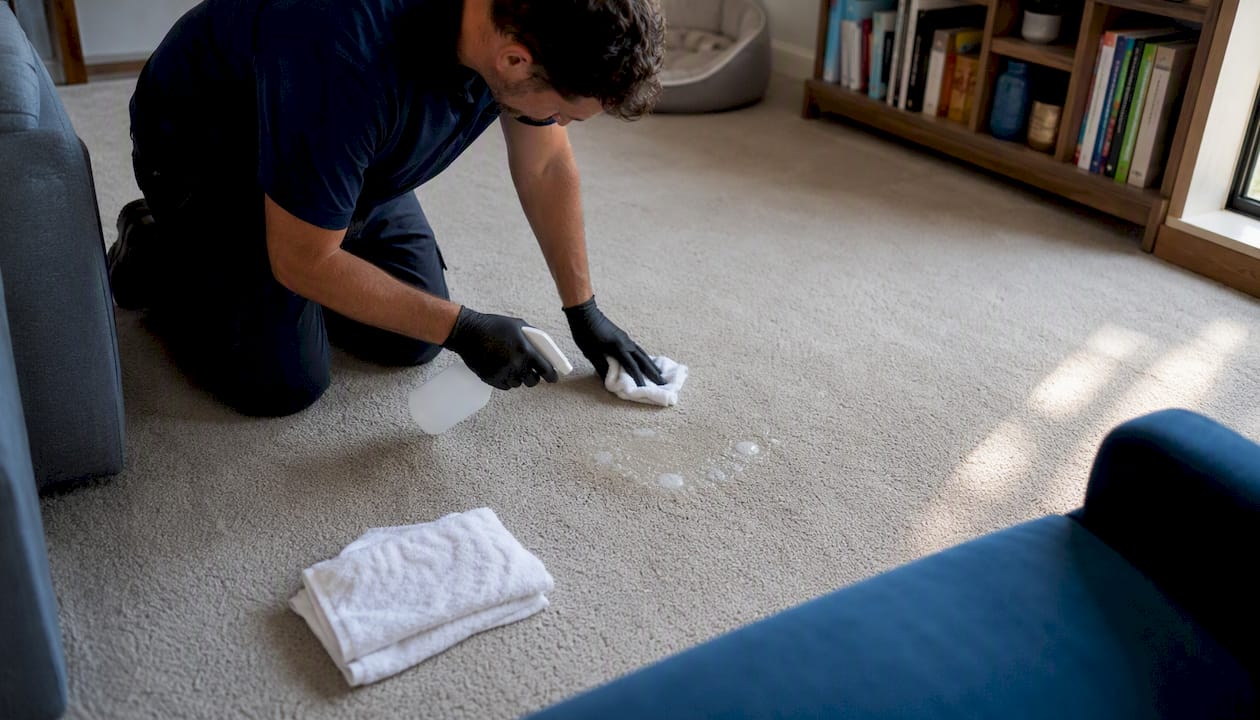
- Blot, don't rub. Press white towels firmly onto the wet patch and stand on them if you can. Blotting with absorbent materials and applying steady weight is more effective than rubbing, which spreads urine deeper into the fibres.
- Avoid steam and hot water. Heat sets protein stains and makes them harder to remove. Cold water only until the enzyme cleaner goes on.
- Call a pro if odour persists. Two correct enzyme treatments with no lasting result means the contamination is in the pad. That's the single trigger for professional help.
Pro Tip: IICRC-certified technicians follow industry standards for urine remediation, including pad-level inspection and treatment. When vetting a cleaner, ask whether they hold IICRC certification.
Key takeaways
Enzyme cleaners are the only retail product that reliably removes uric acid from carpet fibres; call a professional if odour returns after two correct treatments or if the pad is contaminated.
| Point | Details |
|---|---|
| Blot first, always | Press white towels firmly onto a fresh accident before applying any product. |
| Enzymes are the permanent fix | Only enzyme cleaners break down uric acid crystals; masking sprays and vinegar don't. |
| Dwell time matters | Cover enzyme cleaner for 12–24 hours on set-in stains to get full penetration. |
| Call a pro after two failed DIY attempts | Persistent odour means pad contamination; surface treatment won't resolve it. |
| ACT Cleaning by Demand | Offers UV inspection, enzyme pre-treatment, extraction, and written guarantees in the ACT region. |
Table of Contents
- How do you treat a fresh pet urine accident on carpet?
- Which DIY products actually work for removing pet urine?
- What does a professional pet urine treatment actually involve?
- When is DIY not enough, and how do you choose a carpet cleaner?
- How do you stop your pet returning to the same spot?
- What does pet urine treatment cost, and how long does it take?
- How ACT Cleaning by Demand approaches pet urine removal
- Professional pet urine treatment in Canberra and the ACT
- Sources
How do you treat a fresh pet urine accident on carpet?
The sequence is: blot, dilute, apply enzyme cleaner, cover, and air-dry. Each step matters.
- Blot immediately. Fold several white paper towels or a clean white cloth into a thick pad. Press down firmly and hold for 30 seconds. Repeat with dry towels until you've pulled out as much liquid as possible. Standing on the towel applies the right pressure without spreading the stain.
- Dilute with cold water. Pour a small amount of cold water over the area to dilute what remains, then blot again. Cold water only — warm or hot water begins to set the proteins in urine.
- Test for colourfastness. Before applying any cleaner, dab a small amount on a hidden area of carpet and wait five minutes. If the colour lifts, stop and call a professional, especially on wool or delicate fibres.
- Apply an enzyme cleaner generously. Saturate the area so the product reaches the carpet backing. For a fresh accident, follow the manufacturer's dwell time as recommended for light soil. For heavier contamination, the Woolite Carpet Pet Urine Eliminator guidance recommends covering the area for 12–24 hours to maximise enzyme action.
- Cover to keep moist. Lay a damp cloth or plastic wrap over the treated area. Enzymes need moisture to work — letting the product dry out before the reaction completes is one of the most common DIY mistakes.
- Blot and air-dry. After the dwell time, blot up the remaining liquid. Open windows or use a fan to speed drying. Don't walk on the area until it's fully dry.
- Vacuum when dry. Once the carpet is completely dry, vacuum to restore the pile.
Pro Tip: On wool or natural-fibre carpets, skip the DIY enzyme treatment and call a professional sooner. Wool is sensitive to both enzyme products and excess moisture, and a botched DIY attempt can cause permanent fibre damage that's far more expensive to fix.
Which DIY products actually work for removing pet urine?
Enzymatic cleaners are the only retail product class that reliably breaks down uric acid crystals, which are the source of persistent urine odour. Oxidisers and peroxide-based products can lift the visible stain and reduce surface smell, but they don't dissolve the uric acid structure the way enzymes do. Masking sprays are the weakest option — they cover odour temporarily, and the smell returns as soon as humidity rises.
Here's how the main categories compare:
- Enzyme cleaners (e.g., Woolite Carpet Pet Urine Eliminator, available through BISSELL): best for fresh and set-in stains; address the uric acid source; safe for most synthetic carpets when tested first; require a long dwell time for heavy soil; generally the right first choice.
- Oxidiser sprays (e.g., OxiClean Carpet & Area Rug Pet Stain & Odor Remover): useful for surface stain removal and light deodorising; product guidance emphasises testing colourfastness and repeating treatment where needed; not designed to penetrate pad-level contamination.
- Britex products (Bunnings): Britex offers a carpet cleaning machine hire service through Bunnings, with guidance specifically for Australian pet owners. The Bunnings Britex guide covers pad-focused steps and is a practical option for larger or older stains where a hired extraction machine adds real cleaning power beyond a spray bottle.
- Vinegar and baking soda: useful as an emergency measure when nothing else is on hand, but they don't break down uric acid crystals. The smell may reduce temporarily, then return. Treat these as a first-response holding measure, not a solution.
- Masking sprays and air fresheners: avoid. They address the symptom, not the source.
Safety callouts worth knowing:
- Always test any product on a hidden area first, particularly on wool, berber, or patterned carpets.
- Never use bleach on urine stains. It reacts with ammonia in urine and creates harmful fumes.
- Avoid steam or hot water before enzyme treatment. Heat sets the protein, making the stain harder to remove.
- Follow manufacturer dwell times precisely. Under-applying or rinsing too early is the most common reason enzyme treatments fail.
What does a professional pet urine treatment actually involve?
A professional job does something DIY can't: it finds all the contamination, not just the visible patch. UV blacklight inspection often reveals that the surface stain is just a fraction of the total affected area. Professionals report that visible surface stains frequently underestimate pad contamination by a factor of two to three. That's why a DIY treatment on the visible spot sometimes fails — the pad underneath is still saturated.
The professional process, step by step
- Inspection: UV/blacklight scan of the entire room to map all contamination, including spots invisible under normal light.
- Concentrated enzyme pre-treatment: A professional-grade enzyme product is applied at higher concentration than retail products and worked into the carpet to reach the pad. The area is covered and left to dwell.
- Extraction: Hot-water extraction (truck-mounted where possible) flushes the pad and removes dissolved uric acid, enzyme residue, and moisture. Low-moisture extraction is used for delicate fibres.
- Deodorising: A neutralising deodoriser is applied after extraction to address any residual odour compounds.
- Pad replacement or subfloor sealing: For severe or long-standing contamination, the pad may need to be cut out and replaced. If urine has reached the subfloor, a sealant is applied before new pad and carpet are laid.
Pro Tip: Ask any professional cleaner whether they inspect the pad before quoting. A company that quotes without lifting a corner of carpet or using a UV light is likely quoting for surface cleaning only.
Realistic timeline for a single room
| Stage | Typical duration |
|---|---|
| UV inspection | brief duration |
| Enzyme pre-treatment dwell | variable time depending on severity |
| Hot-water extraction | moderate duration |
| Drying time (carpet only) | several hours |
| Pad replacement (if needed) | may take from a few hours to a full day |
IICRC certification is the clearest trust signal when choosing a technician. It means the cleaner has been trained to industry standards for water damage and contamination remediation, not just general carpet cleaning.
When is DIY not enough, and how do you choose a carpet cleaner?
Call a professional if any of these apply:
- Odour returns after two correct enzyme treatments.
- The stain covers a large area or there are multiple spots across the room.
- You can smell urine on humid days even after treating (a sign that uric acid crystals remain in the pad and are being reactivated by moisture).
- The carpet is wool, silk, or a delicate natural fibre.
- You're preparing for an end-of-lease inspection and need a written guarantee.
Questions to ask before you book
- Do you use enzyme or bio-enzymatic products, or just hot water and detergent?
- Do you inspect and treat the pad, or only the carpet surface?
- Do you use truck-mounted extraction equipment?
- Are your technicians IICRC-trained?
- Do you offer a written re-treatment guarantee if the odour returns?
Red flags to watch for
- The company promises to "eliminate" odour without inspecting the pad first.
- They insist on steam cleaning without enzyme pre-treatment.
- They won't give a written guarantee or re-treatment clause.
- The quote is given over the phone without asking about the number of stains, room size, or carpet type.
- They use the words "deodorise" and "clean" interchangeably, suggesting they're masking rather than removing the source.
Decision guide:
| Situation | Recommended approach |
|---|---|
| Single fresh spot, synthetic carpet | DIY enzyme treatment |
| Set-in stain, synthetic carpet | DIY with Britex hire or enzyme soak |
| Odour returns after two DIY attempts | Book a professional |
| Wool or delicate fibre | Professional from the start |
| Multiple stains or large area | Professional with pad inspection |
| End-of-lease or bond refund at risk | Professional with written guarantee |
How do you stop your pet returning to the same spot?
Remove every scent marker completely. That's the single most effective prevention step. Pets return to spots where uric acid remains in the pad or fibres because the residual scent signals "toilet" to them, regardless of how clean the carpet looks or smells to you.
Practical prevention measures:
- Apply enzyme cleaner after every accident, even minor ones. Don't skip the dwell time.
- Clean litter boxes daily. Cats that avoid a dirty litter box will find alternatives.
- Rule out medical causes. Frequent accidents in unusual spots can indicate a urinary tract infection or other health issue worth a vet check.
- Place washable mats or puppy pads in high-risk areas while you're working on training.
- Reward correct toileting consistently. Positive reinforcement is more effective than correction after the fact.
Humidity reactivates uric acid crystals that weren't fully broken down. If a treated spot starts smelling again on a humid day, the crystals are still there. That's a sign the original treatment didn't reach the pad, and a professional extraction is the right next step.
Pro Tip: After a professional clean, let the area dry completely before reintroducing your pet. Bring back familiar bedding gradually rather than all at once — a sudden return of the pet's own scent to a freshly cleaned area can trigger re-marking. Give the carpet 24–48 hours fully dry before the pet has unsupervised access.
What does pet urine treatment cost, and how long does it take?
For a single fresh spot, DIY costs are low: a quality enzyme spray or Britex hire from Bunnings runs well under $50, and the time investment is a few hours including dwell time. The real cost of DIY is getting it wrong and needing a professional anyway.
Typical DIY cost ranges:
- Enzyme spray (retail, e.g., Woolite or equivalent): $15–$30 per bottle.
- Britex machine hire (Bunnings): around $40–$60 per day depending on location.
- OxiClean spot spray: $10–$20 per bottle.
Professional treatment in the ACT and surrounding region:
Professional single-room pet urine treatment varies considerably based on severity, carpet type, and whether pad replacement is needed. In Canberra/ACT, standard single-room treatment costs are generally moderate and depend on service specifics. Pad replacement adds to that cost and requires a written quote after inspection. Always request a written quote that specifies what's included — "carpet cleaning" and "urine remediation" are not the same service.
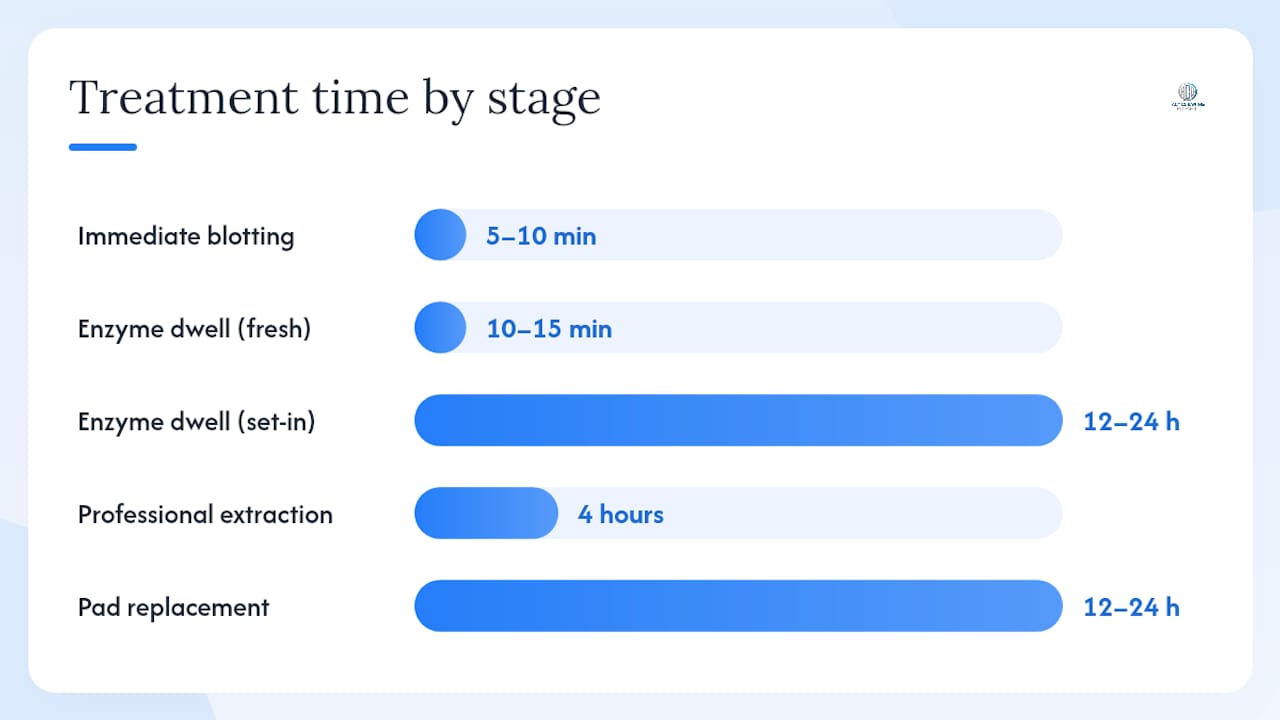
Timeline overview:
| Action | Time required |
|---|---|
| Immediate blotting (fresh accident) | 5–10 minutes |
| Enzyme dwell time (fresh stain) | 10–15 minutes |
| Enzyme dwell time (set-in stain) | 12–24 hours |
| Professional extraction and dry | 4 hours |
| Pad replacement (if needed) | Half to full day |
A re-treatment guarantee from a professional cleaner affects the value calculation significantly. If the odour returns within a stated period and the company retreats at no charge, that's worth paying a premium for.
How ACT Cleaning by Demand approaches pet urine removal
ACT Cleaning by Demand uses eco-friendly enzyme options, pad-level inspection, and extraction for residential jobs across the ACT region, with written guarantees available for urine remediation work. The approach follows the same process outlined in this guide: UV inspection first, concentrated enzyme pre-treatment, hot-water extraction, and deodorising. Where pad contamination is confirmed, pad replacement is offered as part of the service.
What's included in the service:
- UV/blacklight inspection to map all contamination before treatment begins.
- Tailored enzyme pre-treatment matched to carpet fibre type and contamination severity.
- Hot-water extraction to flush the pad and remove dissolved uric acid.
- Optional pad replacement for severe or long-standing cases.
- Eco-friendly products throughout; police-checked staff on every job.
- Written guarantee on urine remediation work.
For tenants preparing for an end-of-lease inspection, a professional urine treatment with a written guarantee is one of the strongest protections against a disputed bond refund claim. Landlords and property managers in the ACT region can also request a written report of treatment for their records.
The company's floor cleaning portfolio covers the range of carpet and hard-floor work carried out for residential clients, including pet odour remediation.
Professional pet urine treatment in Canberra and the ACT
When two DIY attempts haven't shifted the smell, the contamination is almost certainly in the pad, and that's where ACT Cleaning by Demand starts. The service covers UV inspection, concentrated enzyme pre-treatment, hot-water extraction, and deodorising for residential properties across Canberra and the ACT region. Eco-friendly products, police-checked staff, and no lock-in contracts are standard on every job.
For tenants facing an end-of-lease inspection, a written guarantee on urine remediation is included. To request a quote, contact ACT Cleaning by Demand with the room size, approximate number of stains, and your pet type. A technician will confirm the scope and provide a written price before any work begins. Book a residential clean or visit Actcleaningbydemand to get started.
A note from the publisher
Pet urine is one of the most stubborn problems a carpet can face, and the advice in this guide reflects what actually works rather than what sounds reassuring. If you've already tried enzyme treatment twice and the smell is still there on warm days, please don't keep treating the surface. The problem is underneath, and ACT Cleaning by Demand can inspect and treat it properly. A free inspection quote is available for residential properties across Canberra and the ACT. Reach out before the damage goes deeper.
Sources
- How to Get Dog Pee Smell Out of Carpet for Good | Enzyme Cleaners
- How To Clean Pet Urine From Carpet With Britex
- How to Remove Dog and Cat Urine Smell from Carpet
- Pet Odor & Stain Removal - AdvancedCleaning (2026)
Recommended
- How cleaning quotes work for Australian homeowners – ACT Cleaning by Demand
- Why professional cleaners use chemicals: science, safety, results – ACT Cleaning by Demand
- Custom cleaning service packages for every Canberra home – ACT Cleaning by Demand
- How to retain commercial cleaning clients and boost satisfaction – ACT Cleaning by Demand