
If you manage a commercial property or run a business, understanding what is a recurring cleaning contract could be the difference between a consistently maintained space and a reactive, costly cleaning headache. Many property managers treat a cleaning quote as a contract, but these two documents serve completely different purposes. A quote tells you the price. A contract governs accountability, service frequency, quality standards, and what happens when things go wrong. This article cuts through the confusion so you can set up a cleaning arrangement that actually protects your property and your budget.
Table of Contents
- Key takeaways
- What is a recurring cleaning contract?
- Why recurring contracts benefit property managers
- Contract types and service frequency explained
- Legal and compliance requirements to check
- My honest take on recurring cleaning contracts
- Reliable recurring contracts with ACT Cleaning by Demand
- FAQ
Key takeaways
| Point | Details |
|---|---|
| Quotes are not contracts | A quote lists pricing only; a contract governs accountability, supervision, and service standards. |
| Flat monthly rates are preferable | Industry standard recurring contracts use flat monthly pricing for budget predictability over hourly billing. |
| Scope must be building-specific | Vague scope allows inconsistent service; contracts must detail tasks, frequency, and cleaning methods per area. |
| Legal clauses protect both parties | Insurance lapse notifications, exit clauses, and police check requirements reduce your operational risk. |
| Frequency should match property type | Matching service frequency to your property type controls costs while maintaining consistent presentation standards. |
What is a recurring cleaning contract?
A recurring cleaning contract is a formal, ongoing agreement between a property owner or business and a professional cleaning provider. Unlike a one-off service booking, it commits both parties to a defined scope of work delivered at agreed intervals, whether weekly, fortnightly, monthly, or quarterly. The contract is renewed automatically or reviewed at the end of a term, typically 12 months.
Here is where many property managers get caught out. Quotes differ from contracts: a quote lists price, while a contract governs accountability, supervision, and inspection reporting. If all you have is a quote, you have no formal mechanism to enforce service standards, request documented reporting, or exit the arrangement cleanly. You can learn more about how these two documents differ in practice by reviewing how cleaning quotes work for Australian property owners.
A well-drafted recurring cleaning contract must cover the following components:
- Scope of work: Task lists that are building-specific and area-specific, not generic. Without detailed scope, "cleaning the building" means whatever the cleaner decides that day.
- Service frequency: How often each task is performed, from daily rubbish removal to quarterly carpet cleaning.
- Pricing structure: Whether you pay a flat monthly rate or per-visit fee, and what triggers a price review.
- Consumables responsibility: Who supplies toilet paper, bin liners, hand soap, and cleaning chemicals.
- Make-good provisions: What happens when a scheduled service is missed. Missed services should be remedied within 24 hours.
- Exit and notice clauses: Typically 60 to 90 days' notice is required to avoid automatic contract renewal.
- Supervision and reporting: How inspections are conducted, how complaints are escalated, and who is accountable on site.
Pro Tip: Always request that the scope of work be attached as a separate schedule to your contract. This makes it easier to amend individual tasks or frequencies without renegotiating the entire agreement.
Why recurring contracts benefit property managers
The most immediate benefit of a recurring cleaning contract is budget predictability. Industry standard contracts favour flat monthly rates over hourly billing, which removes the uncertainty of variable invoices each month. For property managers juggling multiple sites, this consistency is genuinely useful for financial reporting and budget allocation.
Beyond budgeting, the benefits of recurring cleaning contracts go deeper than most people realise. Here is what they deliver in practice:
- Consistent presentation standards. Regular, contracted cleaning prevents the gradual build-up of grime, wear, and odour that accumulates when cleaning is only done reactively. A consistently clean environment reflects directly on your business and tenant satisfaction.
- Long-term asset protection. Ongoing maintenance is more cost-effective than reactive deep cleans. Flooring, fixtures, and finishes that are maintained regularly avoid the expensive restoration work that neglect creates.
- Reduced reactive spend. When you have a contract in place, you are not scrambling to find a cleaning provider after a spill, an inspection notice, or a tenant complaint. The relationship and processes are already established.
- Documented accountability. Contracts create a paper trail. Inspection reports, service logs, and escalation records mean you have evidence of service delivery if a dispute arises with a provider, a tenant, or an insurer.
- Stronger provider relationships. Recurring contracts shift providers from reactive one-off mode to proactive ongoing client management. Providers invested in long-term contracts are more likely to send experienced staff, respond faster to issues, and accommodate changes.
Research confirms that recurring contracts are strategic assets that support predictive maintenance and protect property value long-term. For commercial offices, strata buildings, and retail properties, this is not an administrative nicety. It is a core part of professional property management. Property managers overseeing multiple tenancies should also consider the value of retaining commercial cleaning clients through well-structured service agreements.
Contract types and service frequency explained

Not all recurring cleaning contracts look the same. Typical contract frequencies include monthly maintenance, quarterly deep cleans, bi-annual services, and annual preventative maintenance. Matching these to your property type and use is what determines both cost-effectiveness and service outcomes.
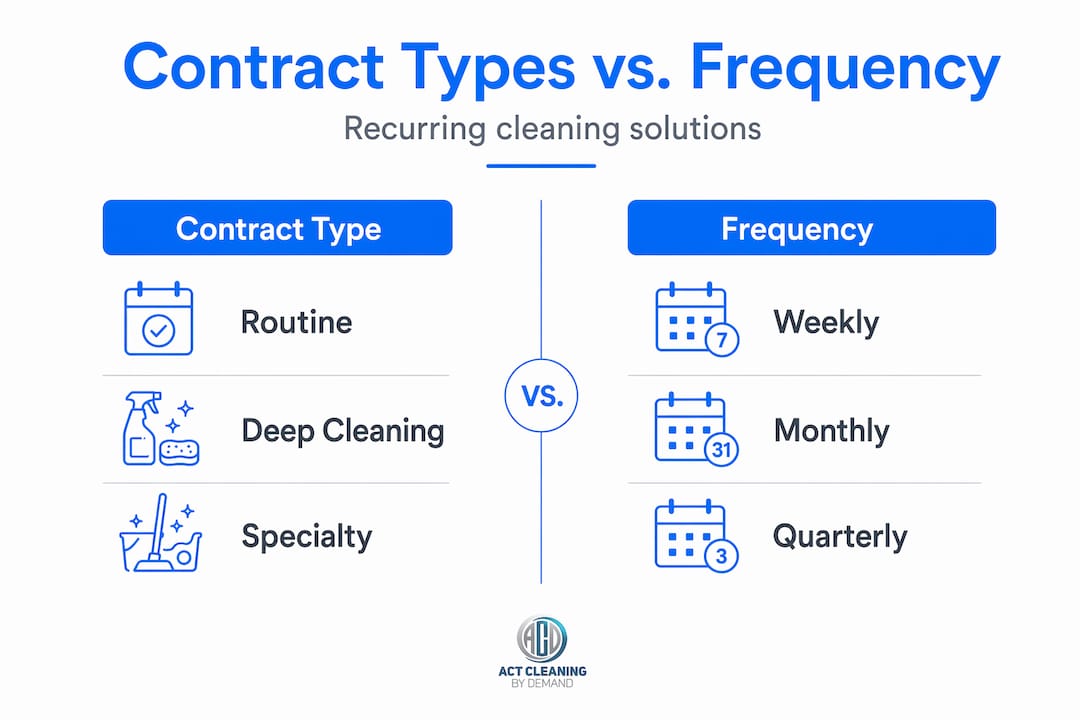
The table below outlines the most common cleaning contract types and where they fit best:
| Contract type | Service frequency | Best suited for |
|---|---|---|
| Routine maintenance contract | Weekly or fortnightly | Commercial offices, retail spaces, medical suites |
| Monthly maintenance contract | Monthly | Strata common areas, residential properties |
| Quarterly deep clean contract | Every three months | High-traffic hospitality and food service venues |
| Bi-annual specialised contract | Twice per year | Carpet and upholstery cleaning, facade washing |
| Annual preventative contract | Once per year | Roof gutters, high-level glass, air vent cleaning |
For a commercial office with 50 staff, you would typically combine a weekly routine maintenance contract with a quarterly deep clean. A strata property with shared corridors and lift areas might run fortnightly common area cleaning alongside an annual window and facade wash.
Pricing varies significantly by frequency and scope. Service packages in urban markets start around $1,000 per month for multi-unit properties, though this scales with the number of areas covered and specialist tasks included.
Pro Tip: When negotiating frequency, start by identifying your highest-traffic areas and build outward. Over-servicing low-use spaces is one of the most common ways businesses overspend on cleaning contracts.
Understanding residential cleaning standards can also help you benchmark expectations for commercial spaces, particularly where properties serve dual residential and commercial functions.
Legal and compliance requirements to check
This is the section most business owners skip, and it is the one that causes the most problems. A recurring cleaning contract must address legal and compliance obligations that protect both you and the people working on your site.
Before signing any long-term cleaning agreement, verify that the following are addressed:
- Public liability insurance: The cleaning provider must hold a current certificate of currency. Contracts should mandate immediate notification of any insurance lapse. If your provider's cover lapses and an incident occurs, your property and business may be exposed.
- Workers compensation cover: All staff performing work on your premises must be covered. Request evidence of current cover at contract commencement and at renewal.
- Police checks and background verification: Particularly relevant for properties where cleaners access sensitive areas, private offices, or residential tenancies. Many templates omit police check requirements, raising operational risks.
- Safety Data Sheets (SDS): Providers must supply SDS documentation for every cleaning chemical used on your site, as required under Australian work health and safety legislation.
- Subcontracting clauses: If your provider uses subcontractors, the contract should specify whether those subcontractors must meet the same verification standards. Understanding subcontracting in cleaning arrangements is critical before signing.
- Exit conditions and auto-renewal terms: Contracts typically run 12 months with 60 to 90 days' notice required to avoid involuntary renewal. Diarise these dates from the moment you sign.
- Escalation and dispute resolution: The contract should specify the process for raising complaints, expected response times, and what constitutes grounds for early termination without penalty.
A property manager overseeing a compliant cleaning programme should also consult resources like this property manager cleanout guide to understand service benchmarks and how to document them properly. Compliance is not just box-ticking. It is how you protect your business if something goes wrong.
My honest take on recurring cleaning contracts
I have seen a lot of property managers sign what they believe is a solid cleaning arrangement, only to find themselves six months in with no documentation trail, missed services that were never rectified, and no practical way to exit the relationship cleanly. In my experience, the governance role of a cleaning contract is almost always underestimated.
Most clients focus on price. They compare quotes, pick the lowest number, and assume the rest will sort itself out. What they miss is that a contract without detailed scope, reporting requirements, and exit conditions is not a contract at all. It is a handshake with extra paperwork.
The most practical shift I have seen in property management is treating recurring cleaning contracts the same way you would treat any other service-level agreement. You would not engage an IT provider or a security firm without specifying deliverables, escalation paths, and compliance requirements. Cleaning should be no different.
What genuinely transforms outcomes is the combination of flat-rate monthly pricing, a building-specific scope schedule, and a documented make-good process. When those three elements are in place, both the property manager and the cleaning provider know exactly what success looks like. That clarity prevents the majority of disputes before they start.
The providers worth working with long-term are the ones who will give you all of this without being asked. If a provider pushes back on adding a scope schedule or declines to provide insurance documentation upfront, that tells you everything you need to know before you sign anything.
— Deng
Reliable recurring contracts with ACT Cleaning by Demand
ACT Cleaning by Demand makes setting up a recurring cleaning contract straightforward for business owners and property managers across Australia. Their customised cleaning packages are built around your specific site requirements, not generic service bundles.
Whether you need ongoing house cleaning services for a residential property or scheduled window cleaning as part of a broader maintenance plan, ACT Cleaning by Demand structures contracts with flat monthly pricing, clear scope schedules, and full compliance documentation. Every engagement is backed by public liability insurance, verified personnel, and eco-friendly cleaning methods that meet Australian safety standards. Contact ACT Cleaning by Demand today to discuss a recurring contract tailored to your property's needs.
FAQ
What is a recurring cleaning contract?
A recurring cleaning contract is a formal ongoing agreement between a client and a cleaning provider that defines the scope of work, service frequency, pricing, and accountability terms. Unlike a one-off booking, it governs the relationship over a set term, typically 12 months.
How does a cleaning contract differ from a quote?
A quote provides pricing only, while a contract specifies accountability, supervision, inspection reporting, and exit conditions. Relying on a quote alone leaves you with no formal mechanism to enforce service standards or resolve disputes.
What should be included in a recurring cleaning contract?
A recurring cleaning contract should include a building-specific scope of work, service frequency, flat monthly pricing, consumables responsibility, make-good provisions for missed services, insurance requirements, personnel verification standards, and exit clauses with notice periods.
How often should recurring cleaning services be scheduled?
Service frequency depends on property type and usage. Commercial offices typically require weekly or fortnightly cleaning, strata common areas often suit monthly schedules, and specialised services such as carpet or window cleaning are commonly contracted quarterly or bi-annually.
What legal requirements apply to cleaning contracts in Australia?
Cleaning providers must hold current public liability insurance and workers compensation cover, supply Safety Data Sheets for all chemicals used, and provide evidence of police checks for personnel accessing sensitive areas. Contracts should require immediate notification of any insurance lapse.
Recommended
- How to retain commercial cleaning clients and boost satisfaction – ACT Cleaning by Demand
- Why commercial cleaning invoicing is complex – ACT Cleaning by Demand
- How cleaning quotes work for Australian homeowners – ACT Cleaning by Demand
- What is subcontracting in cleaning? A Canberra guide – ACT Cleaning by Demand