Switching cleaning providers mid-contract is expensive, stressful, and disruptive for any commercial property manager or business owner. You face retraining new staff, re-explaining site requirements, and managing the inevitable dip in standards during the transition. Clients usually leave due to inconsistency, poor communication, or unmet expectations — not because they found a cheaper option. This guide walks you through proven, practical strategies to keep your cleaning relationships strong, protect your property's cleanliness standards, and avoid the costly cycle of provider turnover that quietly drains time and money from your operation.
Table of Contents
- Understand why clients leave (and stay))
- Set clear expectations with onboarding and a scope of work
- Deliver operational consistency through staff stability and routines
- Communicate and add value beyond basic cleaning
- Why Canberra cleaning contracts are won (and lost) in the details-in-the-details)
- Take the next step: partner with a trusted Canberra cleaning team
- Frequently asked questions
Key Takeaways
| Point | Details |
|---|---|
| Define clear expectations | Comprehensive onboarding and a documented scope prevent misunderstandings and future disputes. |
| Focus on consistency | Retention thrives when the same, well-trained team delivers reliable results through structured routines. |
| Communicate proactively | Monthly check-ins with all client contacts help anticipate issues and reinforce your value. |
| Go beyond the basics | Offer proactive solutions and demonstrate management competence to secure long-term partnerships. |
Understand why clients leave (and stay)
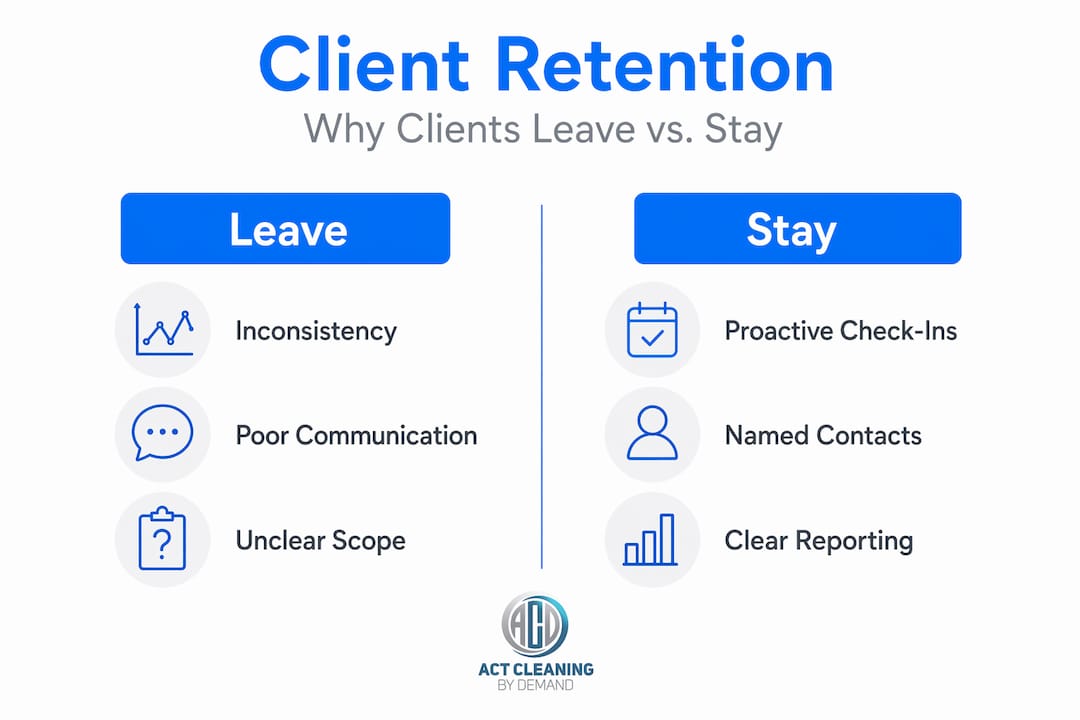
Before you can fix a retention problem, you need to understand what actually drives it. Most property managers assume price is the deciding factor when a client walks. In reality, that assumption leads to the wrong solutions — discounting when you should be communicating, or cutting corners when you should be adding clarity.
Clients often don't leave solely for price. They churn when service is inconsistent or expectations aren't clear. Think about what that means in practice. A client who pays a premium rate will stay loyal if their office reliably looks spotless every Monday morning. The same client will start shopping around if they arrive on Tuesday to find bins unemptied and bathrooms skipped — even if the price is competitive.
The main reasons commercial clients change cleaning providers include:
- Inconsistent results — standards vary from visit to visit, or between different staff members
- Poor communication — complaints go unanswered, no one follows up, issues repeat
- Unclear scope — clients aren't sure what's included and feel shortchanged when extras aren't delivered
- Lack of accountability — no reporting, no feedback loop, no visible quality control
- Staff unfamiliarity — rotating cleaners who don't know the site create errors and security concerns
"The clients who stay longest are those who feel genuinely understood. They know what to expect, they know who to call, and they trust that problems will be fixed — not ignored."
On the flip side, retention levers that work include structured reporting, named account contacts, proactive check-ins, and a clearly documented scope of work. A reliable office cleaning service built on these foundations rarely loses clients to price competition alone.
Set clear expectations with onboarding and a scope of work
Understanding why retention falters, the next step is to prevent the common pitfalls right from the first day. Onboarding is where most cleaning relationships are either set up for success or quietly set up to fail. Get it right and you build a foundation of trust. Get it wrong and you spend the next six months managing complaints that could have been avoided entirely.
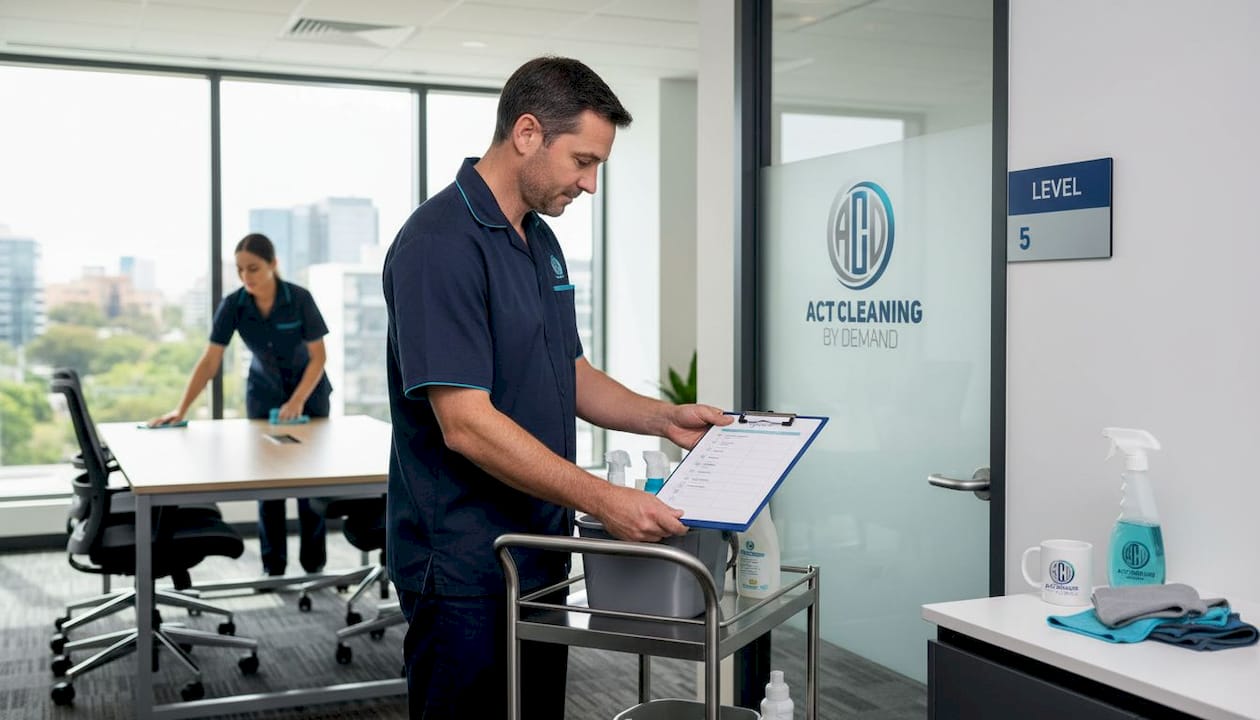
Retention starts during onboarding and commercial clients expect structured reporting from day one. This means your onboarding process needs to be thorough, documented, and mutually agreed upon — not just a verbal handshake and a start date.
Here's a step-by-step approach to onboarding commercial cleaning clients properly:
- Conduct a detailed site walkthrough — visit every area to be cleaned, note special requirements, and identify any access restrictions or compliance needs
- Document the full scope of work — list every task, its frequency, and who is responsible; be explicit about what is excluded as well as what is included
- Agree on reporting methods — decide whether feedback goes via email, a client portal, or a physical logbook; set response time expectations
- Introduce key contacts on both sides — the client should know who their account manager is; you should know who approves extra work or raises complaints
- Schedule a two-week review — check in shortly after starting to catch any misalignments before they become grievances
- Get written sign-off on the scope — a simple email confirmation works; it protects both parties and sets a professional tone
| Onboarding element | Strong outcome | Weak outcome |
|---|---|---|
| Scope documentation | Client knows exactly what's covered | Disputes arise over "missing" tasks |
| Reporting structure | Issues resolved within 24 hours | Complaints escalate or go unaddressed |
| Key contact introductions | Client feels supported and valued | Client doesn't know who to call |
| Written agreement | Shared reference point for both parties | Misunderstandings create friction |
| Early review meeting | Adjustments made before habits form | Problems embed and erode trust |
Pro Tip: Create a site-specific checklist template for each client during onboarding. Laminate it and keep it on-site. It becomes a daily reference for your team and a visible quality tool for the client. For more on how onboarding for cleaning services can shape long-term outcomes, the difference between a structured start and an ad hoc one is measurable within the first month.
Deliver operational consistency through staff stability and routines
Once you've set expectations, the next challenge is delivering on them — every single day. This is where many cleaning operations fall apart. They win the contract with a polished proposal, nail the first few weeks, and then gradually slip as staff turnover kicks in and routines loosen.
HR churn reduces process discipline and shows up as inconsistent results for clients. When a new cleaner arrives at a site they've never seen before, they don't know the quirks: the bathroom that needs extra attention, the boardroom that must be finished before 7am, the area near the server room that requires a dry mop only. That knowledge lives in experienced staff, and when those staff leave, quality dips.
Stable team versus high-turnover team: what clients actually experience
| Factor | Stable cleaning team | High-turnover team |
|---|---|---|
| Site knowledge | Deep familiarity with layout and priorities | Constant relearning; errors repeat |
| Security and access | Trusted, vetted staff known to the client | New faces create concern and friction |
| Task consistency | Routines followed reliably | Variation between visits |
| Client confidence | High; client doesn't need to supervise | Low; client feels they must check everything |
| Issue resolution | Fast; team knows what's normal | Slow; problems aren't recognised |
Routines are the operational backbone of consistent office cleaning delivery. Without them, quality depends entirely on individual motivation — which varies. With them, quality is baked into the process. Build your routines around:
- Daily tasks — bins, surfaces, bathrooms, entry areas; completed every visit without exception
- Weekly tasks — vacuuming, mopping, kitchen deep-clean, glass surfaces
- Monthly or quarterly tasks — floor cleaning routines such as stripping and resealing, deep carpet extraction, high-dusting
- Site-specific priorities — tasks unique to each client that must be flagged and tracked separately
Pro Tip: Track performance metrics for each site. Record completion rates from checklists, note any client complaints by category, and review them monthly. Patterns in the data tell you where your routines are breaking down before the client does.
Communicate and add value beyond basic cleaning
Delivering consistency gets you noticed, but ongoing value and communication turn clients into long-term advocates. Many cleaning providers make the mistake of going quiet once the contract is signed. They show up, do the work, and send the invoice. That's transactional. It works until something goes wrong — and then there's no relationship to fall back on.
Retention is maximised through multi-level contact and monthly check-ins outside routine visits. Here's how to build that communication structure into your operation:
- Map your contacts within each client organisation — identify the facilities manager, the office manager, and any senior stakeholder who cares about cleanliness standards
- Assign a dedicated account manager — one named person who owns the relationship and knows the site inside out
- Schedule monthly check-ins — a 15-minute phone call or brief on-site visit, separate from the cleaning schedule, to discuss satisfaction, upcoming needs, and any changes
- Create a simple feedback mechanism — a short monthly email asking "Is there anything we could do better?" shows you're listening and catches issues before they become reasons to leave
- Document and act on feedback visibly — when a client raises a concern, confirm what you'll do and follow up to confirm it's been resolved
Value-add doesn't mean offering more cleaning hours for free. It means demonstrating competence beyond the mop and bucket. Suggesting improvements to a client's cleaning schedule, flagging a maintenance issue you noticed during a visit, or recommending advanced cleaning offerings like window cleaning to improve the building's presentation — these are the actions that make you indispensable. Similarly, connecting clients with trusted trades like painting services for businesses when you spot wear and tear shows you're thinking about their property, not just your contract.
"The providers who last are the ones who make themselves part of the solution — not just the people who show up with equipment. When a client sees you thinking ahead for them, the relationship changes entirely."
Why Canberra cleaning contracts are won (and lost) in the details
Here's something that experience in the Canberra commercial cleaning market teaches you that no textbook covers: what works in Sydney or Melbourne doesn't always land the same way here. Canberra's commercial sector has a distinct character. Government tenants, professional services firms, and compliance-conscious organisations make up a significant portion of the market. These clients don't just want clean — they want demonstrably clean, with documentation to prove it.
From what we've seen working with Canberra businesses, a few local realities stand out:
- Reliability is scrutinised more heavily than price — a government-adjacent tenant who misses a compliance audit because a bathroom wasn't cleaned properly doesn't care that you saved them $50 a month
- References and track record matter enormously — Canberra's commercial community is smaller and more interconnected than most; reputation travels fast in both directions
- Compliance documentation is non-negotiable — WHMIS data sheets, insurance certificates, and staff vetting records are expected, not optional extras
- Consistency of staff is a security issue, not just a quality one — many Canberra commercial sites have access restrictions and require cleaners to be known, vetted individuals
The common mistake providers make is assuming that a slick proposal and competitive pricing will win and hold a Canberra contract. It might win it. It won't hold it. What holds it is the unglamorous work: the checklist completed every single visit, the complaint answered within two hours, the monthly check-in that catches a problem before it becomes a grievance.
Retention isn't about doing more cleaning — it's about smarter management and communication that make you irreplaceable. That's especially true in a market like Canberra, where the cost of losing a contract is compounded by the reputational damage in a tight professional community.
Our experience at ACT Cleaning by Demand has shown that the clients who stay for years are not necessarily those with the biggest budgets. They're the ones who felt genuinely looked after from day one — whose expectations were set clearly, whose feedback was taken seriously, and whose cleaner knew their site as well as they did.
Take the next step: partner with a trusted Canberra cleaning team
Retaining a reliable cleaning provider isn't just about saving money on transitions — it's about protecting the professional environment your clients, staff, and visitors experience every day. When your cleaning partner understands your site, communicates proactively, and delivers consistent results, you spend less time managing complaints and more time focused on your core business.
At ACT Cleaning by Demand, we build commercial cleaning relationships on exactly the foundations this guide describes: structured onboarding, documented scopes, stable teams, and regular communication. Whether you need a full commercial programme, end of lease cleaning in Canberra for a vacating tenant, or specialist services like commercial window cleaning to lift your building's presentation, we're ready to discuss your specific needs. Reach out today to request a quote or a retention audit of your current cleaning arrangement.
Frequently asked questions
What are the biggest reasons commercial cleaning clients switch providers?
Inconsistency, poor communication, and unclear expectations are the leading reasons commercial cleaning clients leave — price is rarely the primary driver.
Does staff turnover really affect cleaning quality for clients?
Yes. Frequent staff changes disrupt site familiarity and process discipline, and staff churn directly leads to inconsistent results that erode client confidence over time.
How often should cleaning companies check in with commercial clients?
Best practice is to check in monthly with all key client contacts outside of routine cleaning visits, in addition to addressing any issues as they arise.
Can retention be improved without increasing cleaning frequency?
Absolutely. Value-add and retention come from better management, proactive communication, and smarter solutions — not simply adding more cleaning hours to the schedule.