Most cleaning professionals underestimate how much the role of professional cleaning equipment shapes both their profitability and their reputation. The difference between a mop and bucket and a commercial floor scrubber is not just speed. It is the difference between a slip hazard and a dry floor, between a six-hour shift and a two-hour shift, and between winning specialised contracts and losing them to better-equipped competitors. This article unpacks the real operational, safety, and financial impact of professional tools, and shows you how to make smarter equipment decisions for your business.
Table of Contents
- Key takeaways
- Role of professional cleaning equipment in efficiency
- Health, safety, and environmental impact
- Specialised equipment for demanding contracts
- Choosing and maintaining equipment for best results
- My perspective on equipment as a business strategy
- See how equipment-backed cleaning works in practice
- Common questions
Key takeaways
| Point | Details |
|---|---|
| Efficiency gains are dramatic | Ride-on scrubbers clean up to 10 times faster than manual mopping, cutting daily labour costs significantly. |
| Safety is a direct equipment outcome | Commercial scrubbers recover water immediately, eliminating the wet films that cause slip-and-fall incidents. |
| Specialised jobs need specialised tools | Grease-heavy and biohazard contracts require specific machinery and certification; standard tools will not suffice. |
| Maintenance protects your investment | Neglected equipment spreads contamination and breaks down, eroding both hygiene standards and ROI. |
| Right-sizing matters for ROI | Buying equipment that exceeds your facility size wastes capital; matching specs to job type is non-negotiable. |
Role of professional cleaning equipment in efficiency
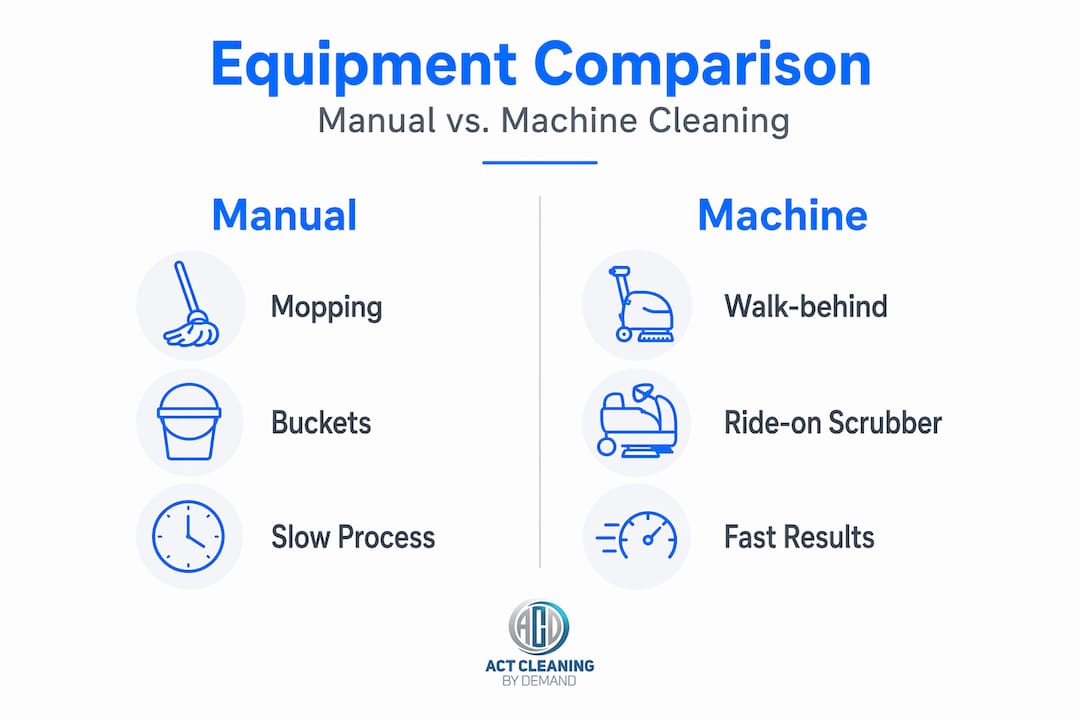
The productivity gap between manual cleaning and machine-assisted cleaning is wider than most business owners expect. Ride-on scrubbers clean 10x faster than manual mopping, and a single machine can cover a 48,000 square foot warehouse in one hour while cutting daily labour costs by $80 to $100 at a $22 per hour labour rate. Walk-behind models still deliver a five to six times speed advantage over hand mopping on smaller floor areas. That is not a marginal gain. That is a fundamental change to how many jobs your team can complete in a day.
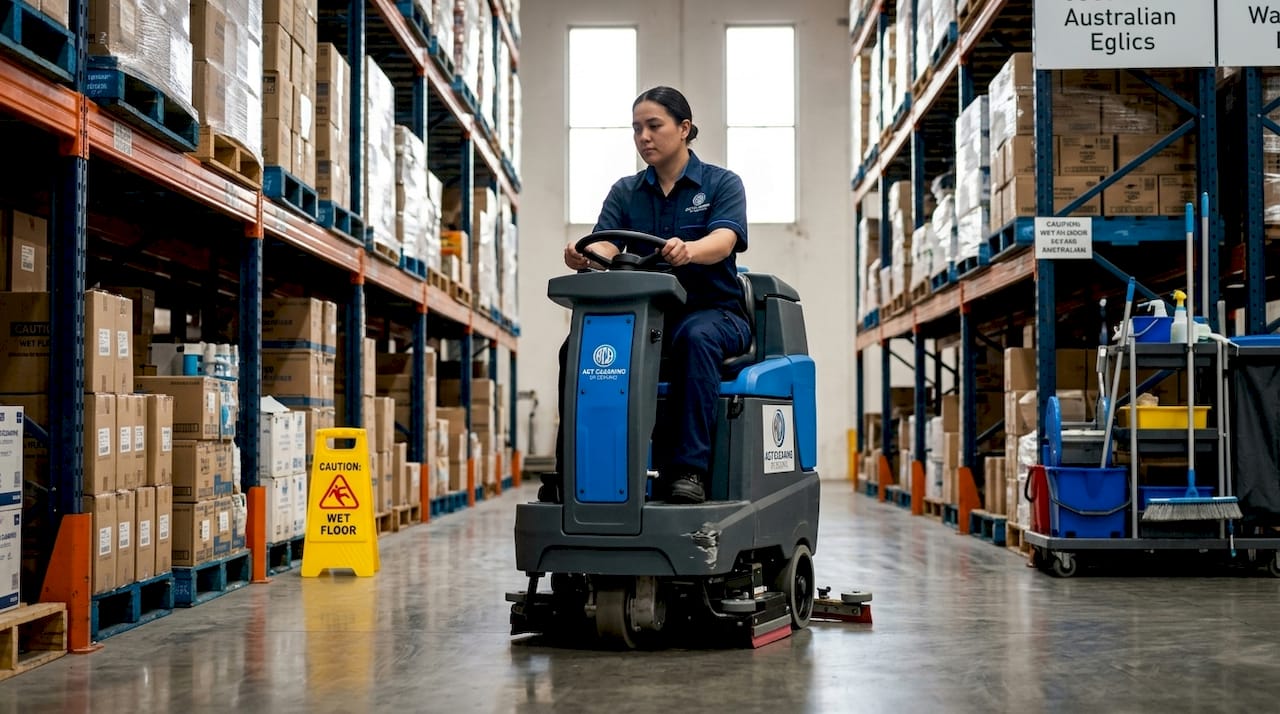
For commercial settings like warehouses, restaurants, and open-plan offices, this speed translates directly into contract profitability. A crew that cleans three sites per shift instead of one is generating three times the revenue with the same headcount. The professional cleaning tools benefits extend beyond speed too. Machine scrubbing produces a more consistent finish than manual methods, which directly affects client satisfaction scores and contract renewal rates.
Matching machine specifications to the job is where many businesses go wrong. A walk-behind scrubber with a 40-litre tank is appropriate for a medium office floor. Putting that same machine into a food processing plant with 2,000 square metres of continuous floor space will mean constant refill stops that eliminate the efficiency advantage entirely. Consider four key variables before purchasing: facility size, floor surface type, power source availability, and the tank capacity required to complete a full cleaning run without stopping.
Pro Tip: When calculating ROI on a ride-on scrubber, factor in the machine's pay-off period by dividing the purchase price by your weekly labour saving. Many facilities recover the investment in under six months.
| Equipment type | Suitable area | Speed vs manual | Approx. cost range (AUD) |
|---|---|---|---|
| Walk-behind scrubber | 200–2,000 m² | 5–6x faster | $3,000–$12,000 |
| Ride-on scrubber | 2,000 m² and above | Up to 10x faster | $15,000–$60,000+ |
| Commercial pressure washer | Exterior and hard surfaces | 4x faster (hot water) | $2,500–$15,000 |
| Robotic scrubber | Predictable open floors | Variable | $25,000–$80,000+ |
Understanding your floor cleaning investment before committing to a machine type will protect your margin and prevent the common mistake of buying capacity you cannot use.
Health, safety, and environmental impact
Professional cleaning equipment does far more than clean faster. It directly manages risk in ways that manual methods simply cannot replicate.
Consider slip-and-fall incidents, one of the most common workplace injuries in Australia. Commercial scrubbers prevent slip hazards by using dual-tank systems that scrub and vacuum simultaneously, leaving floors dry within seconds of the machine passing. A mop, by contrast, applies a wet film that can take 15 to 30 minutes to air dry, creating an extended hazard window. In a busy retail environment or commercial kitchen, that window is genuinely dangerous.
Equipment maintenance is the other side of this safety equation, and it is frequently overlooked. Neglected cleaning tools spread pathogens by becoming vectors of contamination. A vacuum brush not disinfected between jobs can transfer bacteria from one client site to another. Squeegees need rinsing after every use. Machine tanks require daily draining and rinsing to prevent biofilm build-up. These steps are not optional. They are the difference between cleaning and spreading.
Environmental compliance is a growing obligation for professional cleaners, not just a marketing talking point. Wastewater generated by pressure washing and scrubbing must be contained and disposed of according to local council regulations. Chemical selection matters just as much. Using EPA-certified cleaning products reduces liability exposure and demonstrates genuine environmental responsibility to clients who are increasingly scrutinising supplier practices.
Key equipment-related safety and compliance habits every cleaning professional should build into operations:
- Drain and rinse scrubber recovery tanks at the end of every shift
- Disinfect vacuum attachments and brush heads between client sites
- Use colour-coded microfibre cloths to prevent cross-contamination between areas
- Check wastewater containment requirements before any outdoor pressure washing job
- Store chemicals in labelled, sealed containers and follow the product's safety data sheet
"The role of cleaning equipment maintenance protocols extends beyond machine longevity. When you neglect your tools, you are not just risking a breakdown. You are risking your clients' health and your business's reputation."
Specialised equipment for demanding contracts
Standard janitorial equipment is adequate for general commercial cleaning. It is not adequate for grease-laden commercial kitchens, biohazard remediation, or industrial facilities with heavy soiling. Understanding this distinction is how you decide which contracts to pursue and which to pass on.
For restaurant exterior and kitchen exhaust cleaning, equipment specifications are non-negotiable. Hot water pressure washers above 180°F dissolve grease at a molecular level, cutting cleaning time from several hours to under one hour. Systems running at 5.5 to 8 GPM at 3,500 PSI with surface cleaner attachments work four times faster than wand-based methods. A cold water machine in the same environment does not clean grease. It redistributes it. Getting this specification wrong does not just produce a poor result. It can cost you the contract permanently.
Biohazard remediation sits at an even more demanding level. Specialised biohazard contracts require certified machinery and expertise that general cleaning tools cannot provide. Clients in this sector are not negotiating on price. They are making a trust decision based entirely on whether you have the right equipment and the certifications to prove you can use it safely.
Pro Tip: Before quoting on a specialised contract, prepare a written equipment list with model numbers and relevant certifications. Clients in the restaurant and biohazard sectors respond to visible proof of capability far more than they respond to price.
| Contract type | Minimum equipment required | Key specification | Differentiator |
|---|---|---|---|
| Commercial kitchen exhaust | Hot water pressure washer | 180°F+, 3,500 PSI, 5.5–8 GPM | Surface cleaner attachment |
| Biohazard remediation | Certified containment and extraction units | Industry certification required | Documented training records |
| Industrial warehouse | Ride-on scrubber | High tank capacity, scrub width | Battery run-time for continuous use |
| Retail and office | Walk-behind scrubber or auto-scrubber | Noise level, compact width | Low-moisture finish |
For businesses considering specialised residential cleaning needs, the same principle applies. The right machine for the job defines the outcome before a single drop of water hits the floor.
Choosing and maintaining equipment for best results
Buying the wrong equipment is an expensive and common mistake. The decision process needs to be more structured than browsing catalogues and choosing the most impressive-looking machine.
Follow this sequence when evaluating any new equipment purchase:
- Define your cleaning area precisely. Measure the total floor area and map the floor types. A machine that performs brilliantly on sealed concrete may damage polished timber.
- Calculate your tank capacity requirement. A full cleaning run without refilling saves more time than any speed specification on the brochure.
- Assess your power source. Battery-powered machines offer flexibility but require charging management. Mains-powered units suit fixed facilities but restrict movement.
- Account for storage and transport. Ride-on machines require vehicle space and storage. Underestimating logistics adds hidden cost.
- Budget for consumables and maintenance. Squeegee blades, brush pads, and filter replacements are recurring costs that affect the true cost of ownership.
Maintenance overhead and training costs can offset productivity benefits if the facility size does not justify the equipment investment. Robotic scrubbers are a compelling example. They require clear-floor environments, detailed programming, and regular navigation recalibration. They excel at appearance maintenance in predictable spaces but rarely substitute for deep cleaning. Buying one for a complex multi-level facility with varied surfaces and obstacles will produce frustration, not efficiency.
Equipment downtime prevention depends on daily discipline: rinsing recovery tanks, checking squeegee wear, and monitoring brush condition. Skipping these steps compounds quickly. A worn squeegee leaves streaks. A dirty tank develops odour and biofilm. A neglected brush loses scrubbing effectiveness. Each problem makes the machine less useful and the client less satisfied.
Pro Tip: Create a one-page daily maintenance checklist for each machine and laminate it to the machine itself. Staff turnover is high in cleaning businesses, and this ensures new team members follow the correct procedure from day one.
Training is the factor most businesses overlook when investing in new technology. A $40,000 ride-on scrubber operated incorrectly damages floors, wastes chemicals, and creates more work. Allocate formal training time for any new equipment and document the training completion. For guidance on matching equipment approach to specific settings, office cleaning strategies provide practical context for light commercial environments.
My perspective on equipment as a business strategy
I have seen many cleaning businesses invest in equipment for the wrong reasons. The shiny machine at the trade show looks impressive. The sales pitch is compelling. But I have watched operators buy ride-on scrubbers for 500 square metre offices where a walk-behind would have done the job more cost-effectively, simply because the bigger machine felt more professional.
What I have found actually works is treating equipment decisions the same way you would treat a staffing decision. What problem does this machine solve? What will it cost per use over its operational life? Can my current team operate it without significant retraining? These questions cut through the noise quickly.
The most valuable shift I have observed is what happens when you get equipment right. Robotic and automated cleaning tools free staff from repetitive floor work and allow them to focus on detail cleaning, client communication, and quality checks. The role of a professional cleaner changes from machine operator to quality assurance officer. That shift is worth more to a business than the machine itself, because clients notice attentive, communicative cleaners.
My honest warning: do not overestimate ROI without building in training time and maintenance overhead from the start. The productivity number on the spec sheet assumes a well-maintained machine operated by a trained user. Reality is messier. Plan for 80% of the projected gain in year one, and you will be pleasantly surprised rather than disappointed.
— Deng
See how equipment-backed cleaning works in practice
Understanding the theory of professional cleaning equipment is one thing. Seeing it applied consistently across every job is another.
At Com, every service from house cleaning to end of lease cleaning is delivered using industry-grade equipment selected for the specific demands of each job. Canberra homes and businesses receive cleaning solutions built around the right tools, not the cheapest ones. Whether you need a detailed pre-sale clean, a thorough end-of-lease result that satisfies property managers, or regular commercial maintenance that holds up under scrutiny, the equipment behind each service is matched to the outcome you need. Contact the team to discuss a customised programme that reflects your space, schedule, and standards.
Common questions
How much faster is professional equipment than manual cleaning?
Walk-behind scrubbers are 5–6 times faster than manual mopping, and ride-on models can be up to 10 times faster on large open floors. In a 48,000 square foot warehouse, a ride-on scrubber completes the job in approximately one hour.
Does professional cleaning equipment improve hygiene outcomes?
Yes. Commercial scrubbers use dual-tank systems that recover dirty water immediately, eliminating wet residue and reducing pathogen transfer. Equipment maintained correctly prevents cross-contamination between client sites.
What equipment do I need for a commercial kitchen contract?
You need a hot water pressure washer operating at above 180°F with a minimum 3,500 PSI and 5.5 to 8 GPM flow rate. Hot water dissolves grease at a molecular level; cold water systems will not achieve the required standard.
How do I stop cleaning equipment from spreading contamination?
Rinse and disinfect all attachments between sites, drain and rinse recovery tanks daily, and use colour-coded cloths by area. Contamination from dirty tools is a documented risk that disciplined maintenance routines directly prevent.
When does investing in robotic cleaning equipment make sense?
Robotic scrubbers deliver value in large, predictable floor environments with minimal obstacles, but require clear navigation paths and regular recalibration. Training and maintenance overhead can outweigh gains in complex or smaller facilities, so match the technology to your actual operational conditions before purchasing.