Tendering for government cleaning contracts is the formal process of submitting a competitive bid to a government agency, covering scope of work, compliance documentation, pricing, and quality control plans. Public sector cleaning contracts are among the most stable and lucrative opportunities available to Australian cleaning businesses. They often run for five or more years, with base periods plus renewals that can extend a single contract well beyond the initial term. Winning one requires more than a competitive price. It demands meticulous preparation, strict compliance, and a submission that leaves procurement officers with no reason to look elsewhere.
What are the typical requirements for government cleaning tenders?
Government cleaning tenders set a high bar before you even submit a single page. Procurement agencies require contractors to meet mandatory prerequisites, and missing any one of them results in automatic disqualification.
The core requirements fall into several categories:
- Insurance and liability coverage. Public liability insurance is non-negotiable. Most government contracts specify minimum coverage amounts, and you must provide certificates before submission.
- Personnel compliance. Staff must meet Occupational Health and Safety (OHS) standards. Background checks are standard for contracts involving secure or sensitive facilities.
- Supplier registration. Many Australian government agencies require contractors to register on approved supplier databases or procurement portals before a bid is accepted.
- Financial capacity. Contract values ranging from hundreds of thousands to over $22 million AUD mean you must demonstrate the financial capacity to mobilise, cover upfront costs, and sustain operations throughout the contract term.
- Scope understanding. Government contracts cover both recurring tasks (daily cleaning, floor care, restroom sanitation) and non-recurring tasks such as deep cleaning, window cleaning, and emergency cleanups. You must supply all labour, materials, and equipment.
| Requirement | What to prepare |
|---|---|
| Public liability insurance | Current certificate with required coverage limits |
| OHS compliance | Written safety plan and staff training records |
| Supplier registration | Active profile on relevant government portal |
| Financial statements | Recent audited accounts or bank statements |
| Quality Control Plan | Documented procedures for service delivery and monitoring |
Pro Tip: Register on your state or territory's supplier portal well before a tender closes. Registration can take days to process, and a late profile means an invalid bid.
How to prepare a winning cleaning contract bid
A winning tender submission is built before the deadline, not assembled on the day. The preparation process follows a clear sequence.
- Download and read the full tender document. Government solicitations specify every requirement. Read the Statement of Work, evaluation criteria, and submission instructions before doing anything else.
- Attend mandatory briefings or site visits. Some tenders require attendance. Missing a mandatory site visit disqualifies your bid outright, regardless of submission quality.
- Build your Quality Control Plan. Procurement officers prioritise reliability and compliance over lowest price. Your Quality Control Plan must describe how you will monitor service delivery, handle complaints, and correct deficiencies.
- Price accurately using wage determinations. Labour pricing must comply with wage determination statutes or Collective Bargaining Agreements. Factor in annual wage rises, superannuation, and overhead across every year of the contract.
- Prepare all required documents. Assemble insurance certificates, OHS plans, staff credentials, financial statements, and your completed pricing schedule. Missing a single document is grounds for rejection.
- Submit via the official portal before the deadline. Government tenders specify exact submission windows. Electronic submission through secure portals is standard, and the system closes at the stated time with no exceptions.
The table below compares two common approaches contractors take when pricing their bids.
| Pricing approach | Risk level | Outcome |
|---|---|---|
| Price based on current wages only | High | Underprice in later contract years, triggering penalties |
| Price with annual escalation built in | Low | Sustainable margins across the full contract term |
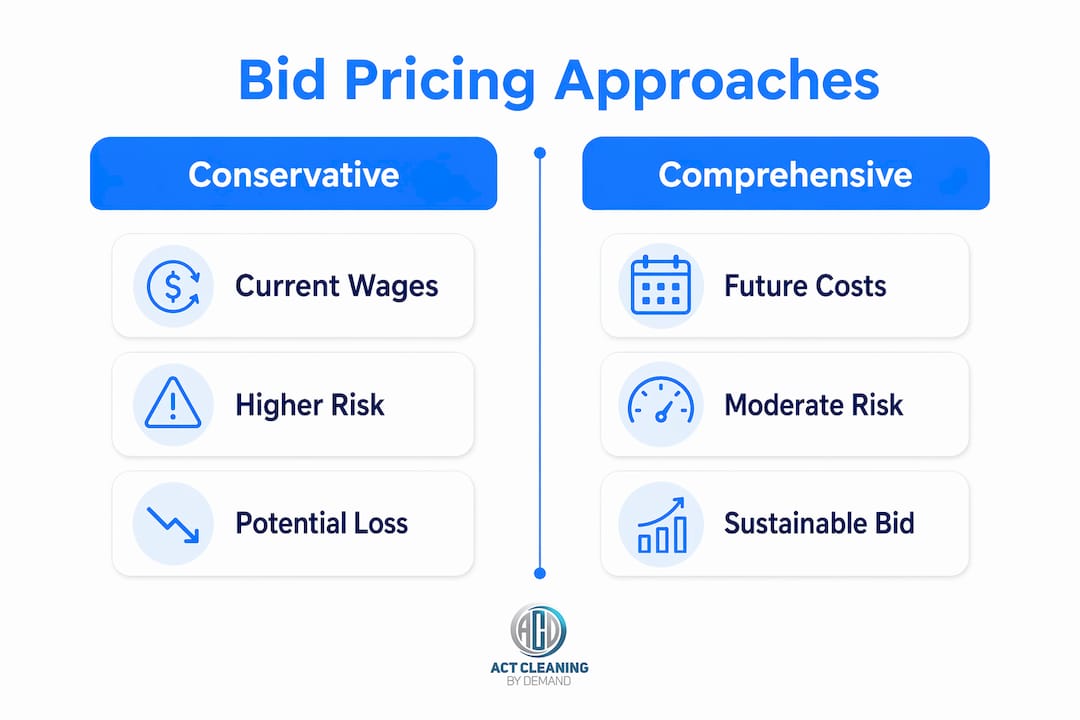
Pro Tip: Use the contract's base period and each option year as separate pricing columns. This forces you to account for cost increases year by year and shows procurement officers you understand long-term contract management.
For contractors who already deliver office cleaning services at a commercial level, the transition to a government scope is largely about documentation and compliance, not capability.
What challenges come with managing government cleaning contracts?
Winning the contract is the start, not the finish. Government facility cleaning contracts carry ongoing obligations that require active management.
- Performance metrics. Agencies monitor service quality through measurable outcomes. Poor performance triggers financial penalties and, in serious cases, contract termination. You need systems in place to track your own performance before the agency does.
- Labour compliance. Wage determinations apply throughout the contract term. Any change in staff rates or classifications must remain compliant. Underpaying workers, even unintentionally, creates legal exposure and contract risk.
- Government-furnished property. Some contracts provide access to government-owned equipment or materials. You are responsible for their care and must document usage and condition.
- Reporting obligations. Contract officers expect regular written reports on service delivery, incidents, and corrective actions. Verbal updates are not sufficient.
- Communication protocols. All formal communication goes through the designated contract officer. Bypassing this chain, even with good intentions, creates compliance issues.
Maintaining client satisfaction in cleaning contracts requires the same discipline in government work as in commercial work, but the consequences of failure are more formal and more costly.
Businesses that work with commercial maintenance partners often find that cross-sector experience in compliance and reporting translates directly into stronger government contract management.
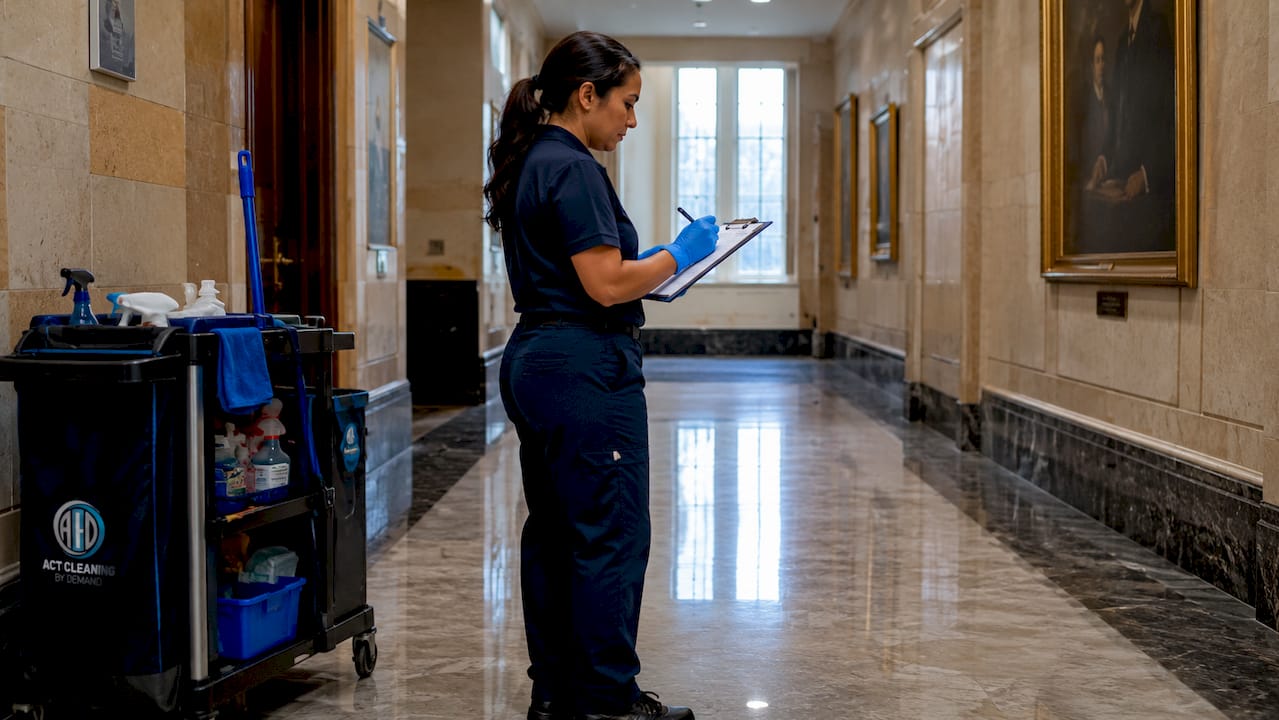
Common mistakes that cost contractors government cleaning bids
The most preventable losses in public sector cleaning contracts come from administrative errors, not from poor cleaning capability. Bid disqualifications most often result from missing paperwork or timing failures, not from service quality concerns.
- Missing the deadline by minutes. Government portals close at the stated time. A submission at 14:01 when the deadline is 14:00 is rejected automatically.
- Incomplete document packages. Every required attachment must be present. Procurement teams do not chase missing documents.
- Underpricing labour. Contractors who price based on current minimum wages without accounting for wage compliance requirements often win the contract and then lose money on it.
- No Quality Control Plan. Submitting a vague or generic plan signals inexperience. Agencies want specific procedures, not general statements about commitment to quality.
- Ignoring set-aside opportunities. Small business set-asides reduce competition significantly. Many contractors overlook these categories and compete against large corporations when they do not need to.
"The contractors who consistently win government cleaning bids are not always the cheapest. They are the ones who submit complete, compliant packages on time and back them up with a credible Quality Control Plan. Procurement officers are risk managers first. Give them a reason to trust you, and price becomes secondary."
Reviewing your floor cleaning capabilities against the contract's scope before submission also prevents the common mistake of bidding on work you cannot deliver at the required standard.
Key takeaways
Winning government cleaning tenders requires complete, compliant submissions backed by a credible Quality Control Plan, accurate wage-based pricing, and active contract management throughout the term.
| Point | Details |
|---|---|
| Meet prerequisites first | Register on supplier portals and confirm insurance before any tender closes. |
| Price for the full term | Build wage escalation and overhead into every option year, not just the base period. |
| Quality Control Plan is critical | Agencies prioritise compliance and reliability over the lowest price submitted. |
| Admin errors disqualify bids | Missing one document or submitting one minute late ends your bid automatically. |
| Target set-aside contracts | Small business categories reduce competition and improve your win rate significantly. |
What I've learned from watching contractors win and lose government tenders
The most common misconception I see is that government cleaning contracts go to the cheapest bidder. They rarely do. Agencies are accountable for public money, and a failed contract costs them far more than a slightly higher price. What they want is certainty. A contractor who submits a thorough Quality Control Plan, demonstrates wage compliance, and shows a track record of consistent delivery gives them that certainty.
The contractors I have seen struggle most are those who treat the tender as a price exercise. They spend hours sharpening their rates and almost no time on their compliance documentation. Then they wonder why a higher-priced competitor won. The answer is almost always in the submission quality, not the number at the bottom of the pricing schedule.
My strongest advice for smaller operators is to target set-aside categories actively. These contracts exist precisely to give smaller businesses a fair shot, and too many contractors do not even look for them. A set-aside contract with lower competition is worth far more than a full-competition tender where you are one of forty bidders.
Persistence matters too. Most contractors do not win their first government bid. The feedback from a failed submission is genuinely useful if you ask for it. Use it, refine your next submission, and keep going.
— Deng
Professional cleaning services built for contract-level standards
Government contracts demand consistent, documented, and professional cleaning delivery. ACT Cleaning by Demand offers office cleaning packages designed to meet the standards expected in formal contract environments, with customisable service schedules and clear reporting. For contracts that include specialist tasks, ACT Cleaning by Demand also provides window cleaning services and a full range of custom cleaning packages suited to government-level scopes. Whether you are building your service capability or looking for a reliable subcontractor, ACT Cleaning by Demand delivers the quality and consistency that government contracts require.
FAQ
What documents are needed to tender for a government cleaning contract?
Most government cleaning tenders require public liability insurance certificates, an OHS compliance plan, staff credentials, financial statements, and a written Quality Control Plan. Missing any one of these results in automatic disqualification.
How long do government cleaning contracts typically run?
Government cleaning contracts commonly include a base period plus four or five one-year renewal options, meaning a single contract can run for five or more years in total.
Why do low-price bids lose government cleaning tenders?
Procurement officers prioritise reliability and compliance over price alone. A bid with a strong Quality Control Plan and demonstrated wage compliance consistently outperforms a cheaper submission with weak documentation.
What are set-aside contracts and should I pursue them?
Set-aside contracts are reserved for small businesses or specific business categories, which reduces competition from large corporations. They represent a practical way for smaller cleaning operators to improve their win rate in government procurement.
What happens if I fail to meet performance standards during a government cleaning contract?
Poor performance triggers financial penalties and can lead to contract termination. Agencies monitor delivery against measurable metrics, so contractors need internal quality control systems to identify and fix issues before the agency does.