
Scheduling in cleaning services is defined as the systematic planning of cleaning tasks by time, location, and assigned personnel to deliver consistent, reliable results. Without it, labour costs blow out, hygiene standards slip, and clients lose confidence fast. The role of scheduling in cleaning services extends well beyond putting names on a roster. It governs how efficiently your team moves, how reliably clients receive service, and whether your operation turns a profit or bleeds money through wasted travel and missed visits. Get it right, and scheduling becomes the engine that runs everything else.
How does scheduling improve labour efficiency and reduce costs?
Unoptimised cleaning schedules cause 25–35% of paid labour hours to vanish into transit time. Optimised routes keep that figure under 15%. That gap represents real money: a two-person crew earning $18 per hour can recover $288 per week simply by lifting billable time utilisation from 60% to 75%.
The biggest culprit is random job assignment. When cleaners drive across town between each appointment, you pay for windshield time that generates zero revenue. Zone-based scheduling fixes this by assigning geographic areas to specific days, cutting travel between client locations from 20–40 minutes down to 5–15 minutes. That recovered time goes straight back into billable cleaning hours.

Manual scheduling compounds the problem. Businesses relying on spreadsheets and phone calls lose 8–12 hours weekly to cancellation handling and route reorganisation alone. Automated scheduling systems verify availability instantly and assign the right staff without back-and-forth. The return on investment typically arrives within 30–60 days.
Key efficiency gains from structured scheduling include:
- Reduced transit time by grouping jobs geographically rather than scattering them across a city
- Higher billable hours through tighter route planning and less idle time between appointments
- Fewer scheduling errors because automated systems flag conflicts before they become problems
- Lower administrative overhead by shifting daily planning into exception management
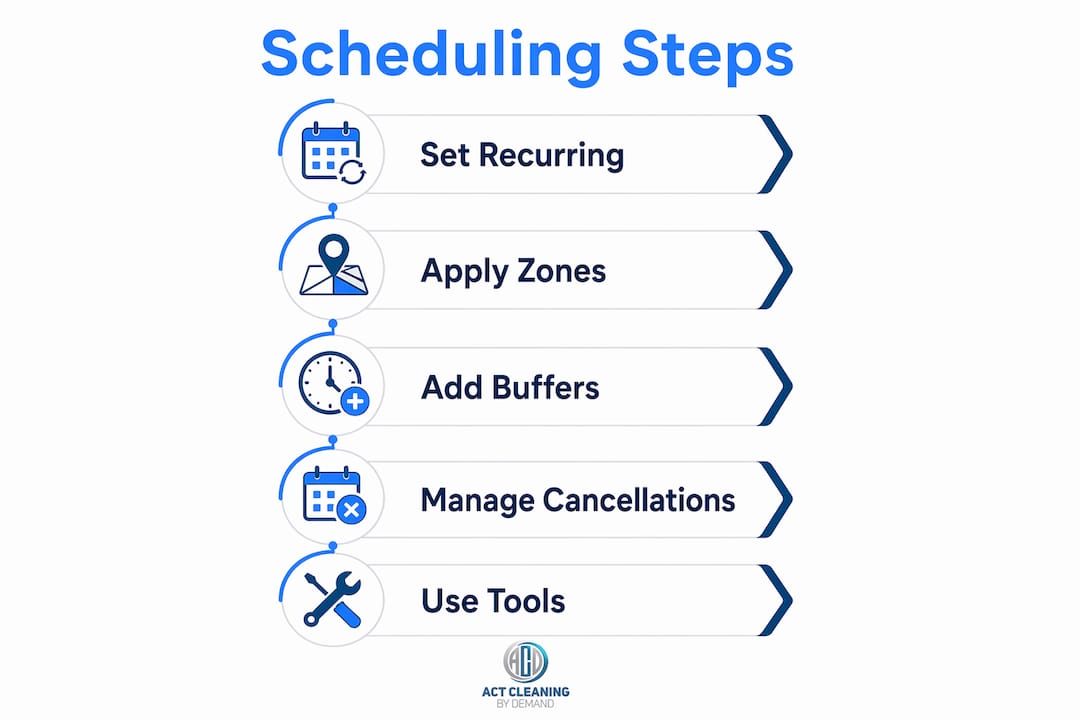
Pro Tip: Add a 15–30 minute buffer between every appointment. One overrun job can cascade delays through your entire day. Buffer time acts as a pressure valve that protects your schedule from a single client running long.
What role does scheduling play in maintaining cleaning quality?
Consistent scheduling prevents dirt and allergen buildup by turning cleaning into background maintenance rather than a crisis response. Spaces cleaned on a predictable cycle stay healthier. Allergens and bacteria do not get the chance to accumulate between visits.
The accountability dimension matters just as much as the hygiene outcome. When tasks are assigned to specific people at specific times, completion logs become possible. Managers can verify that every area was cleaned, not just the visible ones. This proof of service is critical for commercial clients, property managers, and anyone subject to health or safety inspections.
"Scheduling creates accountability and is foundational for hygiene, turning cleaning into a background maintenance system rather than a crisis task."
Breaking large cleaning jobs into daily routines also reduces the physical and cognitive load on cleaners. A weekly deep clean of a commercial kitchen feels manageable when daily tasks keep grease and grime from building up. The impact of scheduling on cleaning quality is most visible in spaces where hygiene standards are non-negotiable, such as medical facilities, food preparation areas, and childcare centres.
Structured scheduling supports:
- Task accountability through named assignments and completion records
- Regulatory compliance by ensuring required cleaning frequencies are met and documented
- Consistent hygiene outcomes by preventing the accumulation that makes deep cleaning necessary
- Client confidence because predictable service builds trust over time
Which scheduling strategies handle cancellations and last-minute changes?
Same-day cancellations are a major margin killer in cleaning operations. Residential businesses risk 3–6% annual revenue loss from missed visits and client churn that traces back to poor cancellation management. The fix is not just faster responses. It is building systems that reduce the damage before it happens.
A published 24-hour cancellation policy changes client behaviour. When clients know a late cancellation incurs a fee, they reschedule earlier. That gives you time to fill the slot rather than absorb the loss. The policy works as a nudge, not a punishment.
Automated cancellation-to-refill workflows go further. When a booking drops, the system immediately checks availability and offers the slot to waitlisted clients or adjusts the day's route. This process, done manually, can consume 20–30 minutes per cancellation. Done automatically, it takes seconds.
Pro Tip: Track "admin minutes per cancellation" as a scheduling health metric. Best practice targets fewer than 5 minutes per cancellation. If your team is spending 20 minutes managing each one, that is a signal to automate, not hire.
Key cancellation management tactics:
- Publish a 24-hour notice policy and enforce it consistently to reduce last-minute losses
- Automate refill workflows so cancelled slots are offered to other clients without manual effort
- Measure admin minutes per cancellation to identify where your process breaks down
- Track cancellation rates by client to spot patterns before they become churn
How can you apply scheduling to maximise reliability and cost-effectiveness?
The most profitable cleaning operations treat scheduling as exception management, not daily planning. They set up recurring appointment series for 6–12 months at a time. The question "who works tomorrow?" disappears because the answer is already locked in. Managers intervene only when something changes, such as a sick day or a client cancellation.
Build recurring series first
Set up every regular client as a recurring booking from the start. A fortnightly house clean booked for the next 12 months costs you one scheduling decision. Booking it week by week costs you 26. The time saving compounds quickly across a full client list.
Apply zone-based scheduling
Solo cleaners using zone scheduling average 3–5 residential cleans daily with minimal driving. Teams handling multiple jobs need the same logic applied at scale. Assign Monday to the northern suburbs, Tuesday to the east, and so on. Clients in each zone get consistent service days, and your team never crosses the city twice in one shift.
Use scheduling tools that match your scale
Entry-level field apps suit sole operators managing fewer than 10 regular clients. They handle basic recurring bookings and route views. As your client list grows past 20–30 regulars, the complexity of managing durations, staff availability, and geographic zones exceeds what a spreadsheet can handle. Automated scheduling systems verify availability instantly and assign appropriate staff, which manual methods cannot match in markets where same-day service requests are now standard.
The table below shows how scheduling approaches compare across different operation sizes:
| Operation size | Recommended approach | Key benefit |
|---|---|---|
| 1–5 clients | Manual recurring bookings | Low overhead, easy to manage |
| 6–20 clients | Entry-level field app | Route visibility, basic automation |
| 21+ clients | Automated scheduling platform | Real-time availability, zone management |
| Multi-crew commercial | Enterprise scheduling system | Staff coordination, compliance logging |
Pro Tip: For residential clients, offer a fixed service day rather than a flexible window. Clients value predictability, and fixed days make zone scheduling far easier to maintain.
Cleaning service time management also improves when you schedule cleaning tasks around client-specific constraints. A commercial office needs cleaning outside business hours. An end-of-lease clean must align with handover dates. Building these constraints into your recurring series from day one prevents conflicts later.
Key takeaways
Effective scheduling is the single most controllable factor in cleaning service profitability, quality, and client retention.
| Point | Details |
|---|---|
| Zone-based routing cuts costs | Grouping jobs geographically reduces travel from 40 minutes to under 15 minutes between appointments. |
| Recurring series reduce admin | Booking 6–12 months ahead turns daily planning into exception management, saving hours each week. |
| Buffer time protects the day | A 15–30 minute gap between jobs prevents one overrun from cascading through your entire schedule. |
| Cancellation policies save revenue | A 24-hour notice policy and automated refill workflows reduce the 3–6% annual revenue loss from missed visits. |
| Consistent schedules improve hygiene | Regular cleaning cycles prevent allergen and bacterial buildup, turning cleaning into maintenance rather than crisis response. |
Why scheduling is the part most cleaning businesses get wrong
I have seen cleaning operations with excellent staff and great products consistently underperform because their scheduling was a mess. Jobs scattered across a city, no buffer time, cancellations handled by phone tag. The cleaners were not the problem. The system was.
The mistake I see most often is treating scheduling as an administrative task rather than a profit lever. When you map out the numbers, the efficiency gains from residential scheduling are not marginal. Recovering $288 per week per crew from better route planning is $14,976 per year. That is not a scheduling tweak. That is a business decision.
The second mistake is ignoring buffer time until something goes wrong. Every experienced operator I have spoken with says the same thing: they added buffers after one bad day taught them the lesson. Build them in from the start.
Automation gets resisted because it feels like overhead. It is the opposite. In markets where clients expect same-day booking and instant confirmation, manual scheduling cannot keep up. The businesses that automate early hold a real advantage in client retention and staff satisfaction. Cleaners who spend less time waiting for instructions and more time on productive work stay longer.
The uncomfortable truth is that most scheduling problems are not solved by working harder. They are solved by designing a better system and then letting it run.
— Deng
Reliable cleaning starts with a schedule that works
Com (ACT Cleaning by Demand) builds every service around structured scheduling that removes the guesswork from reliable cleaning. Whether you need a regular fortnightly house cleaning service or a one-off end-of-lease clean timed to your handover date, Com's booking process locks in your service day from the start. Clients get consistent service windows, and every job is assigned to the right team for your location. If you are ready to stop managing cleaning reactively and want a service that shows up when it says it will, Com is the place to start.
FAQ
What is the role of scheduling in cleaning services?
Scheduling in cleaning services is the systematic planning of tasks by time, location, and assigned staff to deliver consistent, reliable results. It directly controls labour costs, hygiene outcomes, and client satisfaction.
How does zone-based scheduling reduce cleaning costs?
Zone-based scheduling assigns geographic areas to specific days, cutting travel time between jobs from 20–40 minutes down to 5–15 minutes. That recovered time converts directly into billable cleaning hours.
How often should recurring cleaning schedules be set up?
Setting up recurring schedules for 6–12 months at a time reduces daily administrative overhead significantly. It shifts scheduling from daily planning into exception management, freeing up hours each week.
Why does buffer time matter in a cleaning schedule?
A 15–30 minute buffer between appointments prevents one delayed job from pushing back every subsequent booking. Without it, a single overrun cascades through the entire day.
How can cleaning businesses reduce revenue loss from cancellations?
Publishing a 24-hour cancellation policy and using automated refill workflows reduces the 3–6% annual revenue loss linked to missed visits. Tracking admin minutes per cancellation below 5 minutes is the operational benchmark to aim for.