
Choosing the right types of commercial cleaning equipment is one of the most consequential decisions a facility manager makes. Get it wrong and you're looking at inefficient cleaning cycles, operator fatigue, and floors that never quite meet the standard you need. Get it right and your team works faster, your facility looks better, and your costs stay predictable. This guide covers every major category of commercial cleaning machine, explains how they compare across facility sizes and cleaning needs, and gives you the practical framework to make a smarter purchase decision.
Table of Contents
- Key takeaways
- What to consider before choosing commercial cleaning equipment
- 1. Walk-behind floor scrubbers
- 2. Ride-on floor scrubbers
- 3. Sweeper-scrubber combos
- 4. Carpet cleaners and extractors
- 5. Industrial sweepers
- 6. Floor polishers and burnishers
- 7. Robotic floor cleaners
- 8. Wet and dry vacuums
- 9. Steam cleaners
- 10. Pressure washers
- Comparing equipment by facility size and cleaning needs
- Emerging and specialised equipment worth knowing
- My take on choosing the right equipment
- Let ACT Cleaning by Demand support your facility
- FAQ
Key takeaways
| Point | Details |
|---|---|
| Match machine to facility size | Walk-behind scrubbers suit areas under 10,000 sq ft; ride-on models work best at 15,000 sq ft and above. |
| Total cost of ownership matters | Upfront price is only part of the equation. Factor in consumables, maintenance, and labour impact. |
| Most operations need multiple machines | A single machine type rarely covers all cleaning tasks; plan for a mixed equipment system. |
| Consumable quality affects results | Worn pads, brushes, and squeegee blades reduce performance even when the machine itself is appropriate. |
| Robotics require operational planning | Autonomous cleaners need scheduling, charging logistics, and reporting management to deliver real value. |
What to consider before choosing commercial cleaning equipment
Before you compare brands or request quotes, you need a clear picture of your facility's actual requirements. The market is full of capable machines, but the wrong tool for your environment will cost you time and money regardless of its spec sheet.
Key factors to evaluate include:
- Floor and surface type. Hard floors, carpet, tile grout, and outdoor pavement all need different tools. A commercial floor scrubber designed for sealed concrete will underperform on carpet.
- Facility size and layout. Square footage guides machine category. Tight corridors, lifts, and mixed-use spaces affect which models are physically practical.
- Cleaning tasks required. Dust and debris collection, wet scrubbing, stain removal, sanitisation, and surface polishing are distinct functions. Not every machine does all of them.
- Operator considerations. Walk-behind machines are physically demanding over large areas. Operator fatigue is a real productivity cost, not just a comfort issue.
- Coverage rate requirements. How much floor does your team need to clean per shift? Coverage rates in square feet per hour determine whether a machine keeps pace with your schedule.
- Budget and total cost of ownership. TCO matters more than the sticker price. Commercial-grade equipment has higher durability and lower failure rates than residential alternatives, which changes the long-term maths significantly.
- Maintenance and consumables. Pads, brushes, and squeegee blades wear out. Quality consumables directly affect cleaning outcomes, and sourcing them easily should factor into your machine selection.
Pro Tip: Before speaking to a supplier, map out your facility's square footage, floor types, and peak cleaning windows. This single step eliminates at least half the machines on any shortlist.
1. Walk-behind floor scrubbers
Walk-behind floor scrubbers are the workhorse of indoor commercial cleaning for small to medium facilities. The operator walks behind the machine while it scrubs, rinses, and vacuums up dirty water in a single pass. They are compact enough to handle corridors and smaller retail spaces, and most are available in corded electric, battery, and propane configurations.
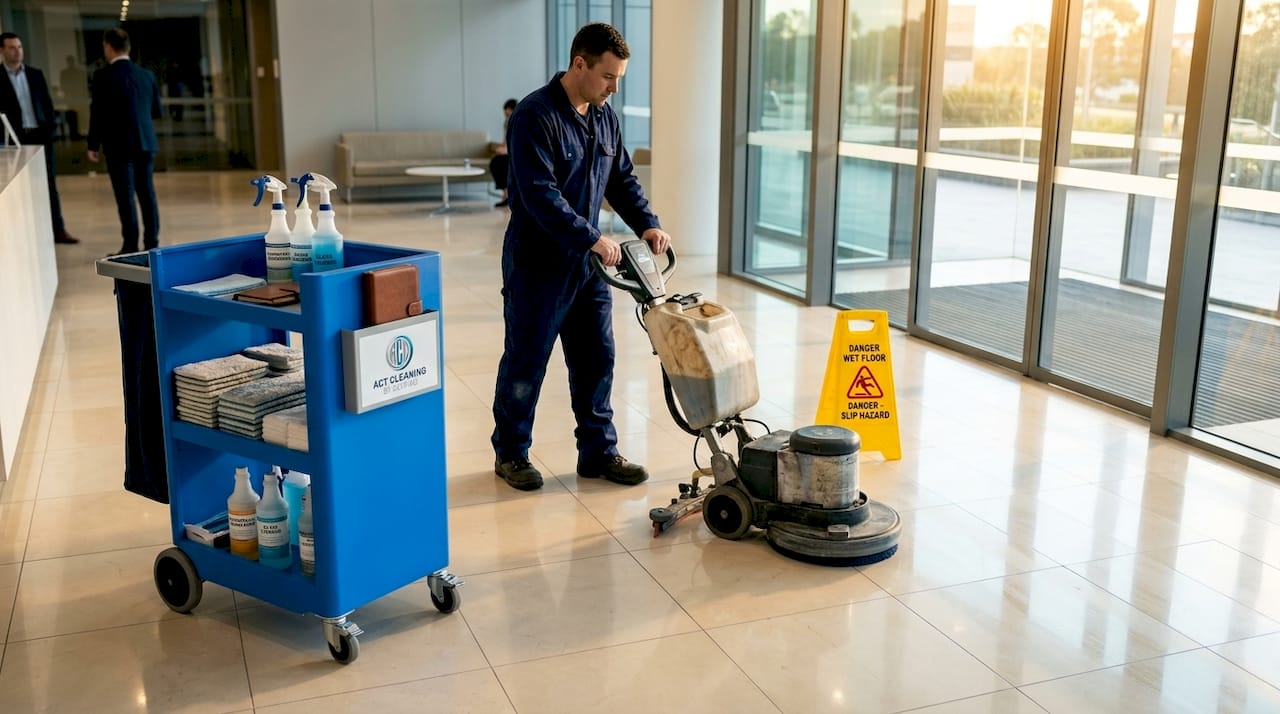
These machines suit facilities under 10,000 sq ft and are a practical starting point for offices, small retail stores, and medical clinics. They are lower cost than ride-on models and easier to train staff on quickly.
2. Ride-on floor scrubbers
When your facility runs to 15,000 sq ft or more, a walk-behind scrubber becomes a labour bottleneck. Ride-on scrubbers handle 40,000+ sq ft per hour, which makes them the right tool for warehouses, logistics centres, large retail floors, and hospital wings.
The productivity advantage is substantial. An operator sitting in a ride-on machine experiences far less fatigue than someone pushing a walk-behind across a 5,000 square metre floor. Ride-on scrubber-dryers are also designed to clean and dry in fewer passes, which is critical in high-traffic areas that need to reopen quickly after cleaning.
3. Sweeper-scrubber combos
A sweeper-scrubber combines debris collection and wet scrubbing into a single machine pass. Without this combination, operators would need to dry-sweep first and then scrub, effectively doubling the time on large floor areas.
These machines are particularly useful in industrial environments where there is both loose debris and ground-in grime on the same floor. Manufacturing floors and distribution centres see the most benefit. The trade-off is that combo machines are heavier and more expensive than either function alone, so they make most sense when both tasks occur on the same surface regularly.
4. Carpet cleaners and extractors
Carpet extractors inject hot water and cleaning solution into the carpet pile, then extract it back along with embedded dirt. They range from compact portable units for smaller spaces to truck-mounted systems for large-scale commercial carpet cleaning.
Portable machines suit limited-access buildings, while truck-mount systems deliver high-pressure power for open, large areas. For day-to-day carpet maintenance between deep cleans, encapsulation machines use a low-moisture polymer that crystallises around soil particles for easy vacuuming.
Offices, hotels, aged-care facilities, and any commercial space with significant carpet coverage should have an extraction solution in their equipment mix.
5. Industrial sweepers
Industrial sweepers are built for bulk debris collection across large outdoor and semi-outdoor areas such as car parks, loading docks, and factory floors. They collect dust, gravel, packaging waste, and other dry debris into a hopper without requiring water.
Walk-behind versions handle smaller paved areas, while ride-on industrial sweepers cover large outdoor hardstand efficiently. These are not the right tool for wet scrubbing, but they are unmatched for fast, dry debris removal at scale.
6. Floor polishers and burnishers
These machines restore and maintain the appearance of hard floors such as vinyl composition tile (VCT), terrazzo, and polished concrete. Buffers operate at 175 to 350 RPM for general scrubbing and polishing, while burnishers run at 1,500 to 3,000 RPM to produce a high-gloss finish.
The distinction matters for purchasing. A buffer is a multi-purpose machine for scrubbing and light polishing. A burnisher is a finish-specific machine for appearance-critical environments like retail showrooms, hotel lobbies, and hospital corridors where floor shine is part of the brand presentation.
7. Robotic floor cleaners
Robotic cleaners represent the most significant shift in commercial cleaning tools over the last decade. They navigate autonomously, follow programmed routes, and can operate overnight or during low-traffic periods without a human operator present.
The Sanitaire PUDU CC1, as one example, covers 7,535 to 10,764 sq ft per hour and recharges in under three hours. The productivity numbers are real, but robotics are not a plug-and-play solution. Operators must manage scheduling, recharging cycles, and reporting systems for the machines to deliver on their promise. Budget for the operational overhead, not just the purchase price.
Pro Tip: Robotic cleaners work best as a complement to a human cleaning programme, not a replacement. Use them for routine overnight scrubbing and reserve your team for detail work and compliance-critical areas.
8. Wet and dry vacuums
Wet-dry vacuums handle both liquid spills and dry debris, making them one of the most versatile tools in any commercial cleaning toolkit. A spill near electrical equipment, a flooded bathroom, or a construction clean-up are all jobs a standard dry vacuum cannot handle safely.
Filtration choices matter significantly here. Facilities dealing with fine dust, allergens, or regulated particulates need HEPA-filter vacuums in addition to standard wet-dry units. Many commercial facilities use both types for different tasks rather than trying to find one machine that handles everything.
9. Steam cleaners
Steam cleaners sanitise surfaces using high-temperature steam without requiring chemical detergents. This makes them a genuinely useful tool in food processing environments, commercial kitchens, aged-care facilities, and anywhere that chemical residue is a concern.
They are not high-volume floor cleaning machines. Steam cleaners excel at grout lines, equipment surfaces, toilet areas, and detail work where chemical-free sanitisation is a priority. From an environmental standpoint, they reduce the volume of cleaning chemicals your operation consumes, which aligns with the growing push toward eco-responsible facility management.
10. Pressure washers
Pressure washers use high-pressure water to blast debris, algae, grease, and grime from outdoor surfaces. Car parks, building facades, loading docks, outdoor dining areas, and perimeter pathways all benefit from periodic pressure washing.
Commercial-grade pressure washers produce significantly more output than consumer models, operating at pressures that remove even stubborn biological growth from paving. They are outdoor and semi-outdoor tools. Bringing a pressure washer onto an interior floor is the wrong application for the job and will create more problems than it solves.
Comparing equipment by facility size and cleaning needs
Choosing between machine categories comes down to matching productivity output to your actual cleaning load. Here is a practical reference:
| Facility type | Recommended machine types | Coverage benchmark |
|---|---|---|
| Small office (under 500 sq m) | Walk-behind scrubber, wet-dry vacuum, steam cleaner | 10,000 to 30,000 sq ft/hr |
| Mid-size retail or clinic | Walk-behind or self-propelled scrubber, carpet extractor | 10,000 to 30,000 sq ft/hr |
| Large warehouse or logistics centre | Ride-on scrubber, industrial sweeper, sweeper-scrubber combo | 40,000+ sq ft/hr |
| Hospital or aged-care facility | Ride-on scrubber, HEPA vacuum, steam cleaner, robotic cleaner | Mixed, compliance-driven |
| Outdoor car park or loading dock | Industrial sweeper, pressure washer | Area and debris volume dependent |
The right scrubber choice is not just about what fits in the budget. It shapes labour requirements, shift length, and whether your floors actually meet hygiene standards by the time the building opens each morning.
Beyond the machine category, consider how filling and recharging cycles affect your team's working time. Labour impact from machine downtime is a hidden cost that many buyers overlook until it shows up in their cleaning schedule.
Most cleaning operations use a mix of machine types rather than relying on a single category. A warehouse might run a ride-on scrubber for the main floor, an industrial sweeper for the loading dock, and a wet-dry vacuum for spot work. That mix is normal and sensible.
Emerging and specialised equipment worth knowing
The category of janitorial equipment has expanded considerably in recent years. A few developments are worth your attention in 2026.
Robotic cleaners are moving from novelty to operational tool in facilities with consistent floor layouts and predictable traffic patterns. The scheduling and reporting capabilities add a layer of accountability that manual cleaning cannot easily match.
Encapsulation carpet machines sit between a full extraction clean and routine vacuuming. They are faster than extraction, use minimal moisture, and extend the interval between deep cleans. For high-traffic carpeted offices on a tight maintenance schedule, they are a practical middle ground.
Cordless multi-surface floor cleaners have improved to the point where they are viable for small commercial spaces and detail areas. They are not replacing full-sized machines, but they fill gaps in a cleaning workflow effectively.
Pro Tip: Before adding a robotic cleaner to your equipment mix, walk your facility with a supplier and map every obstacle, threshold, and tight corner. Layouts that seem simple often have features that limit autonomous navigation in ways that are only obvious on-site.
My take on choosing the right equipment
I've worked closely with enough facility managers to know that equipment decisions go wrong in a predictable way. Buyers focus on the machine and forget everything around it. The consumables, the parts availability, the supplier support, the operator training. A technically excellent machine that uses proprietary pads you can't source locally is a liability, not an asset.
My honest advice: buy for the workflow, not the spec sheet. A mid-range ride-on scrubber that your team uses confidently every day will outperform a premium machine that sits partially charged in the corner because operators find it complicated.
I also think most operations underinvest in their secondary equipment. The main floor scrubber gets the budget; the vacuums, steam cleaners, and spot treatment tools get whatever is left. In practice, the secondary tools are often what determines whether a facility passes a hygiene inspection, because they handle the detail work that a large floor machine physically cannot reach.
Budget for flexibility. The facilities that manage cleaning costs well over time are the ones that built a mixed system from the start rather than trying to solve everything with one machine category.
— Deng
Let ACT Cleaning by Demand support your facility
If you manage a commercial facility in the ACT region, choosing the right equipment is only part of the picture. Trained professionals using the right tools consistently produce results that self-managed cleaning programmes struggle to match.
ACT Cleaning by Demand delivers tailored professional office cleaning services designed around the specific needs of business facilities, from routine maintenance cleans to specialised deep cleans. The team also provides commercial window cleaning that complements a full facility maintenance programme. Every service is customised, eco-conscious, and backed by a track record of strong client relationships across Canberra. If you want consistent results without the overhead of managing equipment and staff yourself, explore what ACT Cleaning by Demand can deliver for your business.
FAQ
What are the main types of commercial cleaning equipment?
The 10 main categories include walk-behind floor scrubbers, ride-on floor scrubbers, sweeper-scrubber combos, carpet extractors, industrial sweepers, floor polishers and burnishers, robotic cleaners, wet-dry vacuums, steam cleaners, and pressure washers.
How do I choose between a walk-behind and ride-on scrubber?
Facility footprint drives this decision: walk-behind scrubbers suit areas under 10,000 sq ft, self-propelled models work from 10,000 to 30,000 sq ft, and ride-on scrubbers are the right choice at 15,000 sq ft and above.
Do robotic floor cleaners replace human cleaning staff?
No. Robotic cleaners work best as a complement to a human cleaning programme, handling scheduled routine scrubbing while staff focus on detail work, compliance areas, and tasks that require judgement.
Why does total cost of ownership matter more than purchase price?
Commercial-grade equipment has higher durability and lower failure rates than residential machines, but consumables, maintenance, and labour costs accumulate significantly over time. Evaluating TCO prevents false savings from cheap upfront choices.
What cleaning equipment suits a standard office environment?
A walk-behind floor scrubber or self-propelled model, a HEPA-filter vacuum, a carpet extractor for carpeted zones, and a steam cleaner for kitchens and bathrooms covers the core cleaning needs for offices of most sizes.