Signing an office cleaning agreement without reading the fine print is where most workplace disputes begin. Vague language like "regular cleaning" or "as required" leaves too much room for interpretation, and when expectations aren't met, it's usually your business that absorbs the cost. Understanding what does an office cleaning contract cover protects your facilities, your staff, and your budget from the outset. This guide breaks down every significant element you should expect to see in a contract, from the scope of work through to insurance, staffing, and termination clauses.
Table of Contents
- Key takeaways
- What an office cleaning contract covers: scope and schedule
- Pricing, billing, and contract duration
- Health, safety, insurance, and compliance
- Staffing, security, and site access arrangements
- Making your contract work for you
- My view on what businesses consistently get wrong
- Transparent contracts: what Com does differently
- Common questions
Key takeaways
| Point | Details |
|---|---|
| Scope of work defines everything | A detailed task list by area and frequency prevents assumptions and disputes from the start. |
| Insurance is non-negotiable | Contracts must specify public liability and workers' compensation coverage with verifiable proof. |
| Consumables need clear ownership | Specify who supplies bin liners, hand soap, and paper products to avoid ongoing confusion. |
| Staff vetting matters contractually | Background checks, training requirements, and supervision ratios should all appear in writing. |
| Review termination terms carefully | Notice periods, auto-renewal clauses, and early exit penalties can lock you in unexpectedly. |
What an office cleaning contract covers: scope and schedule
The scope of work is the backbone of any cleaning agreement. Without it being clearly defined, you have no reliable basis for measuring performance or resolving disagreements. A well-written scope lists every task by specific location within your premises, not just a general description of the building.

You should expect the contract to break tasks into frequency categories. Common office cleaning tasks typically fall into three tiers.
Daily tasks (carried out each business day or each visit):
- Emptying and relining waste bins throughout all work areas
- Vacuuming carpeted zones and mopping hard floor surfaces
- Wiping down kitchen benchtops, sinks, and appliances
- Cleaning and sanitising restrooms including toilets, basins, and mirrors
- Replenishing consumables such as hand soap, paper towels, and toilet paper
- Spot cleaning internal glass partitions and entry doors
Weekly tasks:
- Thorough dusting of shelving, window sills, and hard-to-reach surfaces
- Cleaning inside microwaves and other communal appliances
- Sanitising light switches, door handles, and phone handsets
Monthly or periodic tasks:
- Deep cleaning of kitchen appliances and refrigerators
- High-level dusting of vents, ceiling fans, and cornice areas
- Specialist floor care such as buffing, scrubbing, or stripping and resealing
Explicit exclusions matter just as much as inclusions. Specialist tasks like window cleaning services or carpet steam cleaning are frequently outside the standard scope and need to be addressed as separate line items if you want them covered.
Clear SLAs with inspection scores and defined corrective actions turn subjective opinions about cleanliness into measurable, enforceable standards. Without them, what counts as "clean" is entirely up for debate.
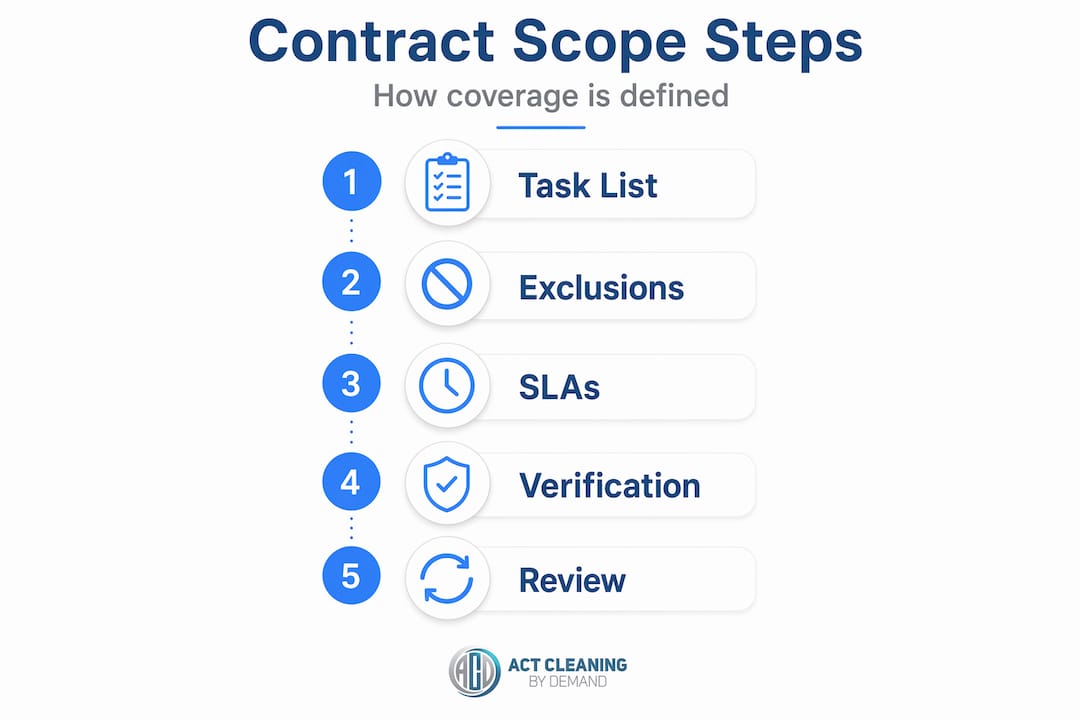
Pro Tip: Ask the cleaning provider to include photo-based inspection verification in the contract. Increasingly, advanced quality control mechanisms such as client access reports and photo evidence are becoming standard expectations in Australian office cleaning agreements.
Pricing, billing, and contract duration
Understanding the financial elements of your contract is just as critical as understanding what tasks are included. Office cleaning services details around pricing are often where businesses get caught off guard.
Common pricing models:
- Fixed monthly fee: A single set rate covers all agreed services. Predictable for budgeting.
- Per-visit pricing: You pay a set amount each time the team attends. Works well for lower-frequency services.
- Hourly rate: Common for ad hoc or variable-scope arrangements. Can be harder to budget unless visit durations are capped.
Australian commercial cleaning contracts typically cover pricing models, billing cycles, payment terms, and how extra work outside the agreed scope is priced and authorised. That last point is critical. If your office hosts a large event and needs an unscheduled clean, the contract should already define how that work is quoted and approved. Leaving it undefined means a disagreement at exactly the wrong moment.
Invoicing frequency varies. Some providers bill monthly in advance, others invoice fortnightly or after each visit. Your contract should state the billing cycle clearly, along with payment due dates and any late payment conditions.
Contract term lengths matter too. Agreements commonly run 12 to 24 months, and many include automatic renewal clauses that roll the agreement over unless you provide written notice within a specified window. That notice period is frequently 30 to 90 days. Miss it, and you could find yourself locked in for another full term.
| Element | What to look for |
|---|---|
| Pricing model | Fixed, per-visit, or hourly rate clearly stated |
| Scope change costs | Pre-agreed rate or authorisation process for extra work |
| Invoice schedule | Billing frequency and payment due dates |
| Contract term | Duration, start date, and renewal conditions |
| Termination notice | Days' notice required to exit without penalty |
| Early exit clause | Fees or conditions for leaving before the term ends |
Pro Tip: Negotiating termination clauses upfront with clearly stated penalties and notice periods is the most effective way to avoid being locked into a poorly performing agreement.
Health, safety, insurance, and compliance
This section of an office cleaning contract protects both parties when something goes wrong. For Australian offices, the regulatory context matters. Cleaning staff work with chemicals, operate equipment, and access your premises unsupervised. The contract must address all of this directly.
Minimum insurance requirements you should expect the contract to specify:
- Public liability insurance: Protects against damage to your property or injury to a third party caused by the cleaning team. A coverage minimum of $10 million is standard in Australian commercial arrangements.
- Workers' compensation insurance: Required by law for any business employing staff in Australia. Protects cleaning employees and limits your own liability exposure.
- Certificate of currency: The contract should require the provider to supply an up-to-date certificate of insurance on request, not just at the time of signing.
Insurance clauses typically define coverage minimums and indemnity limits and should require the provider to notify you of any changes to their coverage during the contract period. Letting that lapse mid-contract is a risk you do not want.
Chemical handling is another area requiring explicit contractual attention. Cleaning products must comply with relevant Australian workplace health and safety legislation. The contract should confirm that public liability, chemical compliance, and damage reporting are all addressed, along with a clear process for how incidents or property damage are reported and resolved.
The allocation of responsibility clause is often overlooked. If a cleaner damages a piece of equipment or a surface during their work, who pays? The contract should state this clearly rather than leaving it to negotiation after the fact.
Staffing, security, and site access arrangements
Who enters your premises matters. A cleaning contract that covers the tasks but says nothing about who performs them or how they access your building is leaving your business exposed.
-
Understand the employment structure. The Fair Work Ombudsman distinguishes between employees covered by the Cleaning Services Award and independent contractors. This distinction affects rights, obligations, and the protections that apply to the workers in your building. Your contract should clarify whether the cleaning team are direct employees or subcontractors in cleaning, and what quality controls apply either way.
-
Confirm staff vetting procedures. Background checks, training requirements, and supervision ratios should appear in the contract explicitly. This includes police checks, chemical handling training, hygiene protocols, and whether staff carry photo identification on site.
-
Define building access rules. The contract should specify precisely who holds keys or access cards, how alarm codes are managed and changed, sign-in procedures, and emergency contact details for after-hours situations. Access times, keyholding, and alarm code management must be written clearly to protect your premises.
-
Establish a complaints and issue resolution process. When the standard of cleaning falls short, how do you raise it? The contract should include defined complaint handling, performance review timelines, and escalation channels so that issues are addressed quickly rather than left to fester.
-
Clarify the role of subcontractors. If the cleaning provider uses subcontractors for part of the work, the contract should address this directly. You need to know whether the same vetting and training standards apply to subcontracted staff and whether the primary provider retains full responsibility for their performance.
Pro Tip: Request that the contract specifies a dedicated account manager or site supervisor as your primary contact. Clear communication channels reduce the time it takes to resolve quality issues significantly.
Making your contract work for you
Reviewing a contract before you sign it sounds obvious. But most businesses sign without checking for the specific gaps that create problems later. This office cleaning agreement checklist covers what you need to confirm before committing.
- Does the scope of work list tasks by specific room or area, not just by building?
- Are frequencies for all tasks explicitly stated rather than described loosely?
- Is there a defined process for requesting and pricing work outside the agreed scope?
- Does the contract address who is responsible for supplying consumables? Clarity on consumables supply responsibilities is one of the most overlooked gaps in cleaning contracts.
- Are insurance requirements specified with a certificate of currency provision?
- Does the contract include measurable service standards and a process for inspections?
- Are notice periods for termination stated clearly, along with any early exit fees?
- Is the auto-renewal clause visible and are its conditions reasonable?
- Are staff vetting requirements documented?
When you negotiate, focus particular attention on termination conditions and scope change costs. These two areas create more disputes than any other. Vague language around what triggers a price increase or how much notice you need to terminate is not a minor oversight. It is a structural flaw that costs businesses money.
Scheduling a contract review at least once every 12 months keeps it aligned with any changes to your office size, usage patterns, or cleaning requirements. Treat the contract as a living document, not a filing cabinet item.
My view on what businesses consistently get wrong
In my experience working alongside commercial cleaning operations, the gap between what businesses assume a contract covers and what it actually says is far wider than most office managers realise. They sign an agreement, hand over the keys, and only discover the ambiguities when something breaks down.
The detail that catches people out most often is consumables. I've seen facilities managers argue for weeks over who was responsible for restocking toilet paper and bin liners because the contract said nothing about it. That is a solvable problem at the drafting stage and a genuinely disruptive one after the fact.
My take on service levels is equally firm. A contract that says cleaning will be performed "to a high standard" is not a service level agreement. It is an aspiration. Measurable SLAs with inspection scores, defined response times for complaints, and corrective action timelines are what separate a professional arrangement from a handshake deal.
The businesses I've seen handle this well treat the contract negotiation as seriously as any supplier agreement. They push back on vague language, ask for inspection provisions in writing, and check the termination clause before the pricing page. That sequence matters more than most people think.
— Deng
Transparent contracts: what Com does differently
At ACT Cleaning by Demand (Com), every client agreement is built around clarity rather than convenience. The office cleaning services we provide are backed by contracts that spell out the scope of work by area and frequency, insurance requirements, consumables responsibilities, and staff vetting standards. Nothing is left to assumption.
Whether your Canberra office needs daily cleaning across multiple floors or a tailored schedule for a smaller workspace, Com builds packages around your actual requirements. You can review service inclusions, pricing structures, and contact the team directly through the ACT Cleaning by Demand website. If you want an agreement that holds up, start the conversation today.
Common questions
What is typically included in an office cleaning contract?
An office cleaning contract typically covers the scope of work by area and frequency, pricing and billing terms, insurance requirements, staff vetting, building access arrangements, and complaint resolution processes. The scope of work section is the most critical element, as it defines exactly what tasks are performed, where, and how often.
How long do office cleaning contracts usually run?
Contract terms commonly run 12 to 24 months and frequently include automatic renewal clauses. Review the notice period required to exit the agreement, as missing that window can roll the contract over for another full term.
Who is responsible for cleaning consumables in an office contract?
Responsibility for consumables such as bin liners, hand soap, and paper products must be explicitly stated in the contract. Consumables supply clarity is one of the most commonly missed elements in cleaning agreements and a frequent source of disputes.
What insurance should an office cleaning provider carry?
At minimum, the provider should carry public liability insurance (typically $10 million in Australian commercial settings) and workers' compensation for all employed staff. The contract should require a certificate of currency on request throughout the agreement period.
Can I negotiate the terms of an office cleaning contract?
Yes, and you should. Key areas to negotiate include termination notice periods, early exit conditions, how out-of-scope work is priced, and whether the contract includes measurable service level standards with inspection provisions.