A cleaning service SLA is a formal document that defines measurable performance standards, response times, and accountability obligations between a business and its cleaning provider. The industry term is "service level agreement," and it functions as the operational backbone of any professional cleaning contract. Without one, disputes default to opinion rather than evidence. Failing to document a proper SLA costs Australian businesses an average of $12,400 annually through unmanaged service interruptions and wasted time resolving complaints. That figure alone makes the case for getting this right.
What is a cleaning service SLA and how does it work?
A cleaning service SLA is a standalone document, or a formally integrated section of a cleaning contract, that converts vague expectations into binding obligations. Where a contract sets out commercial terms like price, duration, and liability, the SLA forms the operational playbook. It answers the questions your contract does not: how clean is clean enough, how quickly must a complaint be resolved, and who is responsible when standards slip.
The critical distinction is that SLAs shift payment focus from staffing inputs to output-based models. You are no longer paying for a cleaner to show up for three hours. You are paying for a defined result, measured against agreed standards. That shift changes the entire dynamic of the relationship between a facility manager and a cleaning provider.

Pro Tip: Treat the SLA as a living document, not a filing cabinet item. The best agreements are reviewed regularly and updated as your facility's needs change.
What elements make up an effective cleaning service SLA?
An enforceable cleaning SLA must contain seven core sections. Each one serves a distinct purpose, and missing any one of them creates a gap that disputes will fall through.
-
Task matrix scope. A detailed list of every cleaning task, the area it applies to, and the frequency required. High-traffic zones like reception areas and bathrooms typically need daily attention. Offices may require cleaning three to five times weekly per ISSA benchmarking standards.
-
Measurable performance standards. Vague language like "maintain a clean environment" is unenforceable. Clear, measurable KPIs with minimum thresholds, such as 95% task completion rates, are mandatory for a binding agreement.
-
Tiered response times. Urgent issues like a biohazard spill require a different response window than a missed bin emptying. The SLA must specify response times for each tier. Industry standard targets a response of less than four hours for urgent requests.
-
Reporting and communication framework. This section defines how performance data is captured, who receives it, and how often. Digital logs, inspection reports, and escalation contacts all belong here.
-
Remedies and penalties for non-performance. Without consequences, standards are suggestions. This section specifies what happens when KPIs are missed, whether that is a service credit, a remediation visit, or contract review.
-
Staffing and personnel obligations. This covers vetting requirements, training standards, and what happens when a regular cleaner is absent. Consistency in personnel directly affects service quality.
-
Environmental and chemical compliance. Australian facilities must meet Work Health and Safety obligations. The SLA should specify approved cleaning products, Safety Data Sheet requirements, and any green cleaning commitments relevant to your site.
Pro Tip: Ask your cleaning provider to walk you through each section of their standard SLA before signing. If they cannot explain how they measure performance, that is your answer.
Why are cleaning service SLAs critical for facility managers?
The core value of a service level agreement in cleaning is that it replaces subjective opinion with objective fact. Without a benchmarked SLA, performance assessments become interpersonal conflicts rather than professional evaluations. A facility manager who says "the bathrooms are not clean enough" and a cleaning supervisor who disagrees have no shared reference point. The SLA provides that reference.
A signed SLA does not just protect you legally. It changes the entire conversation from "I think" to "the data shows." That shift alone prevents the majority of disputes before they escalate.
The operational and financial benefits extend well beyond dispute prevention:
- Reduced service interruptions. Documented SLAs reduce service complaints by 68% and improve cleaning team retention. Fewer complaints mean fewer disruptions to your facility's daily operations.
- Regulatory compliance support. A well-drafted SLA incorporates chemical handling, waste disposal, and WHS obligations, reducing your liability exposure.
- Occupant satisfaction. Consistent cleaning standards directly affect how staff, tenants, and visitors perceive your facility. A poorly maintained environment signals poor management, regardless of who is responsible.
- Cost control. Clear performance thresholds prevent scope creep. When tasks and frequencies are documented, you are not paying for extras that should have been included, or arguing about what was agreed.
- Staff retention for your provider. Cleaning staff who work to clear, fair standards are more likely to stay in their roles. Turnover in cleaning teams is one of the leading causes of inconsistent service quality.
Facility managers who treat the SLA as a quality management tool, rather than a legal formality, consistently report better outcomes from their cleaning contracts. The agreement sets the standard. The monitoring enforces it.
How do you measure and monitor cleaning performance under an SLA?
A signed SLA is worthless without a monitoring system behind it. Audits and site inspections are what activate the contractual remedies you negotiated. Without them, you have no evidence to support a complaint or a penalty.
Inspection methods and scoring
Cleaning inspection scores use a rubric that assigns a numerical value to each area or task. A score of 95% or above is the industry benchmark for commercial facilities. Scores below that threshold trigger the remediation process defined in your SLA. Inspections should be conducted by both the client and the cleaning provider, with results shared and discussed.
KPIs that matter in practice
| KPI | Industry benchmark |
|---|---|
| Task completion rate | Above 95% per inspection cycle |
| Urgent response time | Less than 4 hours |
| Client satisfaction score | Above 4.5 out of 5 |
| Inspection frequency | Weekly for high-traffic, monthly for low-traffic |
Industry-standard commercial cleaning SLAs target these figures as minimums, not aspirations. If your current agreement does not reference them, it is worth revisiting.
Digital logs and feedback loops
Digital service logs capture task completion in real time. Many facility management platforms allow cleaning staff to check off tasks via mobile, creating a timestamped record. Client satisfaction surveys, sent monthly or after each inspection, close the feedback loop and give you data for the next review cycle.
Pro Tip: Run a 30-60-90 day review cycle at the start of any new cleaning contract. Mobilisation periods allow you to refine benchmarks based on actual traffic before locking in strict KPIs. Setting hard targets on day one is a reliable way to create disputes.
What are best practices for drafting and updating a cleaning SLA?
Drafting a cleaning SLA well requires separating two things that most people conflate: the contract scope and the operational task detail. Separating these layers with a dynamic task matrix means you can update cleaning frequencies or add new areas without rewriting the entire contract. That flexibility is worth building in from the start.
Key practices for facility managers drafting or reviewing a cleaning SLA:
- Use specific, measurable language. Replace "clean toilets daily" with "sanitise all toilet fixtures, replenish consumables, and mop floors in all bathroom areas by 7:00 AM each business day." Specificity removes ambiguity.
- Cross-reference the SLA with the main contract. The two documents should reference each other explicitly. The contract governs commercial terms. The SLA governs performance. Neither should contradict the other.
- Include escalation procedures. Define who to contact when a KPI is missed, how quickly a response is required, and what happens if the issue is not resolved. A three-step escalation path is standard: site supervisor, account manager, then formal dispute resolution.
- Involve cleaning staff in the setup. Cleaners who understand the SLA and had input into its standards are more likely to meet them. This is not a courtesy. It is a practical strategy for compliance.
- Build in a mobilisation period. A 30-60-90 day review cycle at the start of a contract allows both parties to test standards against real conditions before they become binding KPIs.
- Schedule annual SLA reviews. Facilities change. Staff numbers grow, new areas are added, and cleaning requirements shift. An SLA that was accurate two years ago may no longer reflect your actual needs.
For facilities that also manage HVAC and air quality systems, scheduling HVAC cleaning under a similar SLA framework ensures consistent standards across all building maintenance contracts.
Key takeaways
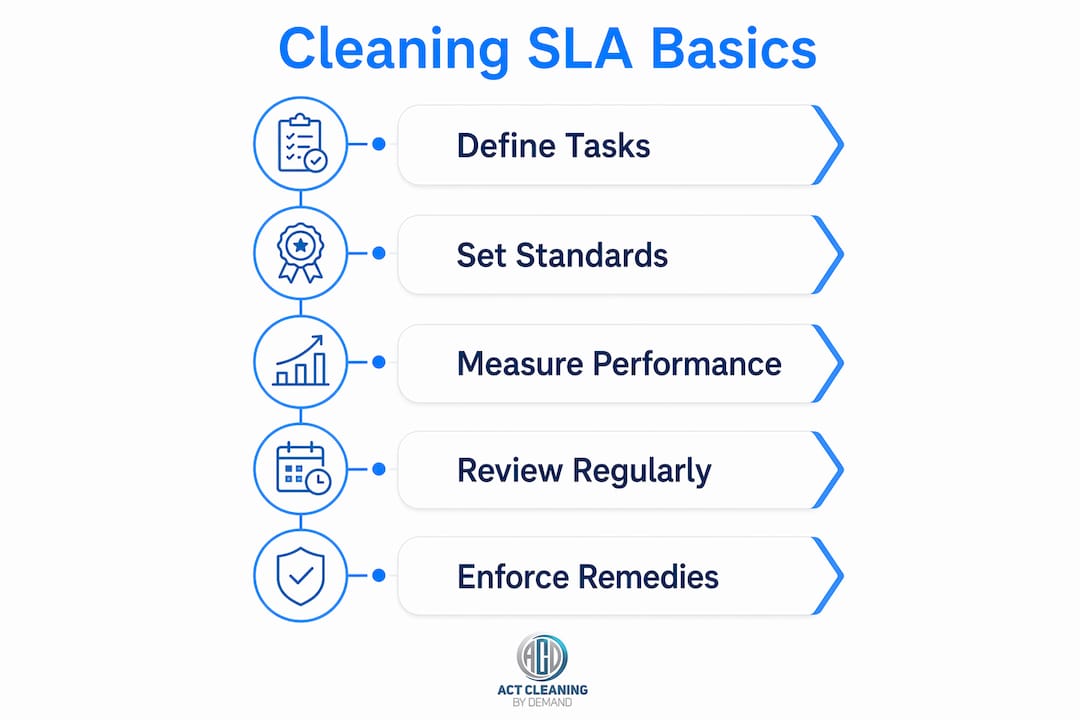
A cleaning service SLA is the single most effective tool for converting cleaning expectations into enforceable, measurable obligations that protect both facility managers and cleaning providers.
| Point | Details |
|---|---|
| SLA vs contract | The contract sets commercial terms; the SLA defines measurable performance standards and operational obligations. |
| Seven core sections | Every enforceable SLA needs a task matrix, KPIs, response times, reporting, remedies, staffing rules, and compliance requirements. |
| Output-based model | SLAs shift focus from hours worked to results delivered, measured against agreed cleanliness scores. |
| Monitoring is mandatory | A signed SLA without audits and digital logs cannot activate remedies or support dispute resolution. |
| Mobilisation period | A 30-60-90 day review cycle at contract start prevents unrealistic KPIs and reduces early disputes. |
Why most cleaning SLAs fail before they are ever tested
The most common SLA failure I see has nothing to do with the cleaning. It is the language. Facility managers sign agreements full of phrases like "maintain a satisfactory standard of cleanliness" and then wonder why disputes are impossible to resolve. Satisfactory to whom? Measured how? Those questions should have been answered before the ink dried.
The second failure is treating the SLA as a one-time document. I have reviewed cleaning contracts where the SLA had not been updated in four years, despite the facility doubling in size and adding a commercial kitchen. The agreement was technically in force. It was practically useless.
The third failure is the monitoring gap. An SLA without a regular inspection schedule is a promise without a witness. The monitoring and reporting systems are what give the document teeth. Without them, you cannot prove non-performance, and you cannot enforce remedies.
What actually works is a short, specific SLA with a dynamic task matrix, a clear escalation path, and a committed review schedule. Involve the cleaning team in setting the standards. Run a proper mobilisation period. Check the scores monthly. The facilities that do this consistently report fewer disputes, better cleaning outcomes, and longer provider relationships. The ones that skip it spend their time arguing about whether the floor was mopped.
— Deng
Reliable cleaning backed by clear standards
Com, ACT Cleaning by Demand, builds every commercial and residential engagement around documented service standards and clear accountability. Whether you need a tailored house cleaning agreement or a full commercial SLA for your facility, the team works with you to define measurable outcomes, not vague promises. For end-of-lease situations where standards are non-negotiable, Com's end-of-lease cleaning service operates to strict contractual benchmarks. Contact Com through actcleaningbydemand.com.au to discuss a cleaning agreement built around your facility's specific requirements.
FAQ
What is a cleaning service SLA in simple terms?
A cleaning service SLA is a formal document that defines exactly what cleaning tasks will be done, how often, and to what measurable standard. It gives both the client and the cleaning provider a shared, objective reference point for performance.
How is a cleaning SLA different from a cleaning contract?
A cleaning contract sets the commercial terms, including price, duration, and liability. The SLA defines the operational standards, such as task frequencies, KPI thresholds, and response times, and sits alongside or within the contract.
What KPIs should a cleaning SLA include?
Industry-standard KPIs include a task completion rate above 95%, urgent response times of less than four hours, and client satisfaction scores above 4.5 out of 5. High-traffic areas typically require daily cleaning as a baseline.
How often should a cleaning SLA be reviewed?
Annual reviews are standard practice, but a 30-60-90 day mobilisation review at the start of any new contract is also recommended. This allows benchmarks to be refined based on actual facility conditions before strict KPIs are locked in.
What happens if a cleaning provider does not meet the SLA?
The remedies section of the SLA defines the consequences, which typically include a remediation visit, a service credit, or formal dispute resolution. These remedies are only enforceable if supported by documented inspection records and audit logs.