
A maintenance clean is a scheduled, recurring cleaning service that keeps a space consistently tidy and hygienic without performing deep restorative work. Think of it as the regular upkeep that sits between your daily tidying and a full deep clean. For both homeowners and businesses, understanding the maintenance cleaning definition is the difference between a space that gradually deteriorates and one that holds its standard week after week. This guide covers what routine cleaning includes, how it compares to deep cleaning, and how to set up a schedule that actually works for your property.
What is a maintenance clean and what does it cover?
A maintenance clean is surface-level, recurring cleaning focused on dusting, vacuuming, mopping, and sanitising key areas. It does not include restoration tasks such as cleaning inside appliances, scrubbing grout, or washing windows from the outside. The purpose of a maintenance clean is to preserve the usability and appearance of a space on an ongoing basis, not to achieve a showroom finish.
The industry term used by facility managers and professional cleaners is routine cleaning or regular cleaning. Both terms describe the same service: a repeating programme of tasks that maintains a clean baseline. Whether you call it a maintenance clean or routine cleaning, the scope and intent are identical.

What makes this service distinct is its frequency. Consistency matters more than intensity on any single visit. A space cleaned thoroughly every fortnight will hold its standard far better than one cleaned intensively once every few months.
What tasks are typically included in a maintenance clean?
The scope of a maintenance clean covers the areas you use every day. Here is what a standard service typically includes:
- Dusting all reachable surfaces, including shelves, benchtops, skirting boards, and light fittings
- Vacuuming carpets, rugs, and upholstered furniture
- Mopping hard floors with appropriate cleaning solutions
- Sanitising bathrooms, including toilets, basins, showers, and mirrors
- Wiping down kitchen surfaces, splashbacks, and the exterior of appliances
- Emptying bins and replacing liners
- Tidying common areas to maintain order
One detail that surprises many clients: clutter directly limits what a cleaner can reach and therefore what gets cleaned. A kitchen bench covered in appliances, mail, and dishes cannot be properly wiped down. The more accessible your surfaces are, the more value you get from each visit.
Pro Tip: Before your cleaner arrives, spend five minutes clearing benchtops and picking up items from the floor. This single habit doubles the effective coverage of a standard maintenance clean.
For a practical breakdown of what to expect from a routine home clean, the tasks above form the consistent core. Specific inclusions can vary based on your service agreement and the size of your property, so always confirm the scope with your provider upfront.
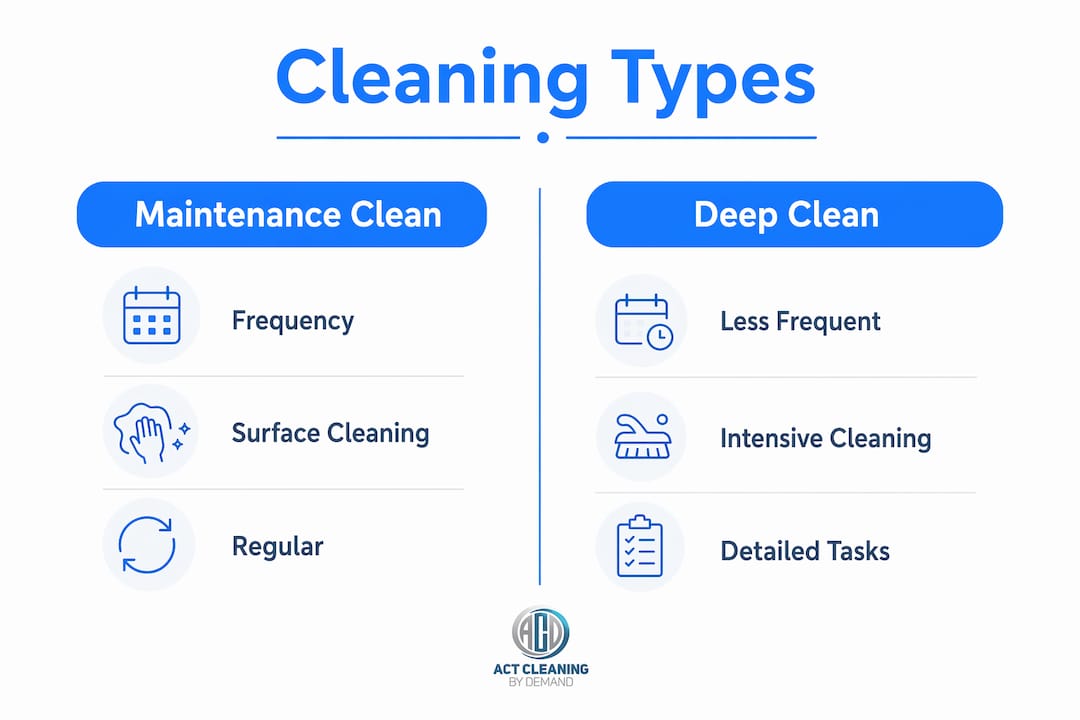
How does a maintenance clean differ from a deep clean?
Maintenance cleaning and deep cleaning serve different purposes and are not interchangeable. Maintenance cleaning is frequent, surface-level, and focused on upkeep. Deep cleaning is intensive, infrequent, and focused on restoration. Confusing the two leads to mismatched expectations and, often, disappointment.
The table below shows the practical differences:
| Factor | Maintenance clean | Deep clean |
|---|---|---|
| Frequency | Weekly, fortnightly, or monthly | Once or twice per year |
| Scope | Surface-level tasks, accessible areas | Inside appliances, grout, behind furniture |
| Time per visit | 1 to 3 hours depending on size | 4 to 8 hours or more |
| Cost per visit | Lower | Higher |
| Goal | Preserve cleanliness | Restore cleanliness |
Standard cleaning does not include moving furniture, detailed appliance cleaning, or extensive grout work. These belong to deep cleaning. A maintenance clean assumes the space is already at a reasonable baseline. If it is not, the maintenance service will underperform no matter how skilled the cleaner.
This is why an initial deep clean is often recommended before starting a maintenance programme. Once the space is restored to a clean baseline, recurring maintenance visits can hold that standard efficiently and affordably. Skipping the initial deep clean and jumping straight into maintenance is one of the most common mistakes clients make.
Pro Tip: If your property has not been professionally cleaned in the past three months, book a deep clean first. You will get significantly more value from every maintenance visit that follows.
For more on how cleaning standards differ between service types, it helps to understand what each level is designed to achieve before you book.
What are the benefits of regular maintenance cleaning?
The benefits of a maintenance clean extend well beyond a tidy appearance. For homes, the advantages are personal and practical. For businesses, they are also financial and reputational.
Consistent hygiene. Regular sanitising of bathrooms and kitchens prevents the buildup of bacteria and mould. This is particularly relevant in high-use spaces where contamination accumulates quickly between visits.
Asset protection. Preventive cleaning preserves asset value by stopping premature damage to fixtures and finishes. Dust and grime are abrasive. Left unchecked, they degrade surfaces over time, leading to costly repairs or replacements that a simple cleaning routine would have prevented.
Daily usability. Maintenance cleaning keeps operations running smoothly by maintaining the functionality of a space. A clean office supports productivity. A clean rental property retains tenants. A clean retail space encourages customers to stay longer and return.
Reputation management. For businesses, the appearance of your premises is a direct signal of your standards. A consistently clean space tells clients, staff, and visitors that you take your environment seriously. The inverse is equally true and far more damaging.
Cost prevention. Commercial maintenance cleaning extends the lifecycle of expensive materials by preventing the buildup of abrasive contaminants. Carpet fibres, timber floors, and stone benchtops all last longer when cleaned regularly. The cost of a monthly maintenance service is a fraction of the cost of replacing flooring or refinishing surfaces.
Viewing cleaning as preventive maintenance rather than a variable expense shifts the entire calculation. It becomes an investment in the longevity of your property, not a cost you cut when budgets tighten.
How to organise and schedule maintenance cleaning services
Setting up an effective maintenance cleaning schedule takes a little planning upfront, but the routine runs itself once it is in place. Here is how to approach it:
- Start with a deep clean. Before your first maintenance visit, get the property to a clean baseline. This gives your cleaner a realistic starting point and sets the standard you want to maintain.
- Declutter before each visit. Clear surfaces, pick up items from floors, and move anything that would block access to areas you want cleaned. This is the single most effective thing you can do to maximise each visit.
- Choose the right frequency. A busy family home or high-traffic office may need weekly visits. A single-occupant apartment or low-traffic workspace may be well served by a fortnightly or monthly schedule. Match the frequency to actual usage, not to what sounds reasonable.
- Communicate your priorities. Tell your provider which rooms or tasks matter most to you. Clear communication about conditions and expectations is the foundation of a service that consistently meets your needs.
- Maintain between visits. Wipe down kitchen surfaces after cooking, hang up towels, and deal with spills immediately. Professional cleaning works best when you are not starting from scratch each time.
Pro Tip: Book your maintenance cleans on a recurring calendar appointment rather than scheduling them ad hoc. Consistency in timing means your space never dips too far below your standard before the next visit.
For households in Canberra, customised cleaning packages let you tailor the frequency and scope to your specific property rather than accepting a one-size-fits-all arrangement.
Key takeaways
Maintenance cleaning works because consistency, not intensity, is what keeps a space at a reliable standard over time.
| Point | Details |
|---|---|
| Maintenance clean definition | A recurring, surface-level service focused on upkeep rather than restoration. |
| Deep clean first | Start with a deep clean before any maintenance programme to establish a clean baseline. |
| Clutter limits coverage | Declutter before each visit to maximise what your cleaner can effectively reach. |
| Asset protection | Regular cleaning prevents abrasive buildup that degrades fixtures, floors, and finishes. |
| Frequency matters | Match visit frequency to actual usage, whether weekly, fortnightly, or monthly. |
Why I think most people misunderstand maintenance cleaning
After years of working in and around the professional cleaning industry, the most common frustration I see is clients expecting a maintenance clean to fix a neglected space. They book a standard fortnightly service, the cleaner arrives to find months of accumulated grime, and neither party ends up satisfied. The client feels let down. The cleaner has done exactly what was agreed.
The misunderstanding comes from conflating the purpose of maintenance cleaning with the outcome of deep cleaning. Maintenance cleaning is a baseline service designed to maintain daily usability, not to achieve perfect conditions. It is not a rescue service. It is a preservation service.
What I have found actually works is treating the initial deep clean as a non-negotiable investment. Once that baseline is set, a fortnightly maintenance service becomes genuinely low-effort and high-value. The cleaner spends their time maintaining rather than catching up, which means you get more coverage, better results, and a cleaner that can actually focus on the details.
The other thing I would push back on is the idea that maintenance cleaning is only for people with large homes or big budgets. A one-bedroom apartment with a consistent fortnightly clean costs less per month than most people spend on takeaway coffee. The return, in time saved and living quality, is disproportionate to the cost.
My honest advice: talk to your provider before you book. Tell them the current state of the property, what you use most, and what matters to you. A good cleaning service will tell you whether you need a deep clean first and what a realistic maintenance schedule looks like for your situation. That conversation is worth more than any checklist.
— Deng
Keep your space consistently clean with ACT Cleaning by Demand
ACT Cleaning by Demand offers tailored maintenance cleaning packages for homes and businesses across Canberra, designed around your schedule and your property. Whether you need weekly office cleaning, fortnightly house cleaning, or a one-off deep clean to establish your baseline, the team delivers reliable, eco-friendly service with no lock-in contracts. Every package is customised to your space, so you are not paying for tasks that do not apply to you. Booking is straightforward through their online platform, and their local team brings the consistency and communication that makes a maintenance programme actually work. Explore their house cleaning services to find the right fit for your property.
FAQ
What is a maintenance clean in simple terms?
A maintenance clean is a recurring professional cleaning service that keeps a space tidy and hygienic through regular surface-level tasks like dusting, vacuuming, mopping, and sanitising. It is designed to maintain a clean standard, not to restore a neglected space.
How often should you do a maintenance clean?
Frequency depends on how heavily a space is used. Busy family homes and commercial offices typically benefit from weekly or fortnightly visits, while low-traffic spaces may only need monthly maintenance cleaning.
What is the difference between a maintenance clean and a deep clean?
A maintenance clean covers accessible, surface-level tasks on a regular schedule. A deep clean is intensive, covers areas like appliance interiors and grout, and is typically done once or twice a year to restore a space to a thorough baseline.
Do I need a deep clean before starting maintenance cleaning?
Yes. Starting maintenance without a baseline deep clean means the recurring service will spend time catching up rather than maintaining. An initial deep clean sets the standard that maintenance visits then preserve.
What is not included in a maintenance clean?
Standard cleaning excludes moving furniture, cleaning inside ovens or fridges, detailed grout scrubbing, and exterior window washing. These tasks belong to deep cleaning and should be scheduled separately.