Cleaning business scalability is defined as the ability to grow revenue and capacity without proportionally increasing costs or degrading service quality. Most cleaning business owners hit a ceiling not because demand dries up, but because their operations were never built to handle more. The difference between a business that stalls at five clients and one that runs fifty contracts profitably comes down to systems, not effort. This guide covers what affects cleaning business scalability, which operational frameworks actually work, and how to avoid the pitfalls that quietly kill margins during growth.
What is cleaning business scalability and why does it matter?
Cleaning business scalability means increasing your cleaning contracts and crews while keeping costs controlled and quality consistent. It is not simply growth. A business can grow and still become less profitable, more chaotic, and more dependent on the owner's daily involvement. True scalability means growth with less pain, not more.
The core principle is straightforward. Flexible processes and systems let you expand without reinventing your operations for each new contract. Without those systems, every new client adds a new problem to solve manually. That is the trap most cleaning business owners fall into before they understand what scalability in cleaning services actually requires.

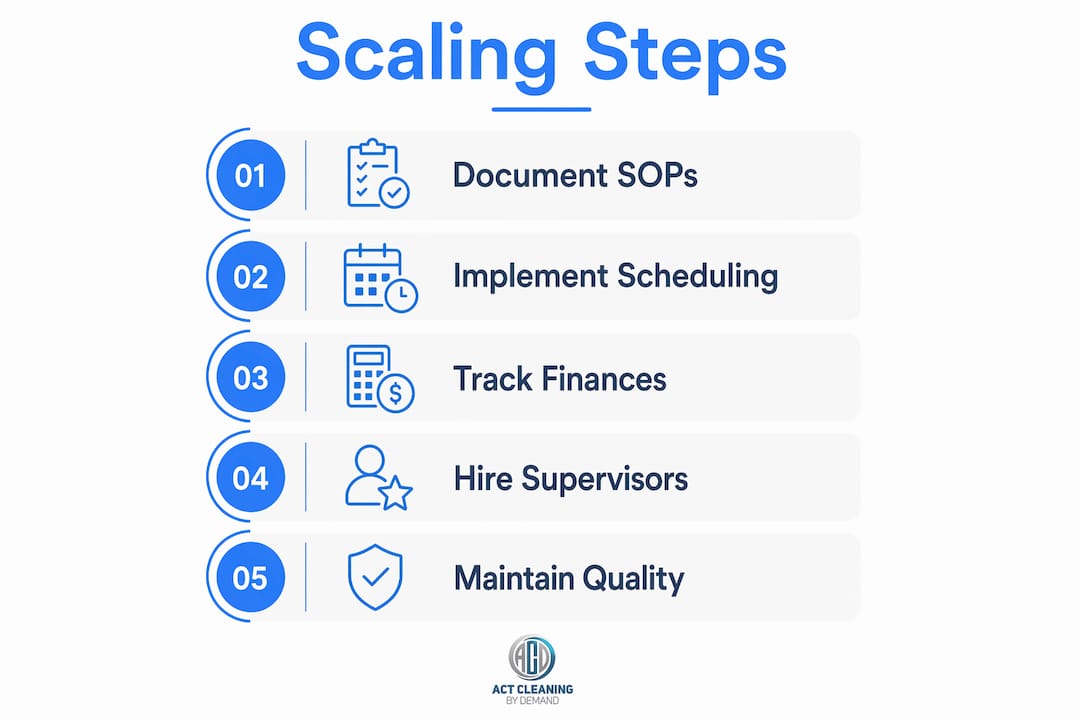
Three foundations drive scalability in any cleaning operation: documented Standard Operating Procedures (SOPs), financial discipline around unit economics, and owner-independent quality control. Get these right at a small scale and growth becomes a process, not a crisis.
What operational systems enable cleaning business scalability?
Operational systems are the engine of any scalable cleaning business. Without them, quality depends on individual cleaners' habits rather than documented standards. Standardised SOPs and checklists prevent quality decline when you add crews or contracts, because the standard is written down and verifiable, not stored in someone's memory.
SOPs and quality control
A well-written SOP covers every task in a clean: sequence, product used, time allocation, and the expected result. Inspection systems then verify the SOP was followed, independent of whether the owner was on site. Photo verification and digital sign-offs replace owner-dependent walkthroughs as your operation grows. Quality control built on digital evidence prevents tribal knowledge loss and makes multi-site management practical rather than exhausting.
Pro Tip: Build your inspection checklist before you hire your second cleaner. Retrofitting quality control onto an existing team is far harder than building the habit from the start.
Automation and scheduling
Reducing owner dependence through automated scheduling, invoicing, and client communication is the single most important shift a cleaning business owner can make. When the owner is the scheduler, the invoicer, and the quality inspector, the business cannot grow beyond what one person can physically manage. Tools like Jobber, ServiceM8, and ZenMaid automate these functions and free up management capacity for genuine growth work.
Technology-enabled workflows reduce coordination load and improve consistency across locations as you scale across time zones, suburbs, and service types. The owner's role shifts from doing to managing systems. That shift is not optional for cleaning service expansion. It is the prerequisite.
- Document every recurring task in a written SOP before adding new staff
- Use scheduling software to remove manual booking and rescheduling from the owner's plate
- Implement digital checklists that cleaners complete on a phone at the end of each job
- Set up automated invoicing so payment collection does not require owner action
- Create a centralised communication channel so client queries reach the right person, not just the owner
How do financial metrics and pricing protect profitability during scaling?
Financial discipline separates cleaning businesses that scale profitably from those that grow themselves into the red. The most important unit economics to track are revenue per labour hour, labour hours per account, inspection pass rates, and rework frequency. Tracking these metrics weekly reveals inefficiencies early, before they compound across a larger contract base.
Revenue per labour hour tells you whether a contract is worth keeping. If a residential clean takes three hours of labour but only generates enough revenue to cover two, the contract is eroding your margin with every visit. Labour hours per account reveals whether your time estimates at the quoting stage are accurate. Most cleaning businesses underprice because they quote based on optimistic time assumptions rather than actual data.
Pricing for full cost coverage
Pricing contracts based on full labour costs, including overheads and supervision, is non-negotiable for sustainable growth. Many cleaning business owners price based on competitor rates or gut feel, then wonder why profit disappears as they add more staff. Supervision, travel time, equipment depreciation, and insurance all need to be factored into every quote.
- Calculate your true cost per labour hour, including superannuation, insurance, and equipment
- Add a supervision and overhead allocation to every contract, not just large commercial ones
- Review every contract's actual labour hours against the quoted hours at least monthly
- Screen new clients for schedule stability and operational compatibility before accepting the work
- Adjust pricing at renewal for any contract where actual hours consistently exceed quoted hours
Statistic callout: Unit economics per job let cleaning business owners guard profitability when expanding crews, software, and equipment. Calculating this figure before signing a new contract is the difference between scaling profitably and scaling into a cash flow problem.
Client selection also affects profitability. Clients with unpredictable schedules, frequent scope changes, or poor communication create coordination overhead that does not show up in the quoted price. Screening for operational compatibility before signing a contract protects your team's capacity and your margin.
What challenges arise when scaling multiple cleaning sites and crews?
Multi-site cleaning operations introduce complexity that grows faster than the number of sites. Adding a second location does not double your coordination work. It can triple it, because you now have two sets of client expectations, two crew schedules, and two quality standards to manage simultaneously. Scaling past 15–35 sites requires genuine operational infrastructure, including digital quality control and automated reporting, rather than manual oversight.
Staff turnover is the hidden cost that derails scaling plans. Turnover rates around 200% in the cleaning industry create coordination crises without systems in place. Every departure means retraining, rescheduling, and potential service disruption. An always-on recruiting pipeline, not just reactive hiring when someone leaves, is a core infrastructure requirement at scale. Managing multiple cleaning crews efficiently requires documented onboarding processes so new staff reach standard quickly.
| Scale stage | Sites | Key system requirement |
|---|---|---|
| Solo operator | 1–5 | Basic SOPs and manual scheduling |
| Small team | 6–15 | Digital checklists, automated invoicing |
| Growth phase | 16–35 | Real-time visibility, dedicated supervisor |
| Multi-site operation | 35+ | Automated reporting, digital QC, recruiting pipeline |
Real-time visibility means knowing the status of every active clean without making a phone call. Digital platforms that log check-in times, checklist completion, and photo evidence give supervisors the information they need to manage quality across multiple sites without being physically present. This is where residential cleaning standards and commercial cleaning standards diverge operationally, and your systems need to account for both.
Pro Tip: Treat your recruiting pipeline like a marketing channel. Post job ads consistently, not just when someone quits. A warm pool of vetted candidates cuts your response time to turnover from weeks to days.
What are common scalability pitfalls and how to avoid them?
The most common mistake in cleaning business growth is scaling before operational systems are mature. Hiring without documented processes increases inconsistency and owner workload rather than reducing it. Each new hire adds a variable that your undocumented system cannot control, and quality complaints follow quickly.
Owner dependence is the second major pitfall. When the owner is the single point of contact for clients, the only person who knows the cleaning standard, and the default problem-solver for every issue, the business cannot function without them. Scalable cleaning businesses implement standardised workflows and centralised communications to remove the owner as a bottleneck. The goal is a business that runs to standard whether or not the owner is reachable.
- Avoid taking on new contracts before your current operations run consistently without your daily input
- Do not hire a new cleaner before their onboarding checklist, training materials, and first-week schedule are ready
- Never price a new contract without running the unit economics calculation first
- Resist the urge to solve quality problems by being present on site. Build the inspection system instead
- Do not skip client screening to fill capacity quickly. A bad-fit client costs more than an empty slot
The system-first mindset is the practical alternative to reactive scaling. Master your current scale before adding the next layer. A business running ten contracts with consistent quality, documented processes, and predictable margins is far better positioned to grow than one running twenty contracts in controlled chaos.
Key takeaways
Cleaning business scalability requires systems, financial discipline, and owner-independence working together before growth adds new contracts or crews.
| Point | Details |
|---|---|
| Define scalability correctly | Scalability means growing revenue without proportional cost increases or quality loss. |
| Build SOPs before hiring | Documented processes and digital checklists sustain quality as crews increase. |
| Track unit economics weekly | Revenue per labour hour and labour hours per account reveal margin problems early. |
| Invest in infrastructure at 15+ sites | Digital quality control and automated reporting replace manual oversight at scale. |
| Adopt a system-first mindset | Master current operations before adding new contracts or staff. |
Scaling is a mindset shift, not just a growth target
I have seen cleaning business owners work harder than anyone I know, only to find their margins shrinking as their client list grows. The problem is almost never effort. It is the assumption that more work means more profit, when the real lever is how well the work is organised.
The owners who scale well are the ones who get uncomfortable with being the centre of everything. They write the SOP when they would rather just do the clean themselves. They build the inspection checklist when they would rather trust their team. They review the labour hour data weekly when they would rather focus on the next sale. That discipline, applied consistently at a small scale, is what makes growth feel manageable rather than overwhelming.
Technology has made this more accessible than it was five years ago. Scheduling platforms, digital checklists, and automated invoicing tools are no longer expensive enterprise software. They are affordable, practical, and built for small cleaning operations. The barrier to building a scalable system is lower than most owners realise. The barrier is usually the decision to prioritise systems over hustle.
My honest advice: if your business cannot run for two days without you making decisions, it is not ready to scale. Fix that first. Everything else follows.
— Deng
Scalable cleaning services in Canberra, built for real growth
Com's approach to cleaning is built on exactly the principles this article covers: consistent standards, tailored packages, and reliable execution across residential and commercial contracts.
Whether you need end-of-lease cleaning handled to a documented standard or a regular office cleaning schedule that runs without constant follow-up, Com has a package built around your specific requirements. The custom cleaning packages for Canberra homes show what a well-organised cleaning operation looks like in practice. Book through the website and see the difference that systems-driven cleaning makes.
FAQ
What is cleaning business scalability in simple terms?
Cleaning business scalability is the ability to grow your contracts and crews without costs rising at the same rate or service quality falling. It depends on documented processes, automated workflows, and financial tracking rather than the owner working more hours.
What affects cleaning business scalability the most?
The biggest factors are operational system maturity, owner dependence, and pricing accuracy. Businesses that scale without documented SOPs and unit economics tracking consistently lose margin as they grow.
How do I start scaling a cleaning company?
Document your current processes as SOPs, implement digital scheduling and invoicing, and track revenue per labour hour for every contract. Master your existing operations before adding new clients or staff.
When does a cleaning business need a supervisor?
A dedicated supervisor becomes necessary when you manage more than six to eight active cleaners or run more than two simultaneous sites. At that point, the owner cannot maintain quality visibility without a layer of management between them and the crews.
Why do cleaning businesses lose profit when they grow?
Profit erosion during growth usually comes from underpricing, untracked labour overruns, and rising coordination costs that were never factored into contract rates. Weekly unit economics reviews catch these problems before they compound.