Cleaning service compliance is the process of meeting all regulatory, safety, and contractual standards required to legally and safely operate a cleaning business in Australia. It covers business licensing, workplace health and safety (WHS) obligations, chemical handling procedures, insurance, and the contractual requirements commercial clients impose before awarding contracts. For cleaning business owners, compliance in cleaning services is not optional. It is the legal and commercial foundation on which every client relationship and every employee's safety depends.
Australia has no single national cleaning licence, but that does not mean operators work in a regulation-free space. Local council registrations, state-level business licences, WHS Act obligations, and insurance requirements all apply. Getting these wrong exposes your business to fines, contract losses, and personal liability. Getting them right builds the kind of client trust that wins and keeps commercial accounts.
What is cleaning service compliance and what does it cover?
Cleaning service compliance means adhering to every legal, safety, and contractual obligation that applies to your cleaning operation. The term covers four core areas: business licensing, workplace health and safety, chemical handling, and financial protection through insurance and bonds.

Australian WHS legislation applies to all cleaning businesses with employees. It requires safe work systems, proper chemical management, and documented training. Beyond WHS, commercial clients routinely impose their own contractual standards, including proof of insurance and janitorial bonds, before they will sign a service agreement.
Compliance in cleaning services also extends to labour law. Regulatory bodies are increasingly scrutinising joint employer rules that affect how cleaning businesses structure staffing and subcontracting arrangements. Staying current with these changes is part of running a compliant operation in 2026.
What licences and registrations do cleaning businesses need in Australia?
No national specialised cleaning licence exists in Australia. General business licences at the local council or state level are mandatory, and the specific requirements vary by jurisdiction. A sole trader in the ACT faces different registration obligations than a company operating across New South Wales and Victoria.
The common licensing and registration requirements for Australian cleaning businesses include:
- Australian Business Number (ABN): Required for all businesses operating commercially.
- Business name registration: Mandatory if trading under any name other than your own legal name, registered through ASIC.
- Local council registration: Some councils require a business activity permit or home-based business approval for operators working from residential premises.
- State-specific contractor licences: Certain states require additional registration for commercial cleaning contractors, particularly those working in government facilities.
- GST registration: Required once annual turnover reaches the relevant threshold.
The distinction between legal requirements and commercial contract mandates matters here. Licensing is the legal baseline; janitorial bonds and public liability insurance are commercial contract essentials that clients demand before signing. Both categories are non-negotiable in practice, even if they sit in different legal categories.
Pro Tip: Verify your local council's specific requirements before you begin trading. Requirements differ between ACT, NSW, Victoria, and Queensland, and getting this wrong at setup costs far more to fix later than it does to check upfront.
How does workplace health and safety compliance apply to cleaning services?
The Work Health and Safety Act applies to every cleaning business in Australia that employs workers. It requires business owners to provide a safe working environment, manage chemical hazards, and document their safety systems. Failing to meet these obligations carries serious financial and legal consequences.
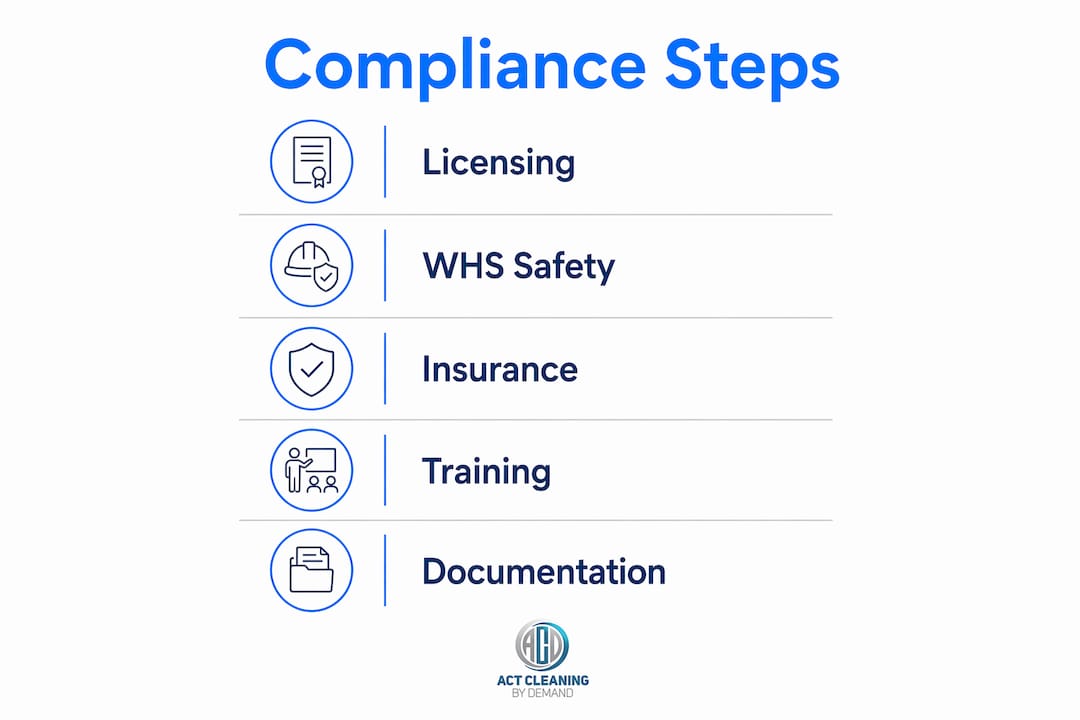
The key WHS compliance steps for cleaning businesses are:
- Obtain and maintain Safety Data Sheets (SDS): Every hazardous chemical used on the job must have a current SDS on file. Workers must be able to access these sheets at any time.
- Label all chemicals correctly: Containers must display the product name, hazard information, and supplier details. Decanting chemicals into unlabelled bottles is a common and costly compliance breach.
- Train all employees in chemical safety: Training must cover correct handling, dilution ratios, PPE requirements, and emergency procedures. Training records must be documented and dated.
- Provide and enforce PPE use: Gloves, eye protection, and respiratory protection must be supplied and worn where required by the SDS or risk assessment.
- Conduct and record risk assessments: Written risk assessments for each work environment demonstrate due diligence and protect the business in the event of an incident.
Penalties for serious WHS violations are significant. Fines for serious violations can reach $15,625 per breach, with repeat or wilful offences attracting far higher penalties. That financial exposure makes documented compliance far cheaper than the alternative.
Pro Tip: Keep digital records of all SDS documents, training logs, and risk assessments in a shared folder your team can access from any device. Scheduling quarterly training refreshers prevents the knowledge gaps that lead to incidents and fines.
What insurance and bonds are needed for compliance and client protection?
Insurance and bonds sit at the intersection of legal compliance and commercial necessity. Some are legally required; others are conditions commercial clients impose as part of their contract requirements. Understanding the difference helps you budget correctly and avoid being disqualified from contracts you are otherwise qualified to win.
The three financial protection tools every cleaning business should hold are:
- Public liability insurance: Covers third-party property damage and personal injury claims arising from your cleaning work. Most commercial clients require a minimum of $10 million in coverage.
- Workers' compensation insurance: Legally required in every Australian state and territory for businesses with employees. It covers medical costs and lost income if a worker is injured on the job.
- Janitorial bond: A surety bond that protects clients against theft or dishonesty by cleaning staff. Commercial clients typically require bonds ranging from $10,000 to $100,000 in coverage, costing $100 to $1,000 annually depending on the bond amount and your credit history.
The role of insurance in cleaning services goes beyond legal protection. Clients use your insurance certificates as a proxy for professionalism. A business that cannot produce current certificates of currency at contract negotiation rarely wins the account.
| Protection type | Legal requirement | Commercial contract requirement |
|---|---|---|
| Public liability insurance | Recommended, not mandated | Almost always required |
| Workers' compensation | Legally required with employees | Required |
| Janitorial bond | Not legally required | Required by most commercial clients |
| Professional indemnity | Not legally required | Required for specialist contracts |
Pro Tip: Review your insurance coverage annually, not just at renewal. Client contract minimums increase over time, and discovering your coverage is insufficient mid-contract negotiation is a problem that costs you the job.
How to integrate compliance into daily cleaning operations
Compliance is an ongoing operational process, not a one-time setup task. The cleaning businesses that avoid fines and retain commercial contracts treat compliance as part of their daily workflow, not a box to tick at the start of each year.
Practical integration looks like this:
- Pre-shift checklists: Include chemical checks, PPE availability, and SDS access confirmation as standard pre-shift items. This takes two minutes and creates a documented safety record.
- Routine internal audits: Conduct a monthly review of training records, insurance certificates, and chemical inventories. Quarterly audits of your WHS documentation catch gaps before regulators or clients do.
- Centralised documentation: Store all compliance records, including SDS files, training logs, and proof of insurance, in one accessible location. Digital documentation portals with real-time records reduce audit risk significantly.
- Staff onboarding protocols: New employees should complete chemical safety training and sign off on WHS procedures before their first shift, not after.
- Client communication: Share your compliance credentials proactively. Provide clients with copies of your insurance certificates, WHS policy summary, and training records. This builds trust and differentiates your business from operators who cannot produce documentation on request.
Compliance is a critical differentiator in high-risk sectors like healthcare cleaning. Non-compliance with infection control standards in healthcare environments risks contract termination and disqualification from government programmes. The businesses that retain commercial cleaning clients long-term are the ones whose compliance records are clean and current.
Good documentation protects against fines, lawsuits, and reputational harm. It also gives clients the confidence to renew contracts without hesitation.
Key takeaways
Cleaning service compliance requires active management of licensing, WHS obligations, chemical safety, insurance, and documentation to protect your business and your clients.
| Point | Details |
|---|---|
| Licensing is state-specific | No national cleaning licence exists; register with your local council and state authority before trading. |
| WHS obligations apply to all employers | Maintain SDS files, train staff in chemical safety, and document risk assessments to meet Australian WHS Act requirements. |
| Insurance and bonds are commercial essentials | Public liability insurance and janitorial bonds are required by most commercial clients, regardless of legal mandates. |
| Compliance is a daily practice | Embed pre-shift checklists, monthly audits, and centralised records into your workflow to stay compliant year-round. |
| Documentation is your best defence | Current training logs, SDS records, and insurance certificates protect against fines, lawsuits, and contract losses. |
What I have learned about compliance after years in the cleaning industry
The biggest mistake I see cleaning business owners make is treating compliance as a startup task. They get their ABN, take out a public liability policy, and assume the job is done. It is not. Compliance is a living part of your business, and the moment you stop maintaining it, you are exposed.
The second mistake is the belief that solo operators are exempt from most obligations. Solo operators still face local licensing and contract insurance requirements, even if some WHS chemical safety provisions only trigger once you employ staff. That distinction does not mean you operate without obligations. It means your obligations are different, not absent.
What actually protects a cleaning business is documentation. I have seen operators lose contracts not because they were non-compliant, but because they could not prove compliance when a client asked. A folder of current certificates, signed training records, and up-to-date SDS files takes an afternoon to organise and saves you from losing accounts worth tens of thousands of dollars.
Stay current with regulatory changes. The guidelines for cleaning service compliance shift as governments update WHS codes and labour laws. Set a calendar reminder to review your compliance position every six months. The cost of staying informed is nothing compared to the cost of being caught out.
— Deng
Cleaning services that take compliance seriously
ACT Cleaning by Demand operates with compliance built into every service it delivers across Canberra and the ACT.
Whether you need professional house cleaning, end of lease cleaning, or office cleaning that meets commercial contract standards, Com delivers documented, insured, and fully trained cleaning teams. Clients receive proof of insurance and WHS compliance as standard. Booking is straightforward through Com's online system, and every package is tailored to your property and schedule. For business owners who want a cleaning partner they can confidently name in a compliance audit, Com is the right choice.
FAQ
What does cleaning service compliance mean in Australia?
Cleaning service compliance means meeting all legal, safety, and contractual obligations required to operate a cleaning business in Australia. This includes business registration, WHS Act requirements, chemical safety procedures, and insurance.
Do solo cleaning operators need to comply with WHS laws?
Solo operators without employees are exempt from some WHS chemical safety provisions, but local licensing and insurance obligations still apply. Compliance requirements are different for sole traders, not absent.
What insurance does a cleaning business need in Australia?
Australian cleaning businesses need public liability insurance and workers' compensation if they employ staff. Most commercial clients also require a janitorial bond before awarding contracts.
How much does a janitorial bond cost?
Janitorial bond premiums typically range from $100 to $1,000 annually, depending on the coverage amount and the business owner's credit history. Coverage levels commonly requested by commercial clients range from $10,000 to $100,000.
How do I prove compliance to commercial cleaning clients?
Provide clients with current certificates of insurance, a summary of your WHS policy, and signed training records for all staff. Comprehensive documentation including SDS files and audit records demonstrates compliance to both clients and regulators.