
If you have ever hired a cleaning company and wondered whether the person who shows up actually works for them, you are not alone. What is subcontracting in cleaning is one of the most misunderstood aspects of the industry, and for Canberra homeowners and businesses, that confusion carries real consequences. Who is responsible when something goes wrong? Who vetted the cleaner at your door? This guide cuts through the uncertainty, explaining exactly how cleaning subcontracting works, what your legal position is, and how to make confident decisions when choosing a cleaning provider.
Table of Contents
- What subcontracting means in the cleaning industry
- Legal considerations and contracts for cleaning subcontracting
- Operational dynamics of subcontracting in cleaning businesses
- Benefits and challenges of subcontracting in cleaning services
- How to choose and manage cleaning subcontractors for your property
- Why relying heavily on subcontracting in cleaning can backfire
- How ACT Cleaning by Demand supports your cleaning needs in Canberra
- Frequently asked questions
Key Takeaways
| Point | Details |
|---|---|
| Subcontracting defined | Subcontracting in cleaning means outsourcing part of the work to an independent contractor under your agreement, not the client’s direct contract. |
| Legal responsibility | The head contractor remains accountable to the client for all service quality, timelines, and deliverables when subcontracting. |
| Operational independence | Subcontractors use their own equipment, schedule, and handle tax obligations but must meet contract standards. |
| Pros and cons | Subcontracting offers flexibility and cost savings but can reduce control and cause accountability issues if poorly managed. |
| Effective management | Choose and manage subcontractors carefully using clear contracts, vetting, quality checks, and communication to ensure reliable service. |
What subcontracting means in the cleaning industry
Subcontracting in cleaning is when a cleaning business, known as the head contractor, engages another independent cleaner or smaller cleaning company to carry out part of the contracted work. As defined in Australian contract law, the subcontractor is responsible to the head contractor, not to you as the end client. You signed a contract with the cleaning company. They signed a separate agreement with the subcontractor. Those are two entirely different relationships.
From your perspective as a client, this arrangement is largely invisible. You deal with one business, receive one invoice, and hold one party accountable. The head contractor manages the subcontractor behind the scenes. This is common across the cleaning industry, particularly for house cleaning services where demand can spike around seasonal events, end-of-lease periods, or large residential projects.
Here is what subcontracting in the cleaning sector typically involves:
- A head contractor wins a cleaning contract with a client
- The head contractor engages an independent cleaner or company for part of the work
- The subcontractor operates under a separate agreement with the head contractor
- The client interacts only with the head contractor throughout the job
- The head contractor remains accountable for the finished result
This model helps cleaning businesses scale quickly without taking on permanent employees, and it lets them bring in specialists for tasks outside their usual scope.
Legal considerations and contracts for cleaning subcontracting
The legal side of cleaning subcontracting is where things get serious. The distinction between a subcontractor and an employee matters enormously under Australian law. Get it wrong and you risk what is known as sham contracting, where a worker is labelled a subcontractor but is actually functioning as an employee. That carries significant penalties.
A well-structured subcontractor agreement, as outlined in Australian cleaning contracts, should cover workmanship standards, insurance requirements, workplace health and safety obligations, invoicing arrangements, and the subcontractor's independence. A genuine subcontractor sets their own hours, uses their own equipment, and works for multiple clients. If your cleaning provider is directing every movement of a so-called subcontractor, that person is likely an employee under the law.
Key legal protections to look for in cleaning subcontracting arrangements include:
- A written subcontract agreement that defines scope, standards, and payment terms
- Proof of public liability insurance from the subcontractor
- Confirmation the subcontractor is registered for GST and handles their own tax
- Clear clauses about whether further subcontracting is permitted
- Safety responsibilities spelled out for each party
Pro Tip: Before signing any cleaning contract, ask the provider whether they use subcontractors and request confirmation that those subcontractors carry appropriate insurance and hold relevant qualifications.
Operational dynamics of subcontracting in cleaning businesses
Understanding how subcontracting actually functions day-to-day helps you set realistic expectations. The head contractor wins the work and manages the client relationship. The subcontractor shows up, does the job, and invoices the head contractor. The client rarely knows the difference unless something goes wrong.
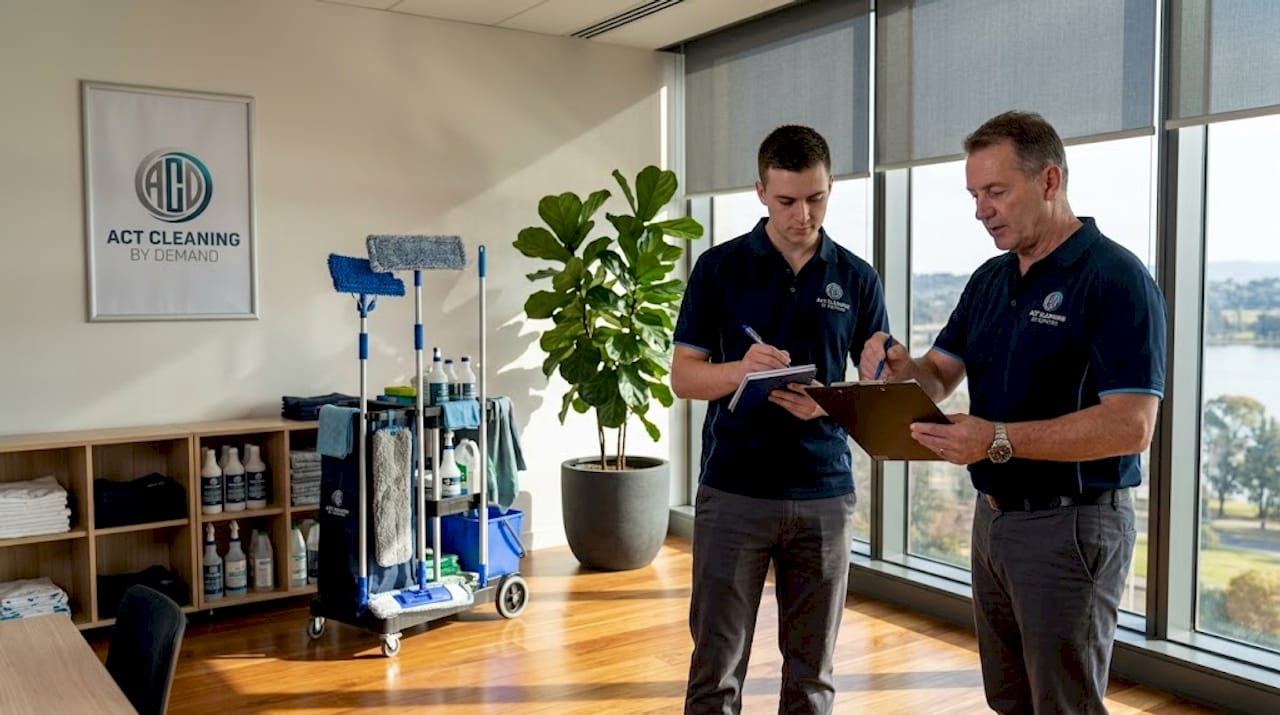
Subcontractors are independent operators who supply their own equipment, manage their own tax obligations, and set their own schedules within the standards defined by the contract. This independence is what legally separates them from employees. But it also means the head contractor has limited day-to-day control over how the work gets done, which is a genuine operational tension.
For office cleaning or large commercial jobs, this model can work well when managed properly. Here are three key operational features that define cleaning subcontractors:
- Equipment independence: Subcontractors supply their own cleaning products, machinery, and materials unless the contract specifies otherwise.
- Tax self-management: Subcontractors handle their own income tax, superannuation, and GST obligations without payroll involvement from the head contractor.
- Schedule autonomy: Subcontractors agree to deliver work within a timeframe but determine their own working hours, provided the outcome meets contract standards.
This structure enables cleaning businesses to take on more work than their permanent staff could handle, but it requires clear contracts and active quality management to function well.
Benefits and challenges of subcontracting in cleaning services
Subcontracting is not inherently good or bad. It is a tool, and like any tool, its value depends entirely on how it is used. For Canberra homeowners and businesses, understanding both sides helps you ask better questions before signing anything.
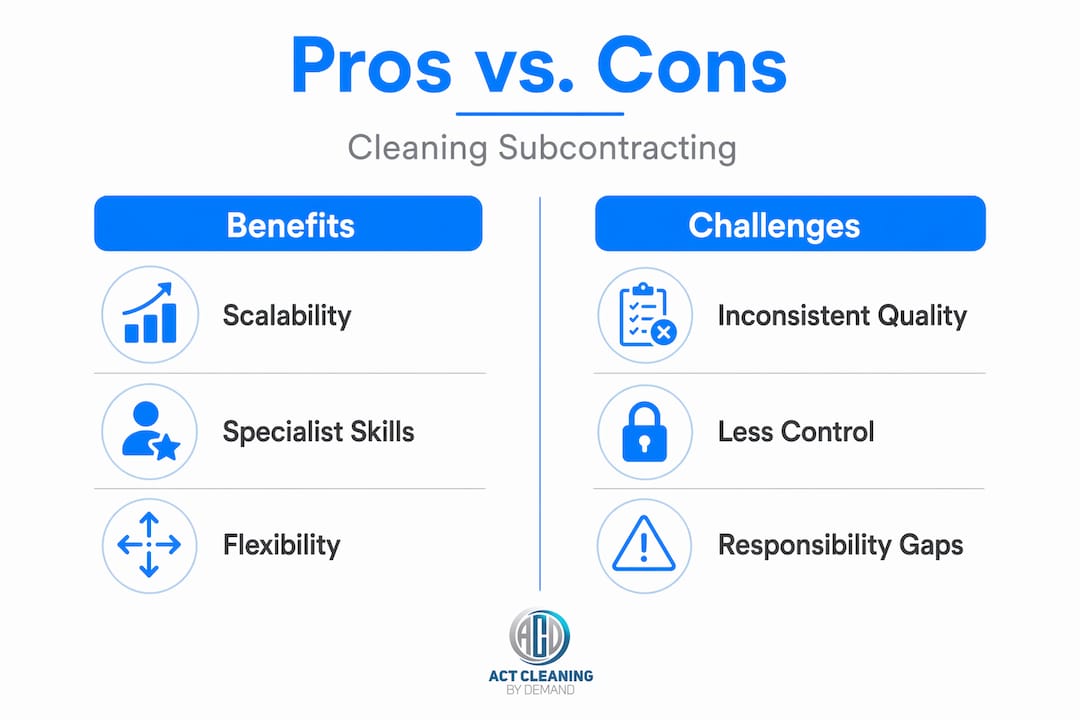
Subcontracting helps scale operations quickly to meet fluctuating demand without fixed commitments, but it can reduce control and complicate quality management. On the other side, subcontracting can undermine accountability and cause coordination issues that lead to inconsistent service quality.
| Advantages of subcontracting cleaning | Challenges of subcontracting cleaning |
|---|---|
| Flexible scaling to meet demand | Reduced direct control over cleaners |
| Lower costs, no payroll or benefits | Risk of inconsistent quality |
| Access to specialist cleaning skills | Fragmented accountability |
| Reduced permanent staff overhead | Communication and scheduling gaps |
| Faster response to large or urgent jobs | Vetting subcontractors takes effort |
When evaluating a cleaning provider that uses subcontractors, consider the following:
- Does the head contractor have a formal vetting process for subcontractors?
- Are subcontractors required to carry public liability insurance?
- What quality control checks are in place after each job?
- How does the provider handle complaints about subcontracted work?
- Is there a clear communication channel between you, the head contractor, and the subcontractor?
Poor floor cleaning outcomes are one of the most common complaints in subcontracted commercial cleaning, often because the subcontractor used incorrect products or equipment for the surface type. Asking specific questions upfront prevents these issues.
How to choose and manage cleaning subcontractors for your property
Whether you are a Canberra business manager overseeing a commercial space or a homeowner coordinating a large clean, knowing how to select and manage cleaning subcontractors protects your property and your money.
Quality, timelines, and deliverables sit in the subcontract agreement, not your main client contract, which means the head contractor must actively manage their subcontractors on your behalf. If they are not doing that, you will feel it in the results.
Follow these five steps to manage cleaning subcontractors effectively:
- Verify credentials: Request proof of insurance, ABN, and any relevant cleaning certifications before work begins.
- Use detailed written contracts: Ensure the scope of work, payment terms, quality standards, and safety requirements are all documented.
- Establish an approval process: If your contract allows further subcontracting, require written approval and vetting of any additional parties.
- Maintain open communication: Set up a direct line with the head contractor and agree on how issues will be reported and resolved.
- Conduct regular quality checks: Schedule inspections after each clean and document any concerns in writing.
For properties like kitchen areas that require specific hygiene standards, quality checks are not optional. They are essential.
Pro Tip: Ask your cleaning provider to confirm in writing that any subcontractors assigned to your property have completed training appropriate to the surfaces and equipment involved in your job.
Why relying heavily on subcontracting in cleaning can backfire
Here is the uncomfortable truth that most cleaning companies will not tell you. Heavy reliance on subcontracting often creates a gap between what the client expects and what the cleaner on the ground actually delivers. When something goes wrong, the head contractor points to the subcontractor, the subcontractor points to unclear instructions, and you are left with a dirty office or a failed end-of-lease inspection.
As one industry source puts it, subcontracting often leads to fragmented responsibility, blame games, inconsistent quality, and client dissatisfaction because workers do not report directly to your vendor. This is not a rare edge case. It is a structural problem baked into the model when it is not managed with discipline.
Directly hired cleaning teams build something subcontractors rarely can: institutional knowledge. They know your property, your preferences, your quirks. They show up with a vested interest in the relationship because their employment depends on it. Facility managers consistently report fewer complaints and faster resolution times with in-house cleaning teams compared to subcontracted arrangements.
This does not mean subcontracting is always wrong. For specialist tasks, overflow demand, or short-term projects, it can be the right call. But when office cleaning accountability is critical, such as in healthcare facilities, food preparation areas, or high-traffic commercial spaces, you want a provider who either manages subcontractors with rigour or employs their own trained staff directly.
The smartest move is to ask your cleaning provider directly: "Do you use subcontractors, and if so, how do you manage them?" Their answer will tell you everything.
How ACT Cleaning by Demand supports your cleaning needs in Canberra
Navigating subcontracting arrangements on your own is time-consuming and, frankly, stressful. ACT Cleaning by Demand takes that burden off your plate by maintaining clear contracts, vetting all cleaning staff, and delivering consistent results across Canberra homes and businesses.
Whether you need house cleaning services, window cleaning services, or end of lease cleaning, ACT Cleaning by Demand brings transparency and accountability to every job. You always know who is cleaning your property and why they are qualified to do it.
Here is what you get when you choose ACT Cleaning by Demand:
- Vetted cleaning staff with verified insurance and qualifications
- Consistent standards across every visit, residential or commercial
- Flexible scheduling tailored to your property's needs
- Local Canberra expertise and genuine accountability
- Clear communication from booking through to completion
Pro Tip: Contact ACT Cleaning by Demand early to discuss whether a direct-staff or managed subcontracting model suits your property best. Getting this right from the start saves significant headaches later.
Frequently asked questions
Who is responsible if a cleaning subcontractor makes a mistake?
The head contractor remains legally accountable to the client for quality, timelines, and deliverables, regardless of whether the work was subcontracted.
Can subcontracted cleaners work exclusively for one business?
True subcontractors manage their own schedules and typically work across multiple clients. Exclusive work arrangements may indicate employee status and create sham contracting risks under Australian law.
How can I ensure quality from subcontracted cleaning services?
Use detailed contracts, verify subcontractors' qualifications and insurance, and conduct regular quality inspections to confirm standards are being met consistently.
Is subcontracting cheaper than hiring employees for cleaning?
Subcontracting can reduce costs because subcontractors are paid only for work completed, without benefits or payroll taxes, but inconsistent quality may create additional costs if jobs need to be redone.
Should I allow cleaning subcontractors to further subcontract work?
Only if your contract includes a clear approval process with vetting requirements, such as proof of insurance and relevant qualifications, to maintain quality and legal compliance.