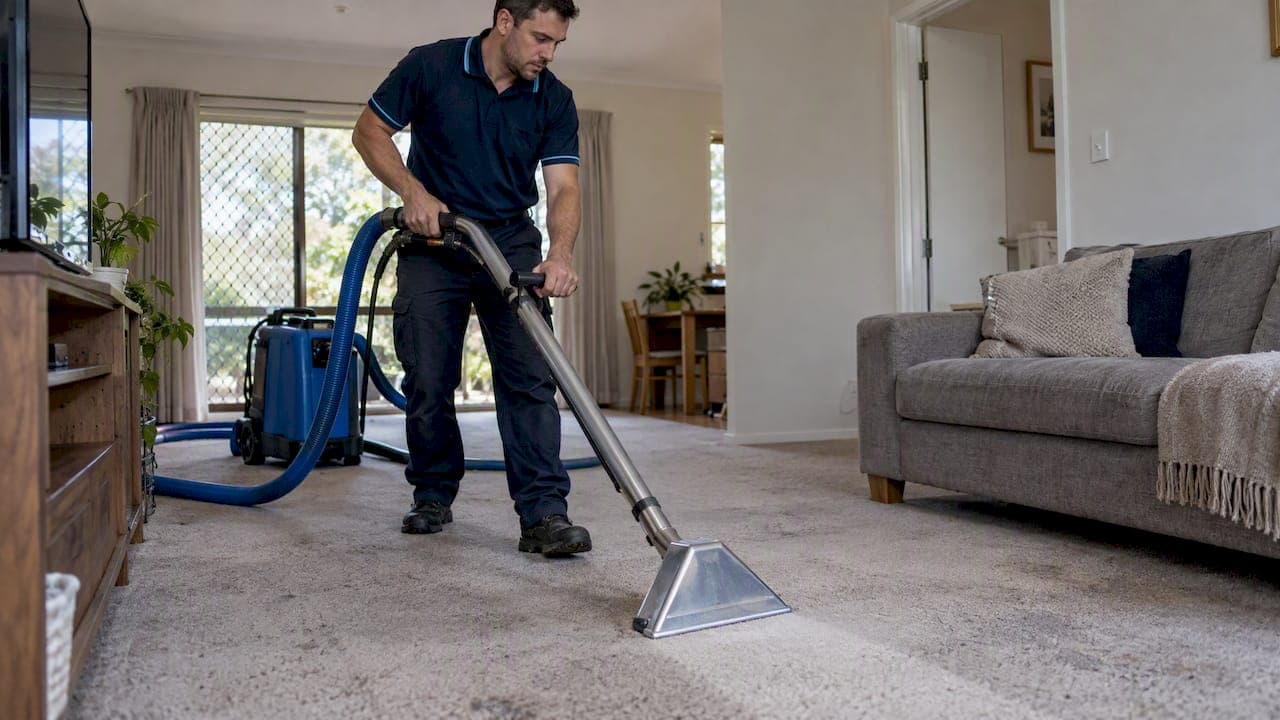
Hire a professional carpet cleaner about every 12 to 18 months for a normal home, sooner if you have pets, kids or heavy foot traffic. Book earlier again whenever a deadline is coming: an end-of-lease inspection, a sale, an event or a client visit. Hire straight away, and don't DIY, if the carpet is mouldy, flood-affected or won't dry.
The rest of this guide explains how to tell which situation you are in, how far ahead to book, and what to ask a cleaner before you say yes.
TL;DR
- For most homes, a professional deep clean every 12 to 18 months is the benchmark. The Carpet Institute of Australia gives 6 to 18 months for commercial carpet, depending on traffic.
- Book when vacuuming no longer restores the look of the carpet, not only when it looks filthy.
- Book at least a couple of weeks before an inspection, sale or event, so drying time and any re-clean fit in.
- Mould, sewage, flood water or persistent dampness is a job for specialists, not a routine clean.
- Check your carpet warranty first. Keep the invoice, because it may be your proof of professional cleaning.
Table of Contents
- The simple rule: every 12 to 18 months, then adjust
- Signs it is time, even if the calendar says otherwise
- Book ahead of a deadline
- How far ahead should you book?
- When hiring beats DIY
- When it is not a cleaning job at all
- Check your warranty before you book
- What to ask a cleaner before you book
- Our perspective: timing beats frequency
- Book carpet cleaning with ACT Cleaning by Demand
- FAQ
- Sources
The simple rule: every 12 to 18 months, then adjust
The Carpet Institute of Australia recommends a professional residential deep clean about every 12 to 18 months. It says to go sooner when traffic, visible soiling or stains justify it. CHOICE points to the Australian standard for carpet cleaning and describes the guideline as once a year.
That gives you a sensible range, and your own house decides where in it you land.
| Situation | Suggested timing |
|---|---|
| Adults only, shoes off, low traffic | Towards the 18-month end |
| Typical family home | Around every 12 months |
| Pets, young children, lots of visitors | Sooner than 12 months. Common advice is every 3 to 6 months, though that is a general rule of thumb rather than a standard |
| Hallways, entries, stairs | More often than bedrooms, as a spot or zone clean |
| Office or shopfront carpet | Every 6 to 18 months depending on traffic (Carpet Institute) |
Canberra adds a few local factors. Many homes have wool-blend or synthetic carpet over concrete slabs or in cold, dry-heated rooms, and dust from winter heating settles into the pile. Spring pollen and bushfire-season smoke can also travel indoors. None of that changes the 12 to 18 month benchmark, but it is a reason not to stretch to the long end.
Signs it is time, even if the calendar says otherwise
The calendar is a backstop. Your carpet tells you earlier.
- It looks flat or grey in walkways even after you vacuum. Vacuuming removes dry soil. Oily soil and embedded grime need a corrective clean, which is why the Carpet Institute's guidance treats professional cleaning as a periodic job rather than a daily one.
- A smell returns a day or two after you air the room. Pet odour and spilled drinks sit deep in the backing and underlay.
- Stains keep coming back after you spot clean. That is usually residue wicking up from below.
- Allergy symptoms get worse indoors. Carpet holds dust, and a clean helps only if the carpet is also dried properly.
- The pile feels stiff or crunchy. This often means previous cleaning left detergent behind. More on that below.
- A visitor, buyer or inspector is coming. This is the most common trigger of all.
The practical test: if routine vacuuming no longer brings the carpet back to how it looked, book. Don't wait until it looks severely dirty.
Book ahead of a deadline
Most people hire a carpet cleaner because something is due, and that is a good reason. The only mistake is leaving it too late.
End of lease or bond cleaning
In the ACT, tenants must return a property in substantially the same condition as at the start, allowing for fair wear and tear. Whether professional carpet cleaning is required depends on your lease and the condition report, so read both before you spend anything. If the agent asks for a professional clean, keep the receipt.
Book the carpets for after you have moved your furniture out and before the final inspection. That order matters: a carpet cleaned while furniture is still being carried through gets marked again. If you want the whole property handled in one visit, our end of lease and bond cleaning comes with a bond-back guarantee.
Before selling
Carpet is one of the first things buyers notice in photos and at open homes. Schedule the clean after any painting, repairs or trades have finished, and before the photographer arrives. If you are doing a full presale clean, carpets go last, once everything above floor level is done.
Before an event or office presentation
For a launch, wedding, open day or a client visit, aim to have the carpet done several days ahead. That leaves time for full drying and for a touch-up if something shows up under good light. For after-party or post-event mess, the opposite applies: call quickly, because spilled red wine, food and drink are far easier to remove while fresh.

After renovation or building work
Builders' dust is fine and abrasive, and it gets into the pile. Have the carpet cleaned after the final sweep and vacuum of the site, not before the last trades leave.
How far ahead should you book?
Some Australian carpet cleaners suggest allowing around two weeks, and more again around Christmas. That is one operator's advice rather than a rule, but the logic holds in Canberra too. Demand spikes at the end of the university semester, at the turn of the rental year, and in the weeks before Christmas, when lots of leases end and families host.
A sensible plan:
- Two to three weeks before your deadline: get a quote and confirm a date.
- The week before: clear small items, vacuum, and note any stains to point out to the technician.
- On the day: allow time for extraction and drying before furniture goes back.
- One to two days after: check for missed spots while you can still ask for a re-clean.
Our own carpet cleaning preparation steps article walks through what to do before the technician arrives.
Drying time is the part people underestimate. As a reference point only, one detailer reports 1 to 2 hour dry times for steam-cleaned car interiors. A whole room of wall-to-wall carpet holds far more water, and drying depends on the method, airflow and weather, so ask your cleaner for an honest estimate for your house.
When hiring beats DIY
You can hire a machine. CHOICE notes that Britex and Rug Doctor units are available through Woolworths, Bunnings and some independent stores. Hiring a machine suits a small, simple job on durable carpet.
But CHOICE also makes the point that a hired machine is not the same as a professional clean. The operator has to choose the right chemistry and moisture level, and DIY users carry the risk of over-wetting and the responsibility for any damage.
Call a professional rather than hiring a machine when:
- the stains are difficult, widespread or keep returning
- you do not know the fibre (wool, nylon, polyester, a blend)
- the carpet is delicate or expensive
- there is heavy traffic soil or pet odour
- the area is large, such as a whole house or an office floor
- your warranty or lease asks for professional cleaning
The over-wetting and too-much-detergent problem
More product does not mean more cleaning. BISSELL Australia says that many portable 2X formulas need only 15 to 30 mL per full tank, and that excess formula stays in the fibres, leaves them stiff and can attract soil. Over-wetting can cause browning, yellowing, resoiling and water rings. The right dose depends on your exact machine and formula, so follow the tank label and manual rather than a generic number.
If your carpet has gone stiff after a DIY clean, a water-only rinse may help with excess formula. If browning, odour or dampness persist, stop experimenting and call someone.
When it is not a cleaning job at all
Some situations should skip the question "when should I clean?" and go straight to "is this safe to handle myself?"
The Australian Centre for Disease Control advises that contaminated carpets should be professionally cleaned or replaced, and that surfaces must be dried completely. It also warns against dry-brushing mould, because that can flick spores to other areas. If you have mould, persistent dampness, sewage or flood contamination, or a carpet that cannot be dried safely:
- Isolate the area and keep people and pets out.
- Do not dry-brush or vacuum the mould.
- Fix the moisture source, such as a leak or poor ventilation.
- Get specialist advice promptly.
Queensland Health notes higher concern for people with asthma, allergies, weakened immunity, older people and pregnant people. If someone in your household is in one of those groups and you can see or smell mould, see your GP about symptoms and get the carpet assessed quickly. If you rent, tell your property manager in writing at the same time.
Our emergency cleaning service covers urgent situations, and for heavier contamination we can talk through what is realistic on the phone before anyone attends.
Check your warranty before you book
Most Australian carpet manufacturers make warranties conditional on correct cleaning and maintenance in line with AS/NZS 3733:2018 or the maker's own care instructions. The Carpet Institute says that failing to follow these can reduce or void coverage. Some warranties require proof of professional hot-water extraction as often as every 12 months, while others set different intervals. Your installed carpet's own documents decide.
So before you book:
- find the warranty or care guide (or ask the retailer or installer)
- note the required method and interval
- keep the itemised invoice from every professional clean
If you do a DIY clean in between and use the wrong method, you may undermine a claim later.
What to ask a cleaner before you book
CHOICE notes that the Australian carpet cleaning industry is unregulated. It suggests checking training, association membership, insurance, method suitability and price transparency, rather than choosing only on the lowest quote. That puts the checking on you, so here is a short list.
- What method will you use, and why is it right for my carpet? A good answer mentions the fibre, not just "steam".
- How do you identify the fibre and choose products? The national unit CPPCLO3101 Clean carpeted floors covers selecting equipment and products, protecting furniture, following manufacturer recommendations, WHS, PPE, SDS, signage and reporting stains. Those are fair things to ask a technician about.
- Are you insured, and can you show it?
- Will the clean be compatible with my warranty? The Carpet Institute recommends asking for evidence of insurance, relevant experience and references, and recommends technicians familiar with AS/NZS 3733:2018.
- How do you handle furniture?
- What are the limits on stains? An honest cleaner will say which stains might not fully lift.
- What is the expected drying time?
- Will I get an itemised invoice? You need it for the warranty and for the agent.
- What happens if I'm not happy? Ask about re-cleans and guarantees in advance.
Compare quotes on scope as well as price: how many rooms, whether stairs, hallways and stain treatment are included, and what is excluded.
Our perspective: timing beats frequency
Most of the carpet enquiries we get are not about carpet at all. They come from a lease ending, a house going on the market, or a spill at a function. In those cases the carpet is one item on a list, and the real mistake is the order of work. We see carpet cleaned before a trade finishes, before furniture is out, or the afternoon before an inspection with no time to dry or re-check.

Our view is simple. Clean carpet on a rough annual rhythm, and always as the last floor-level job before a deadline, with a buffer of a few days. Use eco-friendly products, use no more moisture than the job needs, and keep the invoice. We would rather tell you your carpet only needs a spot treatment than book you in for a full clean. That keeps you booking with us later because you trust the advice.
We also don't lock anyone into contracts. A one-off carpet clean, a clean as part of a bond clean, or a regular schedule for an office are all options, and our cleaners are police-checked and insured.
— Deng
Book carpet cleaning with ACT Cleaning by Demand
We offer carpet cleaning for Canberra homes, alongside end-of-lease, presale, spring and one-off cleaning, so the carpet can be timed with the rest of the job. Businesses can look at our commercial carpet and upholstery cleaning for offices and shopfronts, and you can check the areas we cover across the ACT. Prices are not published, so tell us the rooms, the fibre if you know it and your deadline, and we will quote on that basis.
FAQ
How often should I get my carpet professionally cleaned?
About every 12 to 18 months for a typical home, according to the Carpet Institute of Australia. Households with pets, children or heavy traffic should go sooner. Offices follow a 6 to 18 month range depending on traffic.
Do I have to professionally clean the carpet when I move out of a rental in the ACT?
Not automatically. You must return the property in substantially the same condition as when you moved in, allowing for fair wear and tear, and your lease and condition report set the details. If the agent asks for professional cleaning, book it after your furniture is out and keep the receipt.
Is hiring a carpet cleaning machine good enough?
For small, simple jobs it can be. For large areas, delicate or unknown fibres, pet odour or stubborn stains, CHOICE warns that the risk of over-wetting and damage falls on you. A hired machine is not the same as a trained operator choosing chemistry and moisture.
What happens if I use too much carpet cleaner?
Excess formula can stay in the fibres and leave the pile stiff and quick to resoil. Over-wetting may cause browning or water rings. Follow your machine's label, as BISSELL's FAQ advises, and call a professional if the problem persists.
Should I clean mouldy carpet myself?
No. Don't dry-brush it, isolate the area and get specialist advice. The Australian CDC says contaminated carpets should be professionally cleaned or replaced and dried completely.
Sources
- Carpet Maintenance, Carpet Institute of Australia
- How to buy the best carpet cleaning option, CHOICE
- Preventing mould exposure, Australian Centre for Disease Control
- Mould and damp, Queensland Government
- FAQs, BISSELL Australia
- CPPCLO3101 Clean carpeted floors, training.gov.au
- Steam cleaning car interiors, Phenomenal Auto Care