Public liability insurance is the financial protection that stands between your cleaning business and a claim that could wipe out everything you have built. The industry term is "public liability insurance," and it covers third-party bodily injury and property damage arising from your business operations. In Australia, commercial contracts require $10 million to $20 million in coverage as standard, and residential clients increasingly demand proof of cover before a cleaner sets foot in their home. Without it, a single slip-and-fall or a damaged antique rug can trigger a legal process that costs far more than a year's worth of premiums.
Why cleaning businesses need public liability insurance
Public liability insurance protects your business when a third party suffers injury or property damage because of your work. For cleaning businesses, that risk is constant. Wet floors, chemical spills, and fragile client property are part of every working day.
The financial survival of a sole trader cleaning business can depend entirely on having this cover. Legal defence costs alone, including solicitor fees, court fees, and expert witnesses, can bankrupt an uninsured operator even when the cleaner is not at fault. That is a critical point many business owners miss: you do not have to be negligent to face a costly claim.

Public liability insurance is also a business development tool. Adequate coverage signals professionalism and low risk to large corporate, strata, and commercial clients, opening doors to contracts that uninsured operators simply cannot access. Think of it as the entry ticket to the commercial cleaning market.
What does public liability insurance cover for cleaners?
Public liability insurance covers the specific risks that cleaning work creates every day. Understanding the scope of cover helps you assess whether your current policy actually protects you.
What is typically covered:
- Slip-and-trip injuries caused by wet floors or cleaning equipment left in walkways
- Accidental damage to client property, such as breaking a mirror or scratching a timber floor
- Chemical damage to surfaces, including bleach marks on carpet or acid damage to stone benchtops
- Legal defence costs for defending claims, even unsuccessful ones brought against you
- Compensation payments ordered by a court or agreed in settlement
What is typically excluded:
- Damage to property in your care, custody, and control (a separate endorsement is needed for this)
- Claims arising from mould or bacteria exposure
- Intentional acts or criminal conduct
- Damage to your own tools and equipment
Pro Tip: Read your policy's exclusions section before you sign a contract. The exclusions list tells you more about your real exposure than the coverage summary does.
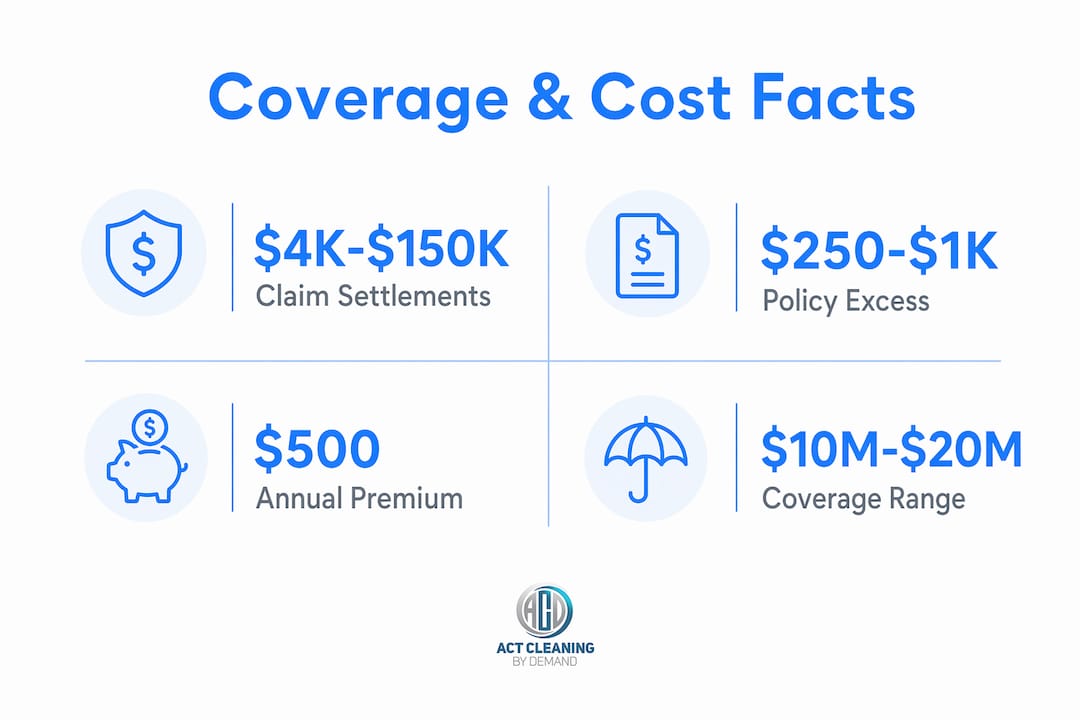
Typical claim settlements range from $4,000 to $150,000, with policy excesses usually sitting between $250 and $1,000. That range shows just how unpredictable a single incident can be financially.
Is public liability insurance legally required for Australian cleaners?
Public liability insurance is not legally mandatory for cleaning businesses in Australia, but the commercial reality makes it effectively compulsory. Contractors, strata managers, and commercial clients routinely require proof of cover before awarding work.
The standard coverage thresholds reflect the scale of the work:
| Contract type | Minimum coverage required |
|---|---|
| Residential cleaning | $10 million |
| Commercial cleaning | $20 million |
| Strata and body corporate | $20 million |
| Government contracts | $20 million or higher |
Annual premiums for a small cleaning business are genuinely affordable. A $10 million residential policy costs around $500 per year, while a $20 million commercial policy runs approximately $1,000 per year. Weighed against a single claim that could reach $150,000, the premium is not a cost. It is risk management.
Operating without cover also damages your reputation. When a prospective commercial client asks for your Certificate of Currency and you cannot provide one, the conversation ends. Insurance is a credibility signal that tells clients you run a serious, accountable business. You can see how this connects to how cleaning quotes work in practice: clients who ask detailed questions about pricing also ask about insurance.
Common claims cleaning businesses face and how insurance responds
Real claims give you a clearer picture of the risk than any policy document. These are the incidents that actually happen.
Slip-and-fall on a wet floor. A client or visitor slips on a freshly mopped surface and fractures a wrist. They claim medical costs, lost income, and pain and suffering. Without insurance, you pay that out of your own pocket. With insurance, your insurer manages the claim and covers the settlement.
Accidental damage to a client's rug. A cleaner moves a Persian rug to vacuum underneath and tears it. The client claims replacement value. This is exactly the scenario that care, custody, and control exclusions can leave uncovered under a standard policy. A specific endorsement is needed to close that gap.
Chemical damage to a stone benchtop. A cleaner uses an acidic product on a marble surface, etching it permanently. The client claims the cost of resurfacing or replacement. Understanding why professional cleaners use chemicals and the risks they carry is part of managing this exposure.
"A single uninsured claim does not just cost money. It can end a business that took years to build."
Floor damage during routine cleaning. Abrasive pads used on the wrong floor type leave permanent scratches. The client claims the cost of refinishing. For businesses that offer floor cleaning services, this is a real and recurring risk.
The financial unpredictability of these claims is the core argument for adequate cover. A $500 annual premium is a straightforward trade for protection against a $50,000 settlement.
Policy details and endorsements you must get right
Having a public liability policy is not enough on its own. The specific endorsements on that policy determine whether you can actually use it when you need it.
-
Request a care, custody, and control endorsement. Standard policies exclude damage to property in your care, custody, and control. A Bailee's endorsement or care, custody, and control extension covers client property you handle directly, such as ornaments moved during cleaning or equipment left in your care.
-
Confirm mould and bacteria cover. Standard policies exclude mould and bacteria claims. If you offer mould remediation or work in environments where this risk exists, ask your broker to remove the exclusion or add specific cover.
-
Obtain the correct Certificate of Currency. Commercial clients often require a Certificate of Currency that names them as an Additional Insured and includes Primary and Non-Contributory clauses. Without these endorsements, a contract can be rejected even when your coverage limits are correct.
-
Work with a specialist broker. Confusion between types of insurance is common in the cleaning industry. A broker who understands cleaning business risks can tailor your policy to match the contracts you are actually bidding for.
-
Review your policy annually. As your business grows and you take on larger contracts, your coverage requirements change. A policy that was adequate for residential work may fall short for a commercial strata contract.
Pro Tip: Before signing any commercial contract, send the insurance requirements clause to your broker and ask them to confirm your policy meets every condition. Do not assume it does.
How public liability fits into your broader insurance strategy
Public liability insurance covers third-party claims, but it does not cover everything a cleaning business faces. Relying on it alone leaves real gaps.
- Workers' compensation covers your employees if they are injured on the job. Public liability does not cover employee injury. In most Australian states, workers' compensation is legally required the moment you employ staff.
- Surety bonds protect clients against theft by your employees. They are increasingly requested by residential clients and are separate from liability cover entirely.
- Tools and equipment insurance covers your own gear if it is stolen or damaged. Public liability only covers damage you cause to others.
- Management liability becomes relevant as your business grows and you take on staff and contractual obligations.
A complete insurance strategy treats public liability as the foundation, not the whole structure. Each policy covers a distinct exposure, and gaps between them are where businesses get hurt.
Key takeaways
Public liability insurance is the single most important financial protection a cleaning business can hold, covering third-party injury and property damage claims that can reach $150,000 or more.
| Point | Details |
|---|---|
| Coverage is effectively mandatory | Commercial and strata clients require $10M–$20M cover before awarding contracts. |
| Premiums are affordable | A $10M policy costs around $500 per year, making cover accessible for sole traders. |
| Exclusions create real gaps | Standard policies exclude care, custody, and control claims and mould exposure without specific endorsements. |
| Endorsements determine usability | Certificates of Currency must name Additional Insureds and include Primary and Non-Contributory clauses for contract compliance. |
| Public liability is not enough alone | Workers' compensation, surety bonds, and equipment cover address risks that public liability does not. |
The real cost of getting this wrong
I have spoken with cleaning business owners who discovered their policy had a gap only after a claim was denied. One operator had a $20 million policy but no care, custody, and control endorsement. A client's antique vase was broken during a clean, and the insurer declined the claim on that basis. The settlement came out of the owner's savings.
The lesson is not just to have insurance. It is to understand what your policy actually covers. Most business owners read the coverage limit and stop there. The exclusions section is where the real story is told.
I also think the industry undersells insurance as a growth tool. When you present a Certificate of Currency with the right endorsements to a commercial client, you are not just ticking a box. You are demonstrating that you run a professional operation. That matters to facility managers and strata committees who are accountable for the contractors they hire.
My advice is to spend one hour with a specialist insurance broker every year. Review your contracts, your coverage, and your exclusions together. That one hour is worth more than any amount of time spent chasing new clients without the right protection in place.
— Deng
Insured, professional cleaning you can count on
ACT Cleaning by Demand operates with full public liability insurance across all residential and commercial services. That means every job is backed by proper cover, giving you confidence that your property and your people are protected.
Whether you need end of lease cleaning that meets strict property manager requirements or reliable office cleaning for your commercial space, ACT Cleaning by Demand brings both the expertise and the insurance credentials that serious clients expect. Booking is straightforward through the website, and every service is tailored to your specific needs. Contact ACT Cleaning by Demand today to request your Certificate of Currency and get a quote from a team that takes professional accountability seriously.
FAQ
Is public liability insurance legally required for cleaning businesses in Australia?
Public liability insurance is not a legal requirement for cleaning businesses in Australia, but it is effectively mandatory. Most commercial, strata, and residential clients require proof of cover before engaging a cleaner.
How much public liability cover does a cleaning business need?
Residential cleaning contracts typically require $10 million in cover, while commercial and strata contracts require $20 million. Government contracts may require higher limits.
What does public liability insurance not cover for cleaners?
Standard policies exclude damage to property in your care, custody, and control, and claims arising from mould or bacteria exposure. Specific endorsements are needed to cover these risks.
How much does public liability insurance cost for a small cleaning business?
A $10 million policy costs approximately $500 per year, and a $20 million policy costs approximately $1,000 per year for a small cleaning business in Australia.
What is a Certificate of Currency and why does it matter?
A Certificate of Currency is a document that proves your insurance is active. Commercial clients often require it to include Additional Insured endorsements and Primary and Non-Contributory clauses before accepting your cover.