
Trained cleaning staff are the single most important factor in whether a cleaning company delivers consistent, profitable service or haemorrhages clients and cash. The difference between a cleaning business that grows and one that stalls almost always comes down to workforce competency, not equipment or pricing. Cleaning company owners who treat staff training as a cost centre rather than a revenue driver leave money on the table every single week. This guide explains the operational, financial, and cultural case for investing in skilled personnel, with practical frameworks you can apply immediately.
Why cleaning companies need trained staff: the operational case
Trained personnel in cleaning reduce the three most expensive operational problems: accidents, equipment damage, and cleaning errors. Each of these costs money directly, either through liability claims, repair bills, or repeat visits that eat into margins.
The health impact alone justifies the investment. Facilities with professional cleaning programmes experience up to 35% fewer short-term sick days among their own staff. That figure matters because your clients measure your value in outcomes, not hours worked. When your team reduces absenteeism inside a client's workplace, you become indispensable.

Well-trained cleaning teams also reduce client biohazards and absentee rates, increasing client operation productivity by 2.6%. That is a measurable return your clients can point to when renewing contracts.
Equipment maintenance is where untrained staff cause the most invisible damage. Failing to empty recovery tanks causes bacteria build-up that transfers directly to client surfaces, negating every cleaning benefit. A cleaner who does not know this is not just doing a poor job. They are actively making surfaces dirtier than before they arrived.
The benefits of skilled cleaners in this area extend beyond hygiene. Proper equipment care extends machine life, cuts repair costs, and prevents the embarrassment of a broken machine mid-job at a client site.
Key operational gains from trained cleaning staff include:
- Fewer repeat visits caused by missed areas or incorrect technique
- Lower equipment repair costs through correct handling and maintenance
- Reduced liability exposure from chemical misuse or slip hazards
- Consistent results that match the service standard promised at the point of sale
- Faster onboarding of new staff when documented procedures exist
Pro Tip: Build a simple equipment maintenance checklist into every shift handover. A two-minute tank check prevents a two-week bacteria problem.
How does training improve staff retention and company culture?
Staff turnover is the silent profit killer in the cleaning industry. Replacing an employee can cost up to two times their yearly salary, ranging from $25,000 to $100,000 in turnover costs. For a cleaning business operating on tight margins, that figure is catastrophic.
Training directly addresses this. 88% of organisations report employee retention as a primary concern, and providing learning opportunities is their top retention strategy. Cleaning companies that invest in skill development signal to staff that their work has a future, not just a roster.
The culture shift that comes with training is equally significant. Offering opportunities to train, mentor, and coach strengthens leadership pipelines and workforce engagement. A cleaner who mentors a new team member develops pride in their craft. That pride translates into lower turnover and higher service consistency.
"Training enables cleaners to understand the direct impact of their work on client business success, increasing their sense of pride and responsibility." — Training That Pays, 2026
A structured approach to building this culture involves four clear steps:
- Introduce training as a career pathway, not a probationary requirement. Frame it as progression, not compliance.
- Pair new staff with experienced mentors for the first four weeks. Peer coaching builds loyalty on both sides.
- Recognise competency milestones publicly. A simple acknowledgement in a team meeting reinforces that skill development is valued.
- Create a feedback loop where staff can flag process problems. This builds ownership and surfaces operational improvements you would otherwise miss.
The return on this investment compounds over time. A team that stays longer becomes more efficient, requires less supervision, and delivers the consistent quality that retains clients.
What makes an effective cleaning staff training programme?
The most common mistake cleaning company owners make is confusing information with training. Short instructional videos are not training. True training requires demonstration, supervised practice, and competency verification before a staff member works unsupervised. Owners who skip this step expose their business to the errors that cause client loss and, in many cases, cleaning business failure within the first two years.
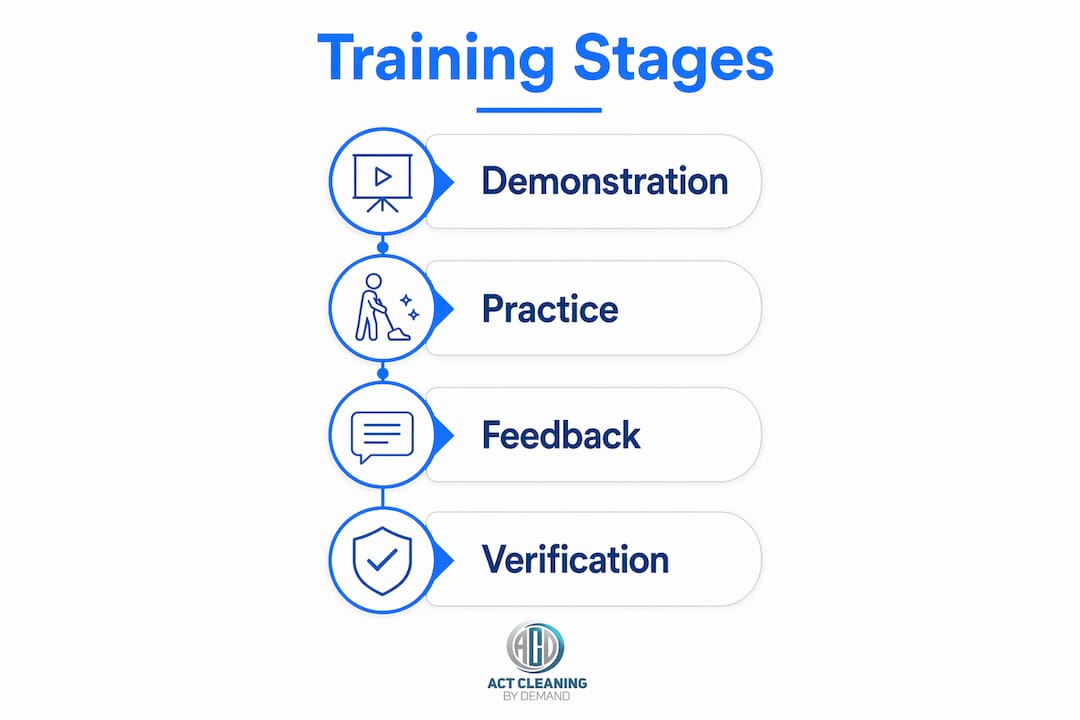
Effective training follows a structured plan with four non-negotiable stages: demonstration, practice, feedback, and verified competency. Each stage must be completed before the next begins. Rushing this process to fill a roster gap is how standards collapse.
The four stages of competency-based cleaning training
Demonstration means a trainer performs the task in full while the trainee observes. This is not a video. It is a live, contextual walkthrough of the exact environment and equipment the trainee will use.
Supervised practice follows immediately. The trainee performs the task while the trainer watches and corrects in real time. This stage should repeat across multiple sessions over one to two weeks, not in a single afternoon.
Feedback is structured and specific. "That corner was missed" is useful. "Good effort" is not. Feedback must reference the standard, not the person.
Competency verification is the final gate. The trainee completes the task independently while the trainer observes without intervening. Only a pass at this stage clears the staff member for unsupervised work.
Training plans with progress tracking help prioritise tasks and optimise resources across the entire workforce. A written plan also protects the business legally if a staff member causes damage and claims they were never trained.
Pro Tip: Tailor training content to the specific role. A commercial office cleaner and a residential end-of-lease cleaner face entirely different surfaces, chemicals, and client expectations. Generic training produces generic results.
Understanding why professional cleaners use chemicals safely and effectively is a core competency that must be verified, not assumed.
How does training translate into client retention and business growth?
Client retention is where the financial case for training becomes undeniable. Trained cleaning staff improve client satisfaction by consistently meeting quality standards and reducing complaints. Fewer complaints mean fewer service credits, fewer awkward calls, and fewer clients who quietly switch to another provider.
The link between customer satisfaction and business growth in the cleaning industry is direct. Clients who trust your team renew contracts, refer colleagues, and accept price increases without pushback. Clients who doubt your team's competency shop around at every renewal.
Training also supports premium pricing. A cleaning company that can demonstrate certified, competency-verified staff commands higher rates than one that cannot. Clients paying for office cleaning or end-of-lease services want assurance that the team knows exactly what they are doing. That assurance is only credible when it is backed by a real training programme.
The business growth benefits of skilled cleaners compound in several ways:
- Consistent quality reduces the cost of client acquisition by generating referrals
- Lower complaint rates free up management time for growth activities
- Staff who understand their impact on client success become better communicators with clients
- Verified competency becomes a marketing differentiator in proposals and tenders
- Reduced turnover lowers the cost of maintaining service standards across a growing client base
Understanding how to manage multiple cleaning crews efficiently becomes far simpler when every crew member has been trained to the same verified standard. Consistency at scale is only possible when training is systematic, not ad hoc.
Key takeaways
Trained cleaning staff are a profit driver, not a cost, and the evidence from operational performance, retention economics, and client satisfaction data all point in the same direction.
| Point | Details |
|---|---|
| Training reduces costly errors | Proper technique and equipment care prevent repeat visits, damage, and liability claims. |
| Turnover costs justify training spend | Replacing one employee can cost up to two times their annual salary, making retention investment obvious. |
| Competency verification is non-negotiable | Staff must demonstrate skill independently before working unsupervised, not just watch a video. |
| Training drives client retention | Consistent quality reduces complaints and builds the trust that leads to contract renewals and referrals. |
| Culture follows training investment | Mentoring and milestone recognition build loyalty, pride, and a workforce that stays. |
Training is not optional: a view from the field
The resistance I hear most often from cleaning company owners is some version of "I can't afford to spend time on training right now." After years of watching businesses grow and stall, I can say with confidence that the opposite is true. You cannot afford to skip it.
The owners who treat training as a one-off induction and then wonder why their staff turnover is high, their clients are unhappy, and their margins are shrinking are solving the wrong problem. They are cutting marketing spend, buying new equipment, and adjusting rosters when the actual issue is that nobody on their team has been properly shown how to do the work.
What I have seen work consistently is treating training as an ongoing system, not an event. The companies that build peer coaching into their culture, that verify competency before sending staff out alone, and that track progress formally are the ones that grow steadily and retain both staff and clients. They also charge more, because their service quality is demonstrably higher.
The upfront time investment in a proper training programme pays back within months. The cost of not doing it compounds quietly until it becomes a crisis.
— Deng
ACT Cleaning by Demand: where training meets consistent results
If you are a Canberra homeowner or business owner who wants the assurance of a trained, reliable cleaning team, ACT Cleaning by Demand delivers exactly that. Every service is backed by staff who know their work, their equipment, and the standards your property deserves.
ACT Cleaning by Demand offers custom cleaning packages tailored to residential and commercial needs across Canberra, from regular house cleaning to end-of-lease cleans that meet real estate standards. The booking process is straightforward, and the results are consistent because the team behind them is properly trained. For clients who want quality they can count on, ACT Cleaning by Demand is the clear choice.
FAQ
Why do cleaning companies need trained staff?
Trained staff deliver consistent results, reduce costly errors, and improve client satisfaction. Without verified competency, cleaning businesses face higher turnover, more complaints, and greater liability exposure.
What is the cost of poor training in a cleaning business?
Inadequate training contributes to cleaning business failure within the first two years. Replacing a single untrained employee who leaves can cost up to two times their annual salary in recruitment and onboarding expenses.
How does staff training affect client retention?
Trained cleaning staff consistently meet quality standards and generate fewer complaints, which builds client trust and reduces contract cancellations. Satisfied clients also refer new business, lowering acquisition costs.
What should a cleaning training programme include?
An effective programme includes demonstration, supervised practice, structured feedback, and competency verification before independent work. Progress tracking plans help prioritise development and protect the business legally.
Does training improve employee morale in cleaning companies?
Training signals that the employer values staff development, which directly improves job satisfaction and loyalty. Peer coaching and mentoring opportunities further strengthen engagement and reduce turnover.