Most property managers assume that once a cleaning contract is signed, invoicing will be the easy part. It rarely is. Why commercial cleaning invoicing is complex comes down to a collision of Australian tax law, inconsistent pricing models, disjointed scheduling systems, and payment terms that vary by vendor. Each factor alone is manageable. Together, they create a billing environment that regularly surprises even experienced property managers, particularly those overseeing multiple sites with different cleaning scopes and service frequencies.
Table of Contents
- Understanding Australian tax invoice requirements for cleaning services
- How operational scheduling and pricing complicate cleaning invoices
- Payment terms and cash flow effects for property managers
- Pricing models and invoice line-item challenges in commercial cleaning
- Best practices for managing complex cleaning invoices efficiently
- Why traditional invoicing methods no longer work for commercial cleaning
- How ACT Cleaning by Demand simplifies your commercial cleaning invoicing
- Frequently asked questions
Key Takeaways
| Point | Details |
|---|---|
| Australian GST requirements | Invoices must include specific legal details and GST information to be valid and support tax credits. |
| Scheduling integration importance | Aligning planning, time tracking, and billing reduces errors and invoicing delays. |
| Payment term impact | Net 15 and Net 30 terms influence cash flow and vendor invoice management timing. |
| Pricing model variety | Different pricing models complicate invoice line-item standardisation and budget comparisons. |
| Effective invoice management | Standardised categories and audit trails help property managers approve invoices efficiently. |
Understanding Australian tax invoice requirements for cleaning services
To fully grasp why cleaning invoicing is challenging, start with the strict Australian tax invoice rules vendors must follow. In Australia, a tax invoice is not just a payment request. It is a legal document that supports GST reporting, input tax credit claims, and compliance with the Australian Taxation Office. If the invoice is wrong, your ability to claim credits may be compromised.
Australian tax invoice requirements specify that every compliant invoice must include:
- The supplier's legal name and ABN
- The invoice issue date
- A clear description of the services provided
- The GST amount, or a statement that the total price includes GST
- For invoices of $1,000 or more, the recipient's name or ABN
That last point catches many property managers off guard. A cleaning invoice for a large commercial fitout or a post-construction clean will almost certainly exceed $1,000, meaning your details must appear on the document. If a vendor sends an invoice without your ABN, you cannot simply accept it and move on. You need to request a corrected version before processing payment or lodging your BAS (Business Activity Statement).
The compliance burden does not sit entirely with the cleaning company. As the recipient, you are responsible for ensuring the invoices you process are valid. This means your accounts team needs a checklist for every invoice received, not just a quick scan before approval.
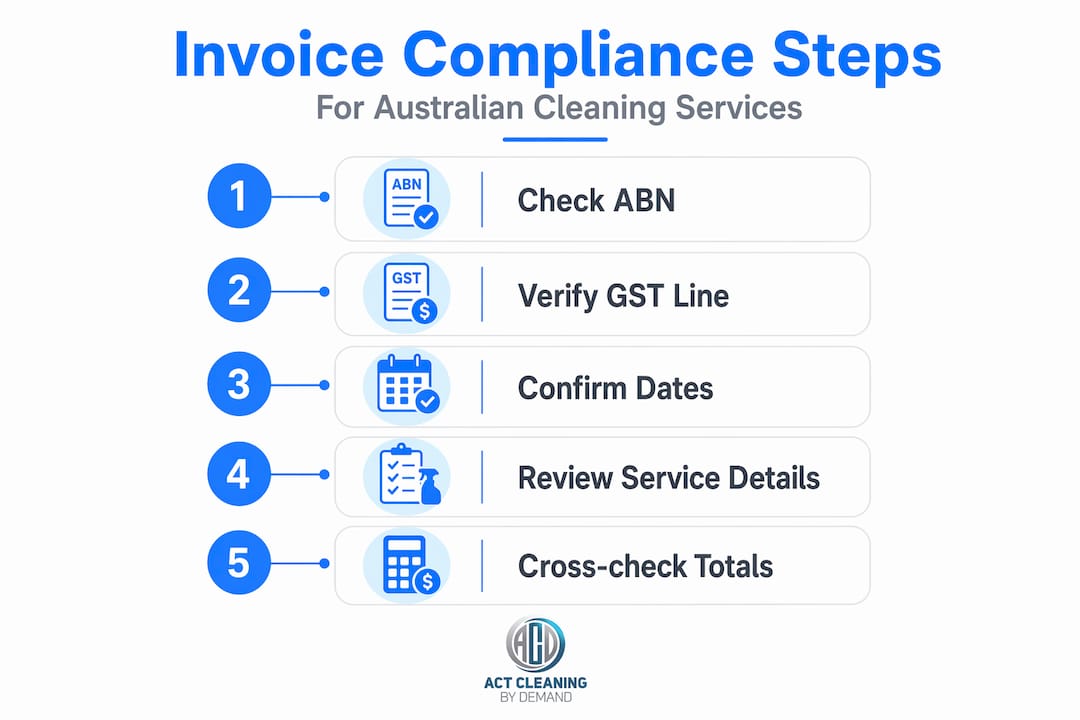
Pro Tip: Create a one-page invoice checklist specific to your cleaning vendors. Include ABN verification, GST line confirmation, and recipient details for invoices over $1,000. This cuts approval time and reduces compliance risk in a single step.
Understanding Australian cleaning invoice legalities is also relevant when working with specialised cleaning providers, where service descriptions must be precise enough to justify the charge.
How operational scheduling and pricing complicate cleaning invoices
Beyond legal invoice requirements, day-to-day operational management heavily influences invoice complexity. The core problem is that scheduling and billing are often handled by separate systems, or worse, separate people. When a cleaner reschedules a visit, adds an extra task, or skips a service due to access issues, that change needs to flow through to the invoice. In practice, it frequently does not.
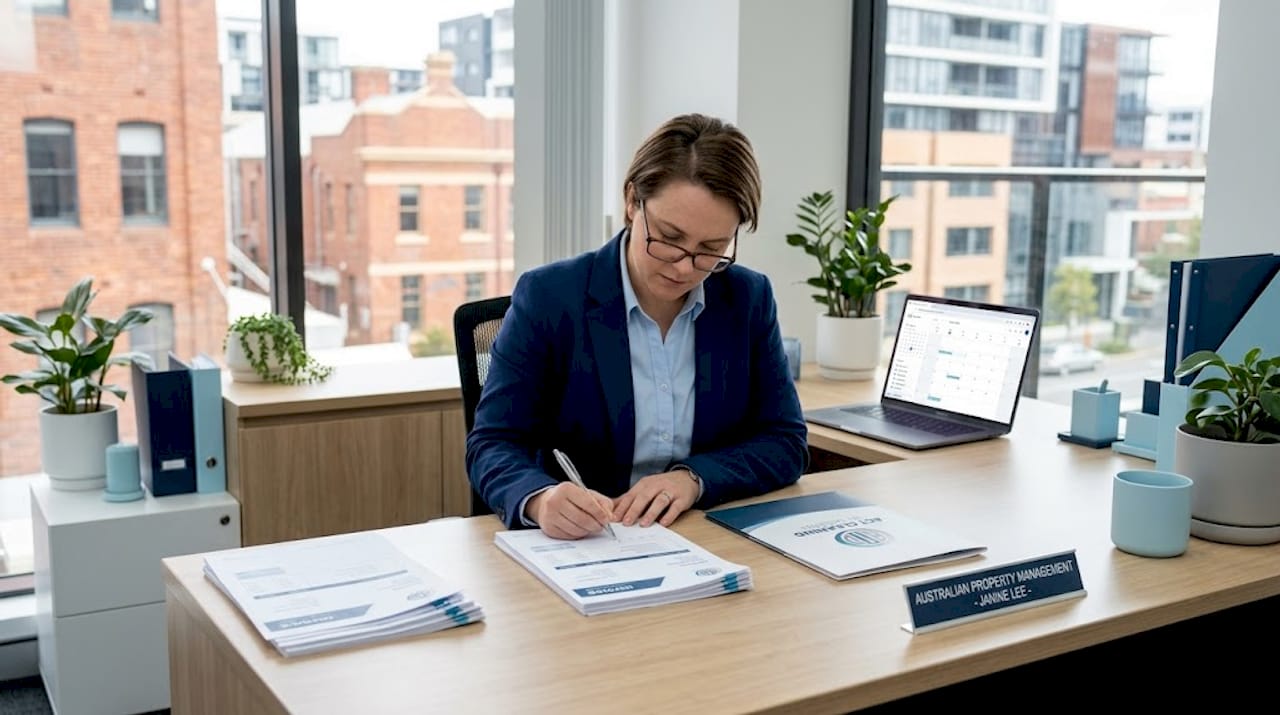
Cleaning invoicing complexity grows as the number of sites, clients, schedules, and pricing rules increases, especially when scheduling and billing are handled separately, causing manual data transfer and errors. For a property manager overseeing five or ten sites, this is not a minor inconvenience. It is a recurring reconciliation problem.
Common operational issues that affect invoice accuracy include:
- Rescheduled visits billed at the original date, causing confusion during period-end reviews
- Ad hoc tasks added on-site but not captured in the billing system
- Scope changes agreed verbally but never documented in writing
- Different pricing applied to the same service type across multiple sites
| Scenario | Manual invoicing outcome | Integrated invoicing outcome |
|---|---|---|
| Rescheduled visit | Billed on original date, requires correction | Auto-updated to actual service date |
| Extra task added on-site | May not appear on invoice | Captured via job notes and billed correctly |
| Scope change mid-contract | Verbal agreement, no paper trail | Documented and linked to invoice line item |
| Multiple sites, different pricing | Manual rate lookup, error-prone | Pricing rules applied automatically per site |
Managing cleaning service line-item breakdowns across multiple properties becomes exponentially harder without a system that connects what was scheduled, what was done, and what was charged.
Pro Tip: Ask your cleaning vendor directly whether their scheduling and billing systems are integrated. If they use separate tools for each, build extra time into your invoice approval process to allow for manual verification.
If you manage multi-site cleaning operations, the operational complexity alone justifies demanding a vendor who can provide itemised, site-specific invoices rather than consolidated billing that obscures individual service costs.
Payment terms and cash flow effects for property managers
Not only do invoice details and operations add complexity, but payment timing further impacts budgeting for property managers. The two most common payment terms you will encounter are Net 15 and Net 30. Understanding the difference matters more than most property managers realise.
Net 15 requires payment within 15 days of the invoice date, while Net 30 allows 30 days. The gap between those two windows has real cash flow consequences, especially when you are managing multiple cleaning vendors with different terms.
| Payment term | Days to pay | Cash flow impact | Best suited to |
|---|---|---|---|
| Net 15 | 15 days | Tight turnaround, requires prompt processing | High-frequency services, smaller invoices |
| Net 30 | 30 days | More flexibility for budget alignment | Larger contracts, monthly billing cycles |
| Net 7 | 7 days | Very tight, often seen in casual arrangements | One-off or emergency cleaning jobs |
| End of month (EOM) | Varies | Predictable but can extend actual payment window | Ongoing contracts with monthly invoicing |
Key considerations for managing cleaning payment terms impact across your portfolio:
- Confirm payment terms in writing before signing any cleaning contract
- Align vendor payment terms with your own accounts payable cycle where possible
- Track invoice receipt dates, not just due dates, to avoid late payment fees
- Negotiate consistent terms across vendors to simplify your budgeting calendar
When vendors use different payment terms, your accounts team must manage multiple due-date timelines simultaneously. A single missed Net 15 invoice can trigger late payment clauses, damage the vendor relationship, or disrupt a cleaning schedule if the vendor pauses services pending payment.
Pricing models and invoice line-item challenges in commercial cleaning
Adding to operational and timing complexities, the varied pricing models also make invoice formats harder to standardise. Commercial cleaning is not priced uniformly, and understanding why cleaning services charge differently is essential for accurate budget forecasting.
Commercial cleaning pricing varies between per-square-metre, hourly, and flat-rate models, influenced by frequency, building type, labour, supplies, and specialty work. Here is how those models typically appear on invoices:
| Pricing model | How it appears on invoices | Common use case |
|---|---|---|
| Per square metre | Line item with area measurement and rate | Regular office or retail cleaning |
| Hourly rate | Hours worked multiplied by rate per cleaner | Variable scope jobs, casual engagements |
| Flat rate | Fixed fee per visit or per period | Predictable recurring services |
| Specialty pricing | Separate line items at different rates | Window cleaning, carpet steam, post-construction |
The challenge for property managers is that a single invoice may contain all four pricing models. A monthly office cleaning invoice might include a flat-rate base fee, hourly charges for extra tasks, a per-square-metre rate for carpet cleaning, and a separate fixed price for window cleaning. Reconciling that against your budget requires line-item literacy, not just a total figure.
Here is how to approach invoice standardisation across your cleaning vendors:
- Request a sample invoice before signing any contract so you can assess line-item clarity
- Specify in your contract which pricing model applies to each service category
- Ask for a separate line item for every service type, even if bundled at a flat rate
- Require that specialty or one-off services be quoted in writing before they appear on an invoice
- Cross-reference pricing for specialty cleaning services against your contract rates at each invoice cycle
Pro Tip: Build a simple invoice template in a spreadsheet that mirrors your expected line items. When a vendor invoice arrives, map it to your template. Any gaps or unexpected charges become immediately visible without having to read the invoice line by line.
For a broader view of how cleaning pricing models affect service positioning and cost structures, it helps to understand the industry context behind how vendors set their rates.
Best practices for managing complex cleaning invoices efficiently
Understanding the challenges leads naturally to practical strategies property managers can implement to ease invoicing complexity. The goal is not to become an expert in cleaning operations. It is to build a process that catches errors before they become disputes.
Creating an audit trail tying invoice lines to job scope changes is the hardest part of cleaning invoice management. Integrated systems that align planned, executed, and billed work reduce errors and disputes significantly.
Follow these steps to build a more reliable invoice management process:
- Integrate scheduling with billing. Ask vendors whether their job management system automatically generates invoices from completed work orders. If not, require written sign-off on each visit before billing.
- Standardise your line-item categories. Create a consistent set of service categories across all your cleaning vendors. This makes budget comparisons and period-end reporting far simpler.
- Maintain a variation log. Every time a service is added, removed, or changed, document it in writing. Reference that variation number on the corresponding invoice line item.
- Review invoices before approving, not after. Build a two-day review window into your approval process. Catching errors before payment is far less disruptive than chasing credits afterwards.
- Conduct quarterly invoice audits. Compare invoiced services against your contract scope every three months. Scope creep, where vendors gradually bill for services not in the original agreement, is common and rarely intentional.
"The hardest part is not calculating totals. It is building an audit trail for each invoice line linked to job changes. Without this, property managers waste time reconciling rather than approving invoices."
Good handling of cleaning invoices starts with clear communication at the contract stage. If your vendor knows you expect itemised invoices with variation references, they will structure their billing accordingly from day one.
Why traditional invoicing methods no longer work for commercial cleaning
Here is the uncomfortable reality that most articles on this topic avoid: the invoicing problems property managers face are not caused by difficult vendors or complicated tax rules. They are caused by outdated, disconnected processes that were never designed for the scale and variability of modern commercial cleaning.
Manual invoicing, spreadsheet-based tracking, and verbal scope agreements made sense when a property manager oversaw one or two buildings with a single cleaning company. Today, the same manager might handle ten sites, three vendors, four pricing models, and a dozen service variations per month. The old approach cannot scale, and the friction shows up as invoice errors, approval delays, and budget overruns.
The real shift that needs to happen is not just on the property manager's side. Cleaning vendors who still send PDF invoices built from a Word template, with no connection to their scheduling system, are creating avoidable problems for their clients. The audit trail problem is not a minor administrative inconvenience. It is a structural weakness in how cleaning services are delivered and billed.
Property managers should actively favour vendors who use modern cleaning service management platforms that connect job scheduling, task completion, and invoice generation in a single workflow. When you evaluate a new cleaning vendor, ask to see a sample invoice and ask how it was generated. If the answer is "we type it up manually," that is important information about the reconciliation work you are inheriting.
The vendors who invest in integrated systems are not just easier to work with. They are demonstrating a level of operational maturity that correlates with fewer service errors, better communication, and more reliable billing. That is worth paying for.
How ACT Cleaning by Demand simplifies your commercial cleaning invoicing
Managing the complexities of cleaning invoicing across multiple sites is demanding enough without adding billing confusion to the mix. ACT Cleaning by Demand provides compliant, itemised tax invoices that meet Australian GST requirements, with clear line-item breakdowns that make budget reconciliation straightforward rather than stressful.
Their integrated approach to scheduling and billing means that what is agreed in the contract is what appears on the invoice, with no surprises. Whether you need professional office cleaning services, specialist end of lease cleaning, or comprehensive house cleaning for managed properties, ACT Cleaning by Demand consolidates your service needs under one reliable vendor. That means fewer invoices to manage, consistent billing formats, and a dedicated team ready to address any variation or query before it becomes a reconciliation problem.
Frequently asked questions
What must a commercial cleaning invoice include to comply with Australian GST rules?
It must show the supplier's legal name, ABN, invoice date, service details, and GST amount or a GST-inclusive statement. For invoices over $1,000, it must also include the buyer's name or ABN.
Why do cleaning invoices often require manual corrections?
Because scheduling and billing are frequently managed separately, operational changes like reschedules or extra tasks may not automatically update the invoice. Separate systems cause manual data transfer errors that require correction before payment can be processed.
How do payment terms like Net 15 and Net 30 affect property managers?
They determine how quickly payment is due after the invoice date, directly affecting cash flow and budget timing. Net 15 and Net 30 terms also determine when follow-up for overdue payments must begin, which matters when managing multiple vendors simultaneously.
What pricing models impact commercial cleaning invoicing complexity?
The three main models are per-square-metre, hourly, and flat-rate, and a single invoice may include all three for different service types. Pricing varies by frequency, building type, labour costs, and specialty work, making line-item standardisation across properties genuinely difficult.
How can property managers reduce invoicing errors in commercial cleaning?
Use integrated scheduling and invoicing systems, standardise invoice categories across vendors, and maintain a written variation log. Integrated systems align planned, completed, and billed work, which is the most effective way to reduce disputes and approval delays.