
Specialised cleaning is defined as cleaning services that target specific, high-risk, or technically complex environments requiring trained personnel, dedicated equipment, and documented protocols. This is why specialised cleaning earns more: it solves problems that general cleaning cannot, and clients pay a premium for that certainty. Specialised services charge 20%–50% more than general cleaning, with profit margins reaching 25%–65% compared to the 10%–20% typical of standard residential or commercial work. For cleaning professionals and entrepreneurs, that gap represents a genuine business model shift, not just a pricing tweak.
Why specialised cleaning earns more than general cleaning
The financial advantage of specialised cleaning comes down to one principle: clients pay for outcomes, not hours. A general cleaner charges for time. A specialist charges for a guaranteed result, whether that is passing a rental inspection, meeting healthcare hygiene standards, or clearing a post-construction site for handover.
73% of cleaning business owners surveyed in 2026 expect to earn more than the previous year, with over half raising prices without losing clients. That confidence reflects a market that has matured past price shopping and now values reliable, documented outcomes.

Specialised cleaning also builds what economists call a defensible position. Clients in healthcare, food production, or rental property management cannot afford failures. A contaminated medical facility or a failed end-of-lease inspection carries real financial and legal consequences. Clients who cannot afford failure stop treating their cleaner as a commodity and start treating them as a necessity. That shift in perception is where premium pricing becomes sustainable.
Which niches pay the most, and why?
Not every specialisation earns equally. The highest-paying niches share two traits: high stakes for the client and a meaningful barrier to entry for the cleaner.
Post-construction cleaning sits at the top of the earnings table. Post-construction rates run two to three times higher than standard cleaning because the work involves removing paint overspray, grout haze, and construction debris that general cleaners are neither trained nor equipped to handle. Builders and developers pay for speed and precision because delays cost them money.
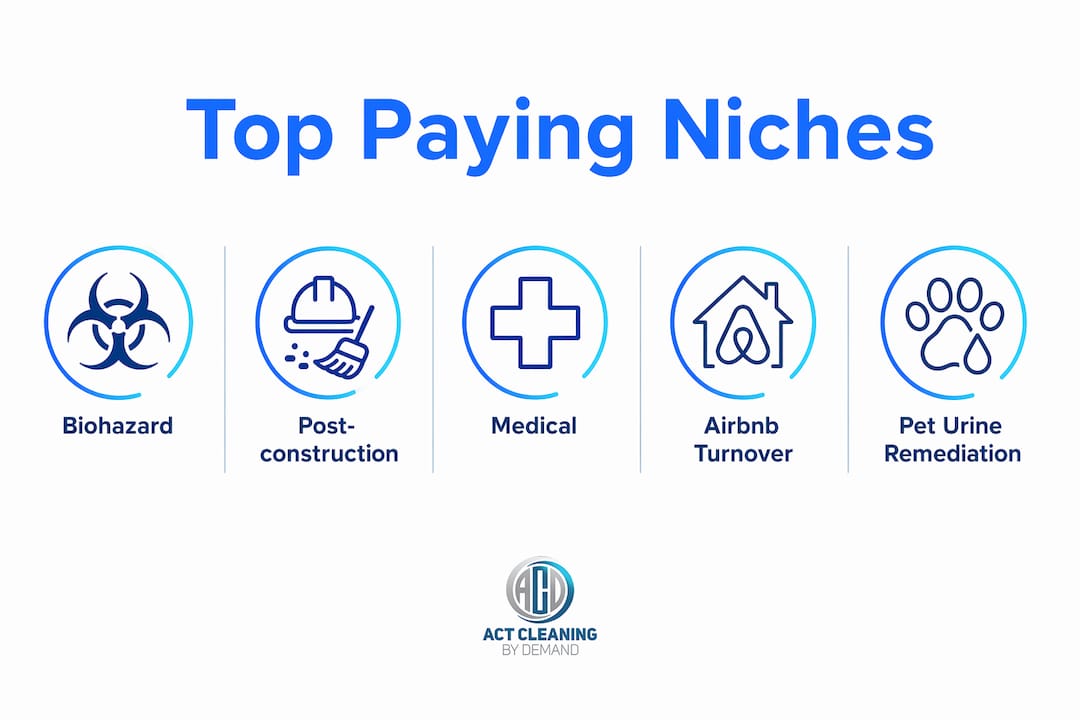
Medical and healthcare cleaning demands compliance with infection control standards and generates recurring revenue. Healthcare facilities clean multiple times weekly, and a single contract can outperform ten residential clients in revenue terms.
Airbnb and short-term rental turnovers reward speed and consistency. Property managers need reliable same-day turnovers, and they pay above-market rates for cleaners who can guarantee a five-star presentation every time. Specialised rental cleaning directly protects a landlord's review score and booking income, which makes the service non-negotiable rather than optional.
Pet urine remediation is a lower-barrier entry point with strong margins. Pet urine specialists charge 40%–70% more than generalists for the same square footage because the work requires enzyme treatments, UV detection, and subfloor assessment that standard carpet cleaning does not cover.
Biohazard remediation carries the highest rates of all, reflecting the training, personal protective equipment, and regulatory compliance required. Entry is slower, but the pricing power is unmatched by any other niche.
| Niche | Relative rate vs. general cleaning | Key barrier to entry |
|---|---|---|
| Post-construction | 2–3 times higher | Physical intensity, specialist techniques |
| Medical and healthcare | Significantly higher | Infection control certification, recurring compliance |
| Airbnb turnovers | Moderately higher | Speed, consistency, property manager relationships |
| Pet urine remediation | 40%–70% higher | Enzyme treatment knowledge, UV detection equipment |
| Biohazard remediation | Highest of all niches | Regulatory training, PPE, licensing |
How compliance and documentation increase what you can charge
Documented cleaning protocols are not just an administrative task. They are a pricing asset. In regulated industries such as healthcare and food production, clients must demonstrate to auditors that their cleaning meets specific standards. A cleaner who arrives with a written, risk-based site specification gives that client something a generalist cannot: audit-ready evidence.
Written, risk-based documentation separates consistent, high-value cleaning from generic work. It tells the client exactly what will be cleaned, how, with which products, and at what frequency. That specificity reduces the client's risk and justifies a higher contract price.
The benefits of documented compliance protocols include:
- Reduced client liability. A written protocol shows due diligence if an incident occurs.
- Faster contract renewals. Clients in regulated sectors renew with providers who make their compliance reporting easier.
- Higher staff consistency. Documented procedures mean any trained team member can deliver the same result, which protects your reputation at scale.
- Stronger referral rates. Clients who trust your documentation refer you to peers in the same industry, where your protocols are already relevant.
Health and safety compliance protocols in specialised cleaning reduce sick days by 44% and extend medical asset life by 30%. Those numbers give healthcare clients a financial reason to pay more, not just a hygiene reason.
Pro Tip: Build a one-page site-specific cleaning specification for every new commercial client. Include product names, dilution rates, frequencies, and sign-off fields. Clients in regulated industries will treat this document as part of their compliance file, which makes switching to another cleaner far more difficult.
Understanding how residential cleaning standards differ from commercial ones also helps you price correctly when crossing between sectors.
Operational advantages: efficiency, loyalty, and pricing power
Specialisation simplifies every part of running a cleaning business. When you focus on one or two niches, your marketing message becomes clear, your equipment list stops growing, and your staff training becomes repeatable. That efficiency directly improves your margins.
Specialised clients also show lower price sensitivity. Clients pay premiums for guaranteed outcomes like passing inspections or fast rental turnovers because the cost of failure exceeds the cost of the service. A landlord who loses a week's rent because of a failed bond inspection will not quibble over a $50 price increase.
Add-on services during scheduled visits are one of the fastest ways to grow revenue without growing your client list. Adding services like window cleaning or steam sanitisation during a scheduled visit yields nearly 90% margin because the transport cost is already absorbed. Cross-selling to existing clients costs a fraction of acquiring new ones, and specialised clients are already primed to trust your recommendations.
The steps to building pricing power through specialisation follow a clear sequence:
- Choose a niche with genuine demand in your area. Research local property managers, healthcare facilities, or construction companies before committing to a specialisation.
- Invest in the right equipment and training. The upfront cost is the barrier that keeps competitors out and justifies your premium.
- Document your process before you pitch your first client. A written protocol signals professionalism before you have a track record.
- Price on outcomes, not hours. Quote based on the result you deliver, not the time it takes. This is the single biggest shift that separates profitable specialists from busy generalists.
- Build referral systems into every client relationship. Ask for introductions to peers in the same industry. A healthcare facility manager knows other healthcare facility managers.
Pro Tip: Niche SEO strategies focused on topical depth can outrank generalist sites in 9–15 months. Build multiple pages targeting specific subqueries like "medical cleaning Canberra" or "post-construction clean ACT" rather than competing on the generic term "cleaning services."
Retaining commercial cleaning clients long-term depends on the same principles: consistent outcomes, clear communication, and documented service delivery.
How long does it take to reach profitability in a specialised niche?
The timeline to profitability varies significantly by niche, and setting realistic expectations protects you from underinvestment or early exit.
Low-barrier niches reach profitability within 30–60 days, while certified niches such as medical or biohazard cleaning typically require 60–120 days to secure the first contract. That gap reflects the time needed for training, certification, and building the client relationships that regulated industries require before signing any agreement.
Key factors that shape your timeline include:
- Certification requirements. Pet urine remediation and Airbnb turnovers need minimal formal certification. Medical cleaning and biohazard work require documented training and, in some cases, licensing.
- Equipment investment. Post-construction and biohazard niches require upfront equipment purchases that delay break-even but dramatically increase per-job revenue once operational.
- Referral network development. Specialised clients rarely find their cleaners through generic advertising. Property managers, healthcare procurement officers, and construction site managers rely on referrals. Building those relationships takes time but produces contracts that renew automatically.
- Scaling from one contract to recurring revenue. The first specialised contract is the hardest to win. The second comes faster because you now have a documented track record and a reference client in the same industry.
Operators who specialise report better client retention and referral rates than generalists. That compounding effect means the investment in specialisation pays back not just in higher rates per job, but in a more stable, predictable revenue base over time.
Key takeaways
Specialised cleaning earns more because it delivers high-stakes outcomes that clients cannot source from general cleaners, creating pricing power, loyalty, and margins that generalist work cannot match.
| Point | Details |
|---|---|
| Premium pricing is structural | Specialised services charge 20%–50% more than general cleaning, with profit margins of 25%–65%. |
| Compliance documentation is a pricing asset | Written protocols give regulated-sector clients audit-ready evidence, justifying higher contract prices. |
| Add-on services multiply margins | Services added during scheduled visits carry near-90% margin because transport costs are already absorbed. |
| Niche focus builds client loyalty | Specialised clients show lower price sensitivity and refer peers in the same industry, compounding growth. |
| Timeline varies by niche | Low-barrier niches reach profitability in 30–60 days; certified niches typically take 60–120 days for the first contract. |
The case for picking a lane and staying in it
I have spoken with cleaning operators who spent years chasing every type of job, from domestic vacuuming to office fit-outs, and most of them describe the same experience: constant quoting, thin margins, and clients who leave for a $10 saving. The ones who turned their businesses around did one thing differently. They stopped trying to be everything and became the best at one specific problem.
The temptation to stay general is understandable. It feels safer to say yes to every enquiry. But generalism keeps you in a price war you cannot win, because there will always be someone cheaper. Specialisation removes you from that competition entirely.
The operators I find most credible are the ones who chose their niche based on two honest questions: What can I tolerate doing repeatedly, and who in my area genuinely needs this done well? A cleaner who hates the smell of pet odours will not last in pet urine remediation, no matter how good the margins are. But a cleaner who is methodical, comfortable with documentation, and willing to invest in training will thrive in medical or post-construction work.
My strongest advice is to resist underpricing your specialisation. The moment you discount to win a contract in a specialised niche, you signal that your expertise is negotiable. It is not. Charge what the outcome is worth, document everything, and let your track record do the selling.
— Deng
Tailored cleaning packages built for specialised results
ACT Cleaning by Demand offers customised cleaning packages designed around the specific needs of residential and commercial clients across Canberra. Whether you need a reliable end-of-lease clean that meets bond inspection standards or a recurring office cleaning programme with documented protocols, ACT Cleaning by Demand builds the service around the outcome you need.
Every package is backed by eco-friendly products, trained staff, and a booking process that removes the scheduling hassle. ACT Cleaning by Demand's focus on quality over volume means clients get consistent results and a provider they can trust to show up and deliver, every time.
FAQ
What makes specialised cleaning more profitable than general cleaning?
Specialised cleaning targets high-stakes outcomes that clients cannot source elsewhere, which removes price competition and supports margins of 25%–65% compared to 10%–20% for general cleaning.
How much more can a specialised cleaner charge per job?
Specialised services typically charge 20%–50% more than general cleaning, with post-construction rates running two to three times higher and pet urine remediation commanding 40%–70% more per square metre.
How long does it take to start earning from a specialised niche?
Low-barrier niches such as Airbnb turnovers reach profitability within 30–60 days. Certified niches such as medical or biohazard cleaning typically require 60–120 days to secure the first contract.
Do I need formal certification to specialise in cleaning?
It depends on the niche. Airbnb turnovers and pet urine remediation require minimal formal certification. Medical cleaning and biohazard remediation require documented safety training and, in some jurisdictions, specific licensing.
Is specialised cleaning worth the upfront investment in equipment and training?
The upfront cost is the barrier that keeps competitors out and justifies premium pricing. Operators who specialise report better client retention, higher referral rates, and more stable recurring revenue than generalists.