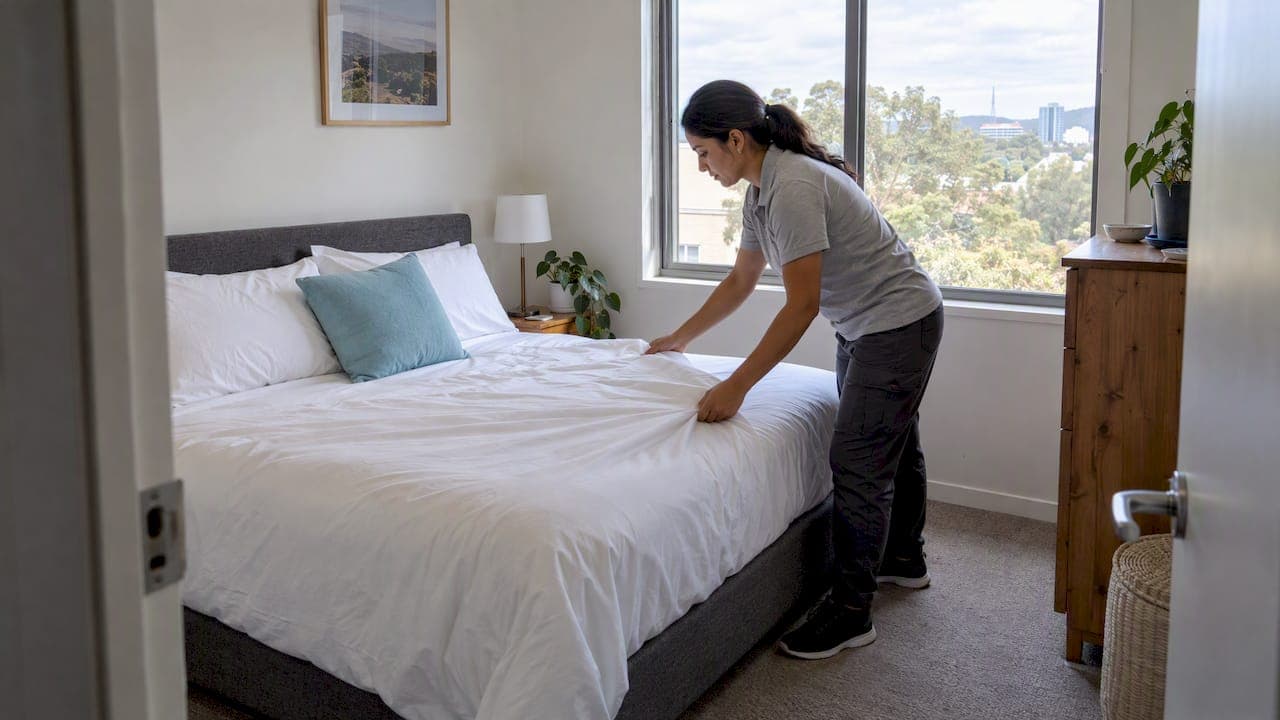
Airbnb turnover time is the gap between one guest leaving and the next arriving, and the working time a cleaner needs inside that gap. For a studio or one-bedroom, the clean itself usually takes 1 to 1.5 hours. For a four-bedroom home or larger it can run 3.5 to 5 hours, and a heavily used stay can take much longer. The window you set must be longer than the cleaning time, because access, laundry, restocking and checks all take minutes that never show up on a checklist.
Below, we break down the numbers by property size, show how to calculate your real working window, and explain what to change when the schedule is too tight. We are a Canberra cleaning company, so the examples are written for ACT hosts.
TL;DR
- A standard turnover clean takes roughly 1 to 1.5 hours for a studio or 1-bedroom and 3.5 to 5 hours for a 4-bedroom or larger, before any problems.
- The window between checkout and check-in is not the working time. Subtract access, inspection, linen, restocking and a buffer, and a four-hour gap often leaves about three.
- On-site laundry is the biggest schedule stretcher, adding around 1 to 1.5 hours. Spare linen sets remove most of it.
- Guest mess, pools or spas, multi-storey layouts and damage can make a same-day reset unrealistic. Plan a longer gap or a later check-in for those homes.
- Set a checkout time that suits the property, not the other way around, and brief your cleaner the same way every time.
Table of Contents
- What turnover time means for a cleaner
- How long a turnover clean takes by property size
- Work out your real window
- What stretches a turnover
- How to finish a turnover inside the window
- Why the time matters for your ratings
- What affects the cost of a turnover clean
- Our view on turnover time
- Book a turnover clean in Canberra
- FAQ
- Sources
What turnover time means for a cleaner
Hosts and cleaners use the phrase differently, and that is where most scheduling arguments start.
For the host, turnover time is the calendar gap: checkout at 10am, check-in at 3pm, so five hours. For the cleaner, it is the working time they can actually spend in the property. One is a number on the booking calendar. The other is what decides whether the place is ready.
A cleaner's working time includes more than scrubbing. One Australian provider's guide says a safe allowance should cover access, inspection, communication, cleaning, linen, restocking, final presentation and reporting any problems, not only active cleaning (Tas Clean Solutions). That matches what we see on short-stay jobs: the last ten minutes, walking through, photographing and flagging a chipped glass or a missing remote, is often what protects your review score.
How long a turnover clean takes by property size
Size is the starting point. The commonly quoted baselines from a turnover guide for hosts look like this, with the heavy-use figure being what a messy stay can push the job to:
| Property | Typical turnover clean | Heavy-use stay |
|---|---|---|
| Studio or 1-bedroom | 1 to 1.5 hours | Up to 2 hours |
| 2-bedroom | 1.5 to 2.5 hours | Up to 3.5 hours |
| 3-bedroom | 2.5 to 3.5 hours | Up to 5 hours |
| 4-bedroom or larger | 3.5 to 5 hours | 7 hours or more |
Treat these as a planning range, not a promise. A two-person crew can halve the elapsed time of a larger home. A single cleaner working through a three-bedroom townhouse with two bathrooms will sit at the upper end. Condition matters as much as size: the same source says a well-kept unit can take about half the time of a heavy-use stay, and a post-party state can double it.
Why the condition at checkout matters so much
A couple who stayed two nights and left the dishes stacked is a 90-minute job in a one-bedroom. Six adults who cooked, drank and left bins overflowing is a different job in the same space. The cleaner cannot know which is coming until they open the door, which is why a buffer matters more than a precise estimate.
Work out your real window
The arithmetic is simple, and most hosts skip it.
- Take the gap between your checkout and check-in times.
- Subtract a buffer at the start, for late checkouts and the walk-through.
- Subtract a buffer at the end, for the final inspection and photos.
- What is left is the working time.
Here is an example. Guests check out at 10am and the next guests arrive at 2pm, so you have four hours. Take off 30 minutes at each end and you have three hours of practical working time. A one- or two-bedroom apartment fits comfortably. A three-bedroom with a load of towels to dry does not.
The same logic applies to bigger gaps. One turnover guide uses an 11am checkout and 3pm check-in as a four-hour window. It looks generous until you count the hidden steps, and the gap overstates the usable time whenever parking, lifts, guest mess or linen handling eat into it.
A quick test before you accept a same-day booking
Ask five questions about the property:
- Can one visit clear the size of the home in the working time you calculated?
- Is spare linen on site, so nothing waits on a dryer?
- Is access sorted without anyone waiting for a key?
- Does the property have extras such as a spa, large garden or balcony to reset?
- If something is damaged or very dirty, does the check-in time have room for it?
If any answer is no, the gap is the problem, not the cleaner.
What stretches a turnover
Once size and condition are set, a handful of factors move the clock most.
Laundry
On-site laundry can add 1 to 1.5 hours, because the cleaner is waiting on wash and dry cycles (prepbnb). Even when the cleaner works around the cycles, a large load of queen sheets and towels in a home dryer can outlast the rest of the clean. In Canberra winters, drying outside is not a plan.

The fix is a second full set of linen for every bed and a linen-return or off-site laundry arrangement. The cleaner strips, remakes with fresh sets and takes the used linen away. Tidy storage matters too: if spare sheets are in a locked cupboard or a different building, the clock keeps running.
Beds and linen detail
Bed configuration matters more than hosts expect. A sofa bed, a trundle or four singles take longer than a queen. Mattress protectors that need washing, stained linen that needs treating, and extra bedding in cupboards all add minutes. Spread over a three-bedroom home, those minutes become half an hour.
Access and travel
Waiting for a lockbox code, finding visitor parking in Braddon or Kingston, or travelling between the property and a storage unit are real costs. Offline entry such as a smart lock or keysafe removes the wait. We cover how to set it up in our guide to Airbnb cleaner access for hosts.
Extras and layout
Pools, spas, large lawns, multi-storey layouts and detailed items such as ovens or balcony furniture can make a three-hour same-day reset unsuitable. If your listing has these features, plan longer gaps or schedule deeper work for quiet days between bookings.
Damage and rubbish
Wall marks, heavy rubbish, spills and moved furniture are the usual schedule breakers. Heavy damage is a maintenance issue, not a clean, and the cleaner should report it rather than try to fix it in the same slot.
How to finish a turnover inside the window
Speed comes from sequence, not from rushing. These steps work for most short-stay homes:
- Walk through and inspect first. Check for damage, left belongings and missing items, and photograph anything the host needs to know.
- Strip beds and start laundry immediately. Everything that has to wash or dry should be moving before the rest begins.
- Work zone by zone. Bedrooms and wet areas first, then kitchen, then living areas and any outdoor spaces.
- Restock to a property-specific list. Toilet paper, soap, tea, coffee and cleaning supplies, to the levels you set for that property.
- Do floors last. Vacuuming and mopping on the way out means nothing is walked over after.
- Send a short photo handover before check-in, so you know it is ready without visiting.
These steps follow the zone-by-zone workflow recommended in turnover guides for hosts. For a room-by-room list you can hand to anyone, see our Airbnb cleaning checklist for Australian hosts.
Tools and standard routines
Good equipment shortens the floor work, and cleaners using wet-dry vacuums or robot vacuums report meaningful time savings. The bigger gain comes from a written routine. When every cleaner at your property follows the same list, in the same order, with the same restock levels, the time per clean becomes predictable and you can set check-in times with confidence.
Why the time matters for your ratings
Cleanliness is the review category hosts lose most often, and a shortcut at turnover shows up on the next guest's rating. Airbnb's search ranking is influenced by review scores, and hosts commonly aim to stay above about 4.7 out of 5 on cleanliness, as one Australian management company points out (Blue Clean Services). A tight window that forces a rushed clean is a false saving if it costs you visibility.
What affects the cost of a turnover clean
We do not publish a flat rate for short-stay cleans, because the price follows the time and the time follows the property. The factors that move a quote are the ones already covered:
- the number of bedrooms and bathrooms,
- how much linen has to be changed and whether it leaves the property,
- the usual condition guests leave it in,
- extras such as a balcony, spa or outdoor area,
- how tight your check-in window is,
- how often you need us, since regular bookings are easier to schedule than ad hoc ones.
The quickest way to an accurate figure is to tell us your bedroom count, your check-in and checkout times and where the spare linen lives. A quote built on those answers will be far closer than a generic per-hour rate.
Our view on turnover time
We clean short-stay homes across Canberra and the ACT, and the same lesson keeps coming back: the hosts with the fewest problems are not the ones with the fastest cleaners. They are the ones who set a window that fits the property.

We would rather tell you a same-day turn is too tight than squeeze it in and hope. If your home has a spa, three bathrooms and no spare linen, a 10am to 2pm gap is a risk, and we will say so. Moving check-in to the afternoon, or keeping a second linen set, usually costs you less than a single bad review.
We also think the clean should be a routine rather than a rescue. That means a written checklist, photo handover, offline entry, and the same trained people where possible. Our cleaners are police-checked and insured, we use eco-friendly products, and there are no lock-in contracts, so you can scale up for peak season and back down in winter without penalty.
— Deng
Book a turnover clean in Canberra
If you want the schedule handled, our Airbnb cleaning service covers short-stay changeovers across Canberra and the ACT. We build the plan around your property and your check-in times, and you can see everything we offer on our services page.
FAQ
How long should I allow between Airbnb guests?
Allow the cleaning time for your property size, plus buffers at each end. For a one- or two-bedroom home, a four-hour gap works well. For a larger home, laundry on site, or a spa or pool, give yourself more room or a later check-in.
Is a same-day Airbnb turnover realistic?
It can be, when the property size, linen process, access and condition all fit the time you have. It stops being realistic when guests leave heavy mess, damage turns up, or laundry has to be done on site. Having a second linen set is the single biggest help.
Does a spare set of linen really save time?
Yes. Pre-laundered linen or a linen-return arrangement can save an hour or more per turnover, because the cleaner no longer waits on the washer and dryer. It is the cheapest way to make a tight window workable.
Who should check the property after the clean?
The cleaner should do a final walk-through and send photos, and note any damage or missing items. You can then confirm readiness remotely before the next guest arrives.
Sources
- How long an Airbnb cleaning takes by property size (prepbnb)
- How much time an Airbnb turnover should allow (Tas Clean Solutions)
- Airbnb turnover cleaning operations guide (Spotless)
- Airbnb management guide for property owners (Blue Clean Services)