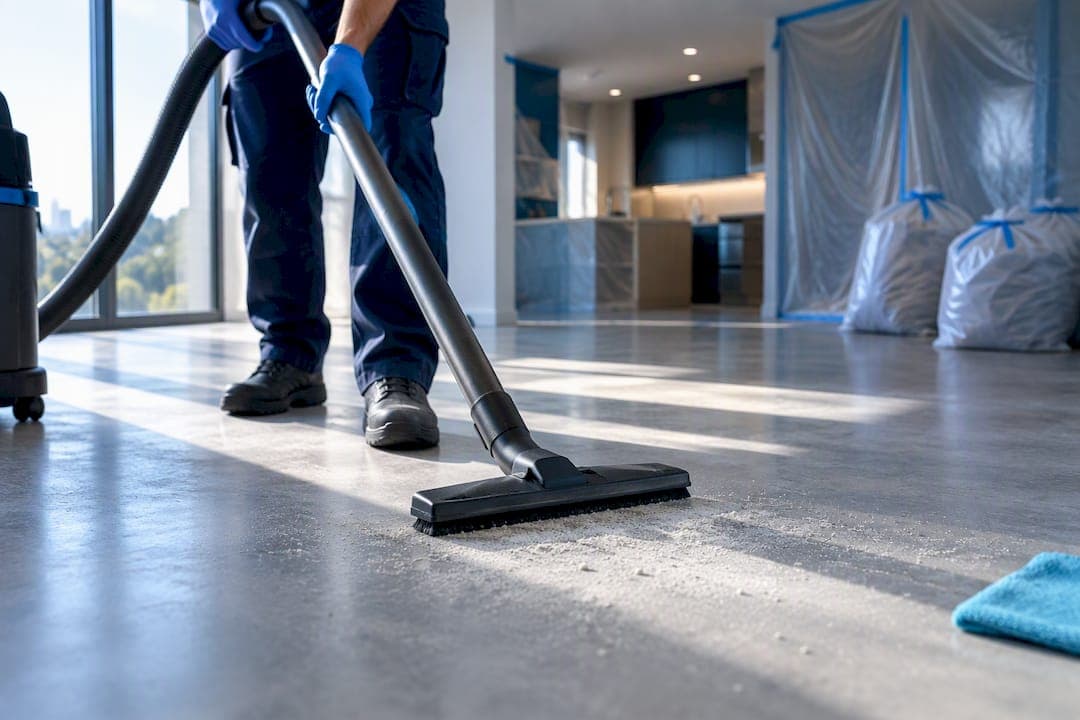
The most reliable way to remove renovation dust is a HEPA-first, staged clean, ideally overseen by a specialist using industrial HEPA vacuums and air scrubbers. Expect a repeat pass one to two days later, since fine particles keep resettling after the first clean. If the job involved cutting engineered stone, concrete, or tiles, treat post renovation dust removal as a safety task first, not just a tidy up, because silica dust needs proper controls.
TL;DR:
- A professional post-renovation clean requires industrial HEPA vacuums, air scrubbers, and multiple passes over 24 to 48 hours to effectively remove fine dust particles.
- The cleaning sequence should start with ventilation, then dry vacuuming from top to bottom, followed by damp wiping and floor cleaning last.
- Household vacuums often re-emit fine dust unless they have true HEPA filters rated at least M or H class, and air scrubbers are essential to pull suspended particles during the clean.
- For silica-containing dust from engineered stone or concrete, strict safety controls include wet cutting, local ventilation, and exposure monitoring, not just PPE.
- Larger or prolonged renovation projects involving silica risk should be handled by specialists, with prep including clearing valuables, ensuring access, and verifying ventilation options.
Table of Contents
- What does a professional post-renovation dust removal service include?
- What's the right cleaning order for room-by-room dust removal?
- Why household vacuums and cloths often fail on fine dust
- What does Australian silica safety guidance actually require?
- When should you call in a specialist, and what should you prep?
- Why this guide reflects professional cleaning practice, not just theory
- Book a HEPA-first post-renovation clean with ACT Cleaning by Demand
- Where to check the regulations and technical detail
- Sources
- FAQ
What does a professional post-renovation dust removal service include?
A genuine specialist clean goes well beyond wiping benches and vacuuming carpet. It targets the fine particulate that settles into every crevice a standard clean misses.
Most quotes for post construction debris removal cover:
- Industrial HEPA vacuuming of floors, skirting, window tracks, and hard-to-reach corners
- Air scrubbers running during and after the clean to pull suspended particles out of the air
- Vent, duct grille, and light fitting attention, since dust settles inside fittings long before it's visible on surfaces
- Removal of grout haze, paint splatter, and cement residue from tiles and glass
- Bagging and clearing loose construction debris left behind by trades
What's usually quoted separately: heavy rubbish removal (skip bins, offcuts, packaging), full duct cleaning if the HVAC system needs it, and specialist remediation for mould or biohazard contamination. A reasonable guarantee to ask for is a satisfaction check-back within a set window, not a vague promise of "spotless." Ask what happens if dust reappears after the first visit, because with heavy renovation dust it often does.
What's the right cleaning order for room-by-room dust removal?
Cleaning renovation dust in the wrong order just moves it around. The sequence matters as much as the equipment.
- Ventilate first. Open windows if weather allows, and run HEPA air purifiers before you touch a surface. This drops the airborne load before you start disturbing settled dust.
- Dry HEPA pass, top to bottom. Vacuum ceilings, light fittings, and cornices before walls. Gravity means dust you dislodge up high will fall onto everything below.
- Walls, trims, and cupboards next. Wipe with a damp microfibre cloth only after the dry pass, never before. Wetting dust too early smears it into a paste that's harder to shift.
- Vents and soft furnishings. Vacuum vent covers and upholstery with a brush attachment, since fabric traps fine particles that resettle for days.
- Floors last. Dry vacuum first, then damp mop. Floors collect everything that fell during the previous steps, so cleaning them early just means redoing the job.
- Repeat after 24 to 48 hours. Fine dust that was airborne during the first clean will have settled by now. This second pass isn't a sign the first one failed. It's expected.
Protect adjacent finished rooms with plastic sheeting while you work through unfinished ones, and change or clean vacuum filters between heavily dusted rooms so you're not redistributing what you just captured. Double bag dust waste and take it out daily rather than letting bags sit and leak fine particulate back into the air.
Pro Tip: Run an air scrubber in the room you've just finished while you move on to the next one. It keeps pulling residual dust out of the air instead of letting it drift back onto clean surfaces.

Why household vacuums and cloths often fail on fine dust
Most household vacuums aren't built to trap the particle sizes renovation work produces. Standard bagless vacuums often re-emit fine dust straight back out the exhaust, which is why a room can look worse after a quick vacuum than before, according to practitioner restoration guidance.
True HEPA filtration captures at least 99.97% of particles down to 0.3 microns, but plenty of products marketed as "HEPA-style" or "HEPA-like" don't meet that standard. For construction and demolition dust, professionals use M-class or H-class rated vacuums, filtration tiers that Safe Work Australia specifically recommends for cleaning up silica-containing dust.
The other piece is air movement. Air scrubbers pull suspended particles out of the room air continuously, not just off surfaces. Wet suppression can help during active cutting or grinding, but Safe Work Australia's own guidance warns that wet methods can generate a dust-laden mist that still needs ventilation and capture, so wet alone isn't a complete answer.
What separates a proper clean from a token effort:
- Sealed-system vacuums with M or H-class filters, not standard domestic units
- Air scrubbers left running in the work zone during and after cleaning
- Filters changed or cleaned between rooms, not left to clog and blow dust back out
- Waste double-bagged and sealed immediately rather than left open in the work area
What does Australian silica safety guidance actually require?
Renovation dust isn't just an inconvenience. Cutting, grinding, or drilling into concrete, tiles, or engineered stone releases crystalline silica, and repeated exposure carries real long-term health risks.
Safe Work Australia sets out a hierarchy of controls for managing it, and the order matters:
- Eliminate the hazard where possible, for instance choosing a material or method that doesn't generate dust
- Substitute with lower-silica materials or wet-cutting equipment where elimination isn't practical
- Engineering controls such as wet suppression and local exhaust ventilation, plus M or H-class vacuums for cleanup
- Administrative controls, including safe work procedures and limiting time spent in dusty areas
- PPE, worn last, not as the primary defence
That order matters because a dust mask alone doesn't fix a poorly ventilated room full of airborne silica. PPE-only approaches are the weakest link in the chain, and Safe Work Australia's guidance treats them as a backstop, not a solution.
In the ACT specifically, WorkSafe ACT sets the workplace exposure standard for crystalline silica at an eight-hour time-weighted average of 0.05 mg/m3, and recommends air monitoring by a competent person, such as a certified occupational hygienist, when exposure risks exist. If your renovation involved engineered stone benchtops or extensive concrete grinding, that's the point where it's worth asking a contractor whether monitoring is warranted, not just assuming a visual "looks clean" check is enough.
When you're briefing a contractor, ask specifically for: M or H-class vacuums, respiratory protective equipment where dust generation was heavy, wet suppression during any cutting work, and a documented filter change and disposal procedure.
When should you call in a specialist, and what should you prep?
Small jobs, like a single repainted room, are usually manageable with a thorough DIY dry-then-wet clean and patience for a second pass. Bigger jobs are a different story.
Call a specialist when the renovation involved:
- A large area or multiple rooms with prolonged dust generation over days or weeks
- Engineered stone, concrete grinding, or tile cutting, where silica exposure is a genuine concern
- Ductwork that's been open to the work zone, since dust recirculating through HVAC is a common reason it keeps coming back after two or three passes
- A tight settlement or move-in deadline that doesn't allow for multiple DIY passes and trial and error
Cost for professional post construction debris removal scales with scope rather than a flat rate. The main drivers are the size and number of rooms, whether duct or vent cleaning is needed, how many repeat passes the job requires, and whether upholstery or floor restoration is involved on top of the dust clean. A quote should reflect your specific job, not a generic hourly guess.
Before a crew arrives, a short prep checklist speeds things up and can trim cost:
- Clear valuables and fragile items out of the work zones
- Confirm access, including keys, gate codes, or building entry requirements
- Make sure power and water are connected and accessible
- Nominate one point of contact for the crew on the day
Why this guide reflects professional cleaning practice, not just theory
This guide draws on Safe Work Australia's national silica guidance and WorkSafe ACT's exposure standards, cross-checked against practitioner cleaning sequences used in the field. Post-construction and specialty cleaning work, built around customised packages, eco-friendly products, and HEPA-based equipment, informed the practical staging advice throughout.
— Deng
Book a HEPA-first post-renovation clean with ACT Cleaning by Demand
ACT Cleaning by Demand is the direct alternative to piecing together a DIY dust removal job room by room over a stressful weekend. Its post construction and builder cleaning service follows the same staged approach this guide recommends: industrial-grade equipment, eco-friendly products, and cleaning plans built around the actual scope of your renovation rather than a one-size-fits-all checklist.

When you request a quote, ask specifically for the details that matter: industrial HEPA vacuum use, an air scrubber running during the clean, a scheduled repeat pass, and attention to vents and ductwork if the reno generated heavy dust. ACT Cleaning by Demand's team also handles the finer detail that gets missed, including specialist window cleaning to clear grout haze and paint residue off glass, and dedicated floor cleaning for surfaces that took the brunt of the mess. Police-checked staff, no lock-in contracts, and flexible scheduling mean you can book a clean around your trades' timeline rather than the other way round. Head to the services page to see the full range and get a quote.
Where to check the regulations and technical detail
For the rules and standards behind the safety advice in this guide, go straight to the source rather than a summary of it.
- Safe Work Australia's national silica guidance covers the hierarchy of controls and vacuum classes in full
- WorkSafe ACT's air and health monitoring page explains exposure standards and when monitoring is warranted
- For a broader look at cleaning scope beyond dust alone, see this companion guide on post-renovation cleaning scope
Sources
- Guide for working with silica and silica containing products — Safe Work Australia
- Air and health monitoring - WorkSafe ACT
FAQ
How Do I Get Rid Of Dust After A Renovation?
Run a HEPA-first dry vacuum pass from ceiling to floor, then damp wipe and mop, and plan for a second full pass 24 to 48 hours later since fine dust keeps resettling. Household vacuums without true HEPA filtration often blow fine particles straight back into the air, so industrial-grade equipment makes the difference on heavier jobs.
How Long Does It Take For Dust To Settle After Renovation?
Visible dust settles within a day or two, but the finest particles can stay airborne longer and resettle after you think the room is clean. That's exactly why a repeat clean 24 to 48 hours after the first pass is standard practice, not a sign something went wrong.
What's The Best Way To Clean Dust After Builders Finish?
Start top to bottom with a dry HEPA vacuum pass before any wiping, since damp cloths on dry dust just smear it into paste. Work ceilings and light fittings first, then walls, cupboards, vents, and soft furnishings, leaving floors for last, and run an air purifier or scrubber throughout.
Is Renovation Dust Harmful?
It can be, particularly dust from cutting concrete, tiles, or engineered stone, which contains crystalline silica. Safe Work Australia recommends engineering controls like wet suppression and M or H-class vacuums rather than relying on masks alone, and the ACT sets a specific eight-hour exposure standard for airborne silica.
How Much Does Professional Post Renovation Dust Removal Cost?
Cost depends on the size of the job, how many rooms are affected, whether ductwork or upholstery needs attention, and how many passes the space requires. ACT Cleaning by Demand doesn't publish a flat rate for this reason. You can get a quote scoped to your renovation through its services page.