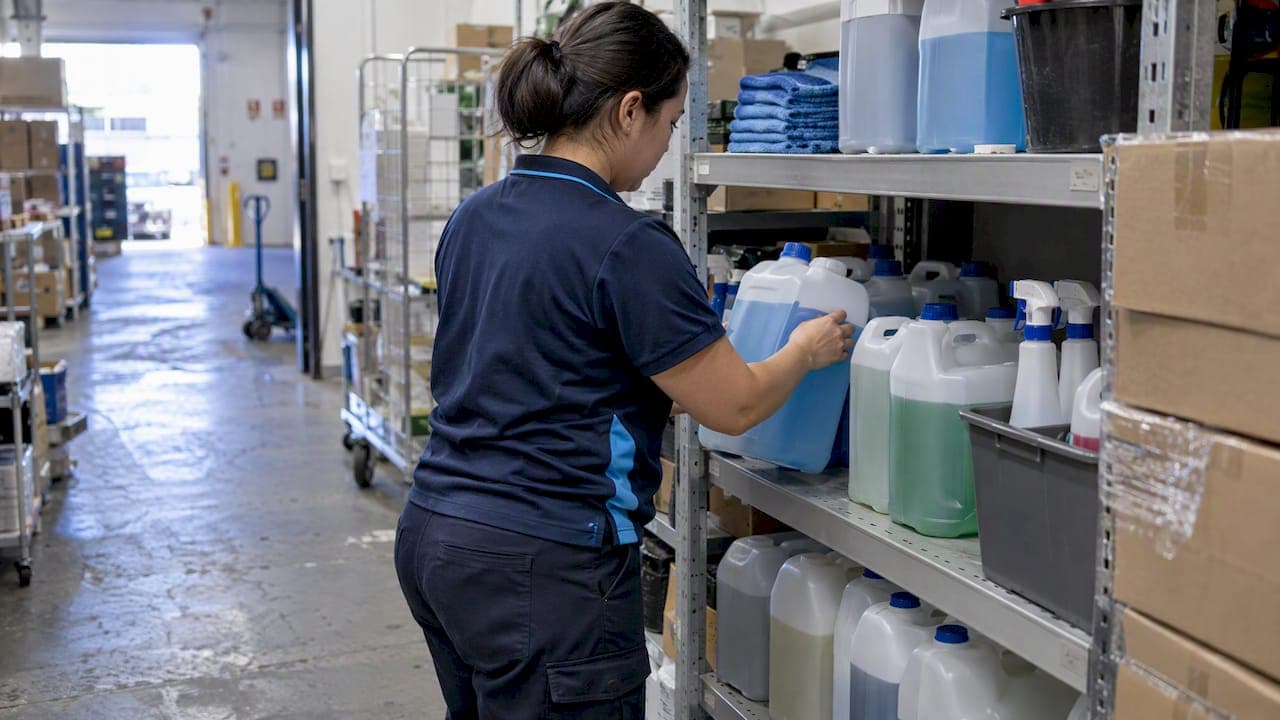
Retail stores in Australia must meet Work Health and Safety hazardous-chemicals duties, and food-selling retailers must also comply with FSANZ Standard 3.2.2. The three immediate actions are publishing a written cleaning schedule, keeping a current safety data sheet register accessible to staff, and running frequent spot checks on high-touch surfaces. The rest of this guide translates those rules into a working scope of work, checklists and the records an auditor expects to see.
TL;DR:
- Retail stores must keep current safety data sheets accessible and label all hazardous chemicals, with SDS review after supplier formulation changes.
- Cleaning schedules should clearly define zones, tasks, and frequencies, with high-touch surfaces cleaned hourly and food-contact surfaces cleaned daily.
- Electronic devices like POS terminals require gentle, alcohol-based disinfectant wipes with manufacturer guidance to prevent damage.
- Waste handling must separate recyclables, organics, and general waste, with daily removal to prevent pest risks and maintain hygiene standards.
- Documentation such as cleaning logs, staff training records, and pest-control receipts is essential for compliance and passing inspections.
Table of Contents
- Which Australian standards and regulators apply to retail cleaning
- Cleaning schedules and frequency: how to build a scope of work that auditors accept
- Area-specific tasks and standards for salesfloor, fitting rooms, toilets, food-contact and back-of-house
- Chemical safety: SDS, GHS 7 labelling, chemical register and safe handling
- Cleaning and disinfection sequence, contact times and product selection
- Documentation, checklists and KPIs to prove due diligence
- Staff training, PPE and safe work procedures
- Inspections, audits and responding to non-compliance
- How ACT Cleaning by Demand helps retail sites meet these standards
- Handling of waste and recycling protocols specific to retail settings
- Special considerations for cleaning and maintaining electronic devices and point-of-sale equipment
- Facility manager perspective: prioritise chemical safety and documentation
- How ACT Cleaning by Demand can implement your compliant cleaning programme
- FAQ
- Sources
Which Australian standards and regulators apply to retail cleaning
Two regulatory streams govern cleaning in an Australian retail store. Work Health and Safety law requires every person conducting a business or undertaking to manage hazardous chemicals properly, including current safety data sheets and GHS 7 labelling for every product on site. Retailers that sell food also sit under Standard 3.2.2, which requires fixtures, fittings and food-contact equipment to stay clean and sanitary enough that they cannot pass on infectious disease. Federal health guidance adds a practical layer on top of both, covering how and how often surfaces should be cleaned and disinfected.
In practice, that means:
- WHS rules govern every hazardous chemical you store, decant or apply in-store.
- Standard 3.2.2 governs any surface, utensil or fixture that touches food.
- Health department guidance governs frequency and method for high-touch and shared surfaces.
Treat these as layered obligations rather than a single checklist. A fitting room falls under general WHS and cleaning guidance, while a deli counter answers to all three at once.
Cleaning schedules and frequency: how to build a scope of work that auditors accept
A documented scope of work is the single most useful artefact you can hand an auditor, insurer or incoming staff member. It should include:
- Site details and a floor plan identifying each cleaning zone.
- A task breakdown per zone, naming exactly what gets cleaned.
- A frequency assigned to each task, from hourly to monthly.
- Named responsibility for each task, whether in-house or contracted.
- KPI definitions and a reporting cadence tied to those KPIs.
Frequency should follow a simple matrix rather than a vague "regularly":
- High-touch surfaces (door handles, EFTPOS pads, trolley handles): checked hourly, cleaned on contact.
- Salesfloor and fitting rooms: cleaned daily, deep cleaned weekly.
- Storage, loading docks and light fittings: checked monthly.
Our flexible cleaning schedules resource walks through tailoring these frequencies to a specific site, which is useful if your store has unusual trading hours or seasonal foot traffic.
Area-specific tasks and standards for salesfloor, fitting rooms, toilets, food-contact and back-of-house
Each zone in a retail store carries its own risk profile, so the tasks need to be specific enough that two different staff members would do the same thing.
- Salesfloor: respond to spills immediately, mop using a two-bucket or colour-coded system, wipe shelving and display units daily, and wipe POS terminals between shifts.
- Fitting rooms: wipe touchpoints such as hooks, handles and seats between customers, inspect curtains and seating for damage weekly, and vacuum carpet daily.
- Toilets and staff areas: clean and sanitise fixtures at least twice daily in higher-traffic stores, remove waste on each check, and log inspection times.
- Food-contact surfaces: clean first, then sanitise, and remove any chipped or cracked utensils immediately rather than scheduling their replacement for later, since damaged food-contact items are an explicit non-compliance under Standard 3.2.2.
- Back-of-house: keep storage organised to avoid pest harbourage, check loading docks for spillage, and log pest-control visits alongside waste collection dates.
Pro Tip: Assign one staff member per shift to a five-minute "touchpoint sweep" of door handles, EFTPOS pads and fitting room hooks rather than relying on the end-of-day clean alone.
Chemical safety: SDS, GHS 7 labelling, chemical register and safe handling
Every hazardous cleaning chemical in your store needs a current safety data sheet and a place on your hazardous chemicals register. The GHS 7 labelling transition for Australian workplaces ended on 31 December 2022, so any supplier SDS issued before that date should be checked against the current version.
Practical controls to put in place:
- Keep SDS copies at the point of use, not filed away in a back office nobody checks during an incident.
- Never decant cleaning chemicals into food or drink containers, and label every decanted container with contents and hazard information.
- Match PPE to the chemical: gloves for concentrated disinfectants, eye protection for anything splashed above shoulder height.
- Check the SDS against the delivered product every time a supplier changes formulation, since a label change can mean a different hazard profile.
Cleaning and disinfection sequence, contact times and product selection
Cleaning always comes before disinfection. A disinfectant applied to a visibly dirty surface cannot work properly because the dirt itself shields the bacteria underneath, which is why health guidance treats "clean then disinfect" as a sequence, not alternatives.
- Frequently touched surfaces, such as door handles and shared POS equipment, should be cleaned and disinfected several times a day.
- Minimally touched surfaces only need cleaning when visibly soiled.
- Combined detergent and disinfectant products simplify the process but still depend on the surface staying wet for the manufacturer's stated contact time.
Statistic callout: health guidance recommends cleaning and disinfecting frequently touched surfaces several times a day, and most disinfection failures trace back to wiping a surface dry before the product has had time to work.
Documentation, checklists and KPIs to prove due diligence
Inspectors and insurers both look for the same paper trail. Keep these on hand:
- A current, dated cleaning schedule.
- Completed daily and weekly logs with staff initials.
- The SDS register and chemical labels.
- Training completion records.
- Maintenance and pest-control receipts.
Track performance with a short set of KPIs:
- Percentage of scheduled tasks completed on time.
- Average response time to a reported spill or hazard.
- Internal audit pass rate month on month.
Digital logging with timestamps is easier to retain and search than paper, though either works if you keep records for a consistent period and action corrective steps when a task is missed. Our office cleaning checklist sets out a daily-to-annual structure that adapts well to a retail floor.
Staff training, PPE and safe work procedures
Training should cover SDS literacy, spill response, correct PPE use, hand hygiene and the clean-then-disinfect technique described above. Anyone who handles cleaning chemicals needs this training, with a refresher at least annually or whenever a product changes.
- Gloves for all chemical handling, closed shoes on the salesfloor, and eye protection for high-splash tasks.
- Single-use cloths or wipes for food-contact surfaces and after any bodily fluid incident.
- Supervisors should spot-check technique, not just attendance at training.
Pro Tip: File a one-page training record per staff member, signed and dated, so a missing certificate never becomes the reason an audit stalls.
Inspections, audits and responding to non-compliance
A short weekly internal audit catches most problems before an external inspector does. Check SDS accessibility and labelling, food-contact surface condition, visible pest evidence, and any damaged equipment such as chipped crockery or cracked utensils, which inspectors treat as immediate non-compliance rather than a maintenance note.
- Walk the full floor plan, not just high-visibility areas.
- Record findings against the same checklist every week so trends are visible.
- Escalate anything unresolved after 48 hours to a documented corrective action plan.
When an issue needs specialist attention, such as suspected pest activity or heavy contamination, bringing in a professional cleaning team resolves it faster than trying to retrain staff mid-crisis.
How ACT Cleaning by Demand helps retail sites meet these standards
We build customised cleaning packages for commercial sites with eco-friendly products and police-checked, insured staff. For a retailer juggling WHS and food-safety obligations, a managed service can supply both the recurring clean and the documentation behind it, schedules, SDS management and training records included, so the paperwork keeps pace with the work.

Handling of waste and recycling protocols specific to retail settings
Waste in a retail store falls into a few distinct streams: general rubbish, recyclables, cardboard from stock deliveries, and, for food retailers, organic waste that needs separate handling. Mixing this creates both a hygiene risk and an unnecessary cost, since cardboard and recyclables collected separately are often cheaper to dispose of than general waste.

Bins in customer-facing areas should be emptied before they overflow, which in practice means checking them against footfall rather than on a fixed clock. Back-of-house bins, particularly near food preparation or stockrooms, need daily removal at minimum, with contaminated waste such as spoiled stock bagged separately to avoid attracting pests.
Loading docks deserve their own protocol. Cardboard and packaging waste accumulates quickly during delivery periods, and leaving it stacked near the dock door for more than a shift invites both pest issues and a trip hazard. A clear "flatten and bin immediately" rule for staff unpacking deliveries keeps this under control.
For food-selling retailers, organic waste needs a dedicated bin, lined and sealed, emptied at least daily, and kept away from food-contact areas to avoid cross-contamination. Recycling streams should be clearly signed so staff do not need to guess, and any chemical containers being disposed of should be handled according to their SDS rather than tossed in with general recycling.
Build waste handling into your cleaning schedule as named tasks, with a responsible person and a frequency, the same way you would treat mopping or disinfection.
Special considerations for cleaning and maintaining electronic devices and point-of-sale equipment
POS terminals, barcode scanners, EFTPOS pads and self-service kiosks are among the most frequently touched surfaces in any retail store, yet they are also the easiest to damage with the wrong product. Standard disinfectant wipes can degrade touchscreens and rubber seals over time, so checking the manufacturer's cleaning guidance for each device before adding it to your schedule avoids a costly replacement.
A few rules keep electronics both clean and functional:
- Power down or lock the screen where possible before wiping to avoid triggering unintended inputs.
- Use a lint-free cloth lightly dampened with an alcohol-based wipe rated for electronics, rather than a general-purpose spray.
- Never spray liquid directly onto a screen or keypad, apply it to the cloth instead.
- Pay particular attention to the gaps around buttons and card slots, where debris and spills collect unnoticed.
Because EFTPOS pads and scanners are handled by almost every customer, they belong in the hourly high-touch rotation alongside door handles and trolley handles rather than the daily general clean. Self-service kiosks need the same frequency, plus a visual check for cracked screens or loose housing, since a damaged unit can become both a safety hazard and a food-safety issue if customers are using it near a counter. Keep a spare set of approved wipes at each till point so staff are not tempted to substitute a stronger chemical that could damage the hardware.
Facility manager perspective: prioritise chemical safety and documentation
If I had to pick one priority, it would be SDS access and labelling, not the mop schedule. Missing paperwork is what turns a routine inspection into an enforcement matter. Cleaning is not just a visual outcome. This week, pull every chemical in your cleaning cupboard and check each one has a current, accessible SDS.
— Deng
How ACT Cleaning by Demand can implement your compliant cleaning programme
We offer office and commercial cleaning, scheduled recurring cleans and deep cleans that can be adapted to various commercial floors, all backed by documented schedules and flexible contract terms.
- Customised cleaning packages matched to your site's layout and trading hours.
- SDS register maintenance and staff training records kept current as part of the service.
- Eco-friendly products and trained, insured cleaners on every job.
If you would like a scope of work drawn up for your store, our services page lists everything we offer and is the quickest way to request a quote.
FAQ
What is the 20/10 rule for cleaning?
The 20/10 rule is a workplace tidiness habit where you spend a set amount of tidying time for every period of clutter created, often used informally in offices and retail stockrooms. It is not a legislated Australian cleaning standard, so it should sit alongside, not replace, your documented WHS and food-safety obligations.
Do you need a licence to clean in Australia?
General commercial cleaning does not require a specific licence in Australia, though businesses handling hazardous chemicals must meet WHS duties around safe storage, SDS access and training. Food-selling retailers also need to meet food-safety registration requirements with their local council.
What is the standard for cleaning in Australian retail stores?
Retail stores follow WHS hazardous-chemicals rules for any cleaning product used on site, and food-selling retailers must also meet FSANZ Standard 3.2.2, which requires fixtures and food-contact surfaces to stay clean and sanitary. Federal health guidance adds practical frequency recommendations for high-touch surfaces on top of these legal requirements.
What should a cleaner do in three hours on a retail shift?
A three-hour retail clean typically covers high-touch surface wipe-downs, floor mopping across the salesfloor, fitting room touchpoint cleaning, toilet sanitising, and a waste and recycling check, prioritised by the store's own frequency matrix. The exact mix depends on store size and whether food is sold on site, since food-contact areas need a clean-then-sanitise sequence that takes longer than a general wipe.
Sources
- Changes to Chemical Classifications and Labelling under GHS 7 - WorkSafe ACT
- Legislation
- Cleaning and disinfection in the community — Australian Department of Health