
Yes, professional cleaners normally offer flexible booking and recurring plans, including weekly, fortnightly, monthly and on-demand slots. The practical move is to pick a frequency you can actually sustain, book a longer first clean to set the baseline, and adjust from there. Providers like Com build customised packages around exactly this kind of flexibility rather than locking you into one fixed routine.
TL;DR:
- Most cleaners offer flexible options like weekly, fortnightly, monthly, and on-demand scheduling, allowing adjustments based on household needs and activities.
- The first cleaning typically takes longer to set a baseline, whereas subsequent visits focus on maintenance, with scheduling adjustments easily made between visits.
- On-demand slots are limited and usually require advanced notice, with most providers asking for 48 to 72 hours to reschedule without fees.
- Pricing mainly depends on property size, visit frequency, and extra tasks like carpet or window cleaning, with recurring plans offering long-term cost savings.
- Flexibility relies on clear communication, easy-to-use booking platforms, and booking a trial run before committing to ensure the schedule suits actual usage patterns.
Table of Contents
- What flexible scheduling options do cleaners actually offer?
- How do you choose a flexible plan that fits your space and life?
- What's the difference between the first clean and recurring visits?
- How do you manage schedule changes, cancellations and access?
- What drives the cost of a flexible recurring plan?
- Who benefits most from flexible cleaning schedules?
- What technology makes flexible scheduling easier to manage?
- What factors affect the right schedule at different times of year?
- What are the limits of flexible scheduling and how do you work around them?
- What implementing flexible schedules actually looks like in practice
- Ready to book a cleaner around your schedule, not the other way round?
- Sources
- FAQ
What flexible scheduling options do cleaners actually offer?
Most cleaning companies build their booking system around a handful of core frequencies, then let you move between them as life changes. Understanding what each one is actually for saves you from either overpaying for visits you don't need or under-cleaning a busy household.
- Weekly suits larger households, homes with young kids, multiple pets, or anyone who genuinely can't keep on top of daily mess between visits.
- Fortnightly is the middle ground most households land on. It's often the most popular recurring schedule because it balances cost against the rate mess actually accumulates for two to four person households.
- Monthly works for low-traffic homes, second properties, or people who do their own light maintenance and just want a periodic deep reset.
- Custom blocks cover things like fortnightly cleans that switch to weekly during school holidays, or a business that wants three visits a week during peak trading and one during quiet months.
- On-demand or ad-hoc top-ups handle one-off situations: a dinner party, a move-out, a sick week where you fell behind.
A remote worker with a cat and a spare room office has very different needs from a share house with three flatmates and a dog. The point of flexible scheduling is that you're not locked into whichever frequency you guessed at when you first booked. A provider worth using will let you bump up to weekly during a renovation, drop to monthly over summer, or add a one-off clean before guests arrive, without renegotiating a contract.
How do you choose a flexible plan that fits your space and life?
Getting the frequency right starts with an honest look at how the property actually gets used, not how you wish it was used.
A quick decision framework:
- Traffic and use — how many people and pets move through the space daily, and how many hours a day is it occupied?
- Surfaces that matter — carpet, hardwood, tile grout and stone benchtops all age differently and some need more frequent attention.
- Allergies and pets — shedding animals or dust-sensitive household members usually push you toward a tighter schedule.
- Budget — work out what you can sustain monthly, not just what one visit costs.
- Special tasks — windows, carpets and upholstery are often add-ons rather than part of a standard visit, so factor them in separately.
Once you've got a shape in mind, the quote conversation should cover specifics. Ask what's included in the standard scope versus what counts as an add-on, how long the first visit will take, whether you'll get the same cleaner or team each time, what insurance covers if something's damaged, and whether they bring their own supplies or expect you to.
Pro Tip: Book a trial run of two to three visits at your chosen frequency before committing to anything longer. It's the fastest way to tell whether fortnightly is genuinely enough or whether you need to step it up.
This trial-and-adjust approach lines up with standard advice from cleaning providers: start with a frequency that feels realistic, then refine it once you've seen how the home looks a few days after each visit.
What's the difference between the first clean and recurring visits?
The first appointment and every visit after it are not the same job, and providers who pretend otherwise are setting you up for disappointment.
The initial clean usually runs longer than a recurring one because it's establishing a baseline: skirting boards that haven't been touched in months, heavy limescale in the bathroom, grease built up behind appliances. Once that baseline is set, recurring visits shift into maintenance mode, keeping the property below what cleaners often call the "tipping point" of grime rather than fighting it back from scratch each time.
What tends to happen over successive visits:
- The same team learns where the extension cords hide and how you like the kitchen laid out.
- Cleaning time per visit often shortens slightly as the team gets more efficient with the property.
- Recurring cleans focus more on upkeep tasks, less on deep resets.
Before locking anyone in, check the trust signals that actually predict reliability: police-checked staff, real customer testimonials, and whether their eco-friendly product claims hold up under questioning. A provider with consistent team assignment tends to deliver more tailored results simply because the same people keep coming back and learning the space, rather than a rotating cast starting from zero each visit.
How do you manage schedule changes, cancellations and access?
Flexible doesn't mean chaotic. Good providers give you clear rules upfront so changes don't turn into a fight.
Most companies ask for 48 to 72 hours' notice to reschedule or cancel a recurring visit without a fee, and keep a separate channel open for genuine on-demand or emergency bookings, though those slots fill fast, so don't expect same-day availability as a given.
For access, you don't need to be home. Most providers can work with a lockbox, a smart lock code, or a spare key held securely between visits, as long as you've set clear instructions.
Worth documenting upfront, not explaining on the day:
- Access method and any codes, and who to notify if they change.
- Pet handling: whether dogs need to be locked away, fed before or after, or are fine roaming.
- Fragrance or product sensitivities, especially if anyone in the house has allergies or asthma.
- Any no-go zones or fragile items you'd rather the team avoided.
Getting these details into your file once means every future visit runs the way you actually want it to, not a guess.
What drives the cost of a flexible recurring plan?
Price in cleaning is mostly a function of time, and time is driven by a short list of predictable factors.
- Property size and layout — more bedrooms and bathrooms means more time, straightforwardly.
- Frequency — recurring plans often bring the per-visit rate down compared to booking one-off cleans, because the team isn't resetting a neglected space every time.
- Travel and time windows — early morning or tight scheduling can carry a premium with some providers.
- Special tasks — carpet steam cleaning, window cleaning and upholstery work are usually quoted separately from the standard visit.
- Equipment needs — jobs requiring specific gear, like commercial-grade extraction for carpets, cost more than a standard wipe-down.
The value case for recurring over one-off is straightforward: keeping a home below that grime tipping point means fewer expensive deep cleans down the track, which is where a lot of the long-term saving actually sits. When comparing quotes, ask for the same things every time: a detailed estimate outlining scope, time estimate, what's included, what's excluded, and add-on pricing. Vague quotes are the biggest source of billing disputes later. Understanding how cleaning quotes work before you compare providers puts you in a much stronger negotiating position.
Who benefits most from flexible cleaning schedules?
Different households and businesses lean on flexibility for different reasons, and the value shows up differently depending on who's booking.
Homeowners get the most straightforward win: a schedule that flexes with seasons, renovations, or a new baby without renegotiating a contract every time circumstances shift. Tenants often need shorter-term or one-off arrangements, particularly around move-in or move-out dates, where a rigid monthly plan makes no sense.
Landlords and property managers are usually juggling multiple properties with different tenant turnover rates, so on-demand booking for vacancy cleans matters more than a fixed weekly slot. Local businesses, especially offices and retail spaces, tend to need cleaning timed around trading hours and foot traffic rather than a generic weekly Tuesday slot; a café might want daily attention while a small consultancy is fine with twice a week.
What ties these groups together is the same underlying need: a provider willing to build the schedule around the property's actual usage pattern, not a one-size-fits-all template. That's the practical case for customised cleaning packages over a rigid subscription model.
What technology makes flexible scheduling easier to manage?
Booking flexibility only works in practice if the system behind it is easy to use, otherwise "flexible" just means more phone calls.
A decent booking platform lets you see live availability, request a specific frequency, and adjust or pause a recurring visit without ringing anyone. Automated reminders ahead of each visit cut down on missed access arrangements, and a simple messaging channel for special instructions, like a gate code change or a new pet at home, saves a lot of back-and-forth on the day. Some platforms also let you rate or leave feedback per visit, which feeds directly into whether the same team keeps getting assigned to your property.

None of this needs to be complicated. The best systems are the ones you barely notice, because the booking, the reminder and the adjustment all happen in a couple of taps rather than a drawn-out email chain.
What factors affect the right schedule at different times of year?
The frequency that works in June often stops working in December, and a decent provider expects you to adjust rather than treating your original booking as fixed forever.
Spring and post-holiday periods tend to need heavier cleaning as dust, pollen and general clutter build up over the cooler months. Households with school-aged kids often want a bump in frequency during holidays when the house is occupied all day instead of empty from 9 to 3. Businesses see the same pattern around retail peak seasons or end-of-financial-year periods when foot traffic spikes. On the other end, a holiday home might drop to monthly or even quarterly outside of booking season.
The practical fix is simple: review your schedule against actual usage every few months rather than setting and forgetting it. If you notice the house looking tired a few days before each scheduled visit, that's your signal to tighten the frequency; if it still looks fine, you might be paying for more than you need.
What are the limits of flexible scheduling and how do you work around them?
Flexibility has real trade-offs, and it's worth knowing them before you build expectations around a system that can't quite deliver everything at once.
On-demand slots are genuinely limited. Popular time windows, especially Fridays and the days before public holidays, book out fast, so last-minute doesn't always mean same-day. Frequent schedule changes can also mean less team continuity, since a provider juggling constant reshuffles has a harder time keeping the same cleaner assigned to your property every visit. And very short notice cancellations sometimes carry a fee, because the provider still has to pay staff for the blocked-out time.
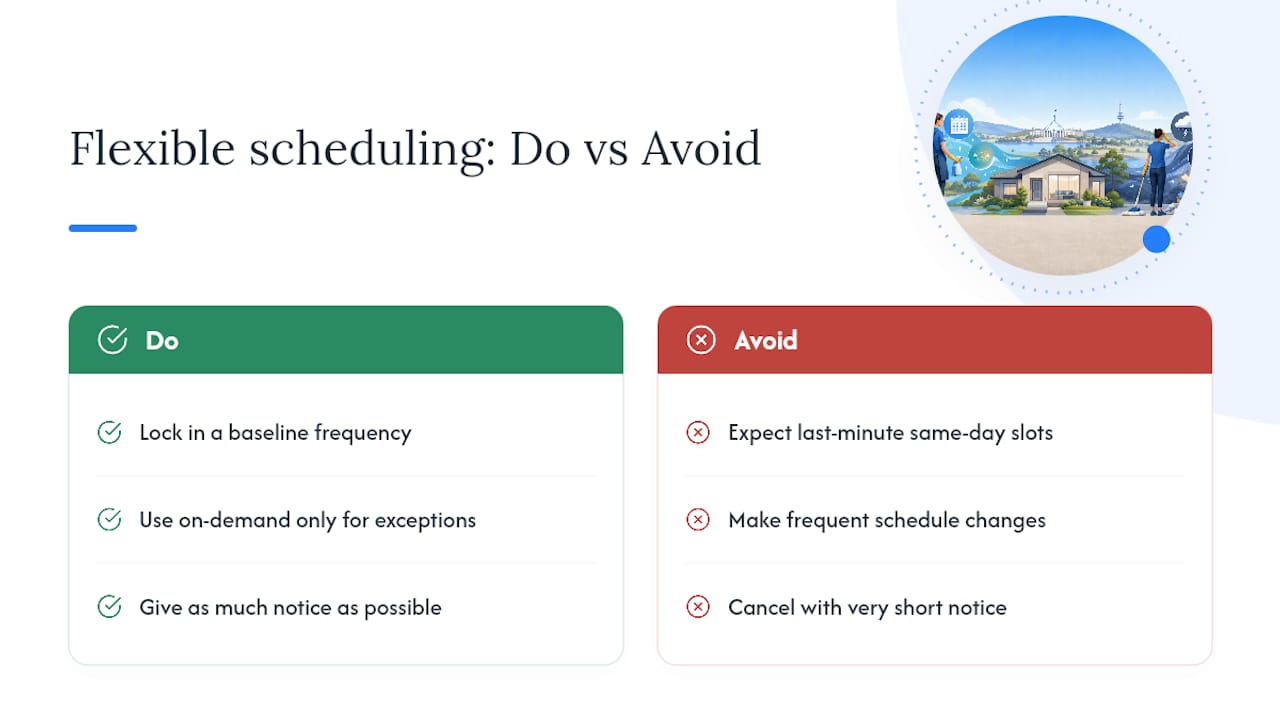
The workaround is mostly about communication: lock in your baseline frequency, use on-demand slots for genuine exceptions rather than routine adjustments, and give as much notice as you can when something has to move. Providers offering commercial cleaning services for larger or multi-site operations face the same continuity challenge at scale, which is part of why consistent team assignment tends to matter more than raw scheduling flexibility once a business grows.
What implementing flexible schedules actually looks like in practice
Most of the friction in "flexible" cleaning comes from providers who advertise flexibility but operate a rigid backend. Com builds customised cleaning packages around the property first, whether that's a share house needing weekly attention or a small office needing twice-weekly visits timed around trading hours, rather than forcing every client into the same three-tier plan.
That customisation runs alongside a genuine commitment to eco-friendly products, which matters more than it sounds for households with kids, pets or anyone sensitive to harsh chemical residue. Police-checked staff and a straightforward booking system round out the practical side. A local example that comes up often: a Canberra household on fortnightly cleaning that struggled with pet hair during shedding season simply shifted to weekly for two months, then dropped back down, without any renegotiation. That's the actual test of a flexible schedule: how easily it moves when you need it to, not how many frequency options are listed on a pricing page.
— Deng
Ready to book a cleaner around your schedule, not the other way round?
If you've read this far, you already know what a genuinely flexible plan should offer: recurring visits at a frequency you choose, on-demand top-ups when you need them, and a first clean that properly resets the baseline before maintenance visits take over. Com builds exactly that, with police-checked staff, eco-friendly products, and no lock-in contracts tying you to a schedule that stops making sense six months in.
Getting a tailored quote is straightforward: tell the team your property size, preferred frequency, and any special tasks like carpets or windows, and they'll scope out the first clean separately from the ongoing plan. Head to the house cleaning services page to see what's included, or check the Inner South service area page if you're in that part of Canberra. Book your first clean and adjust the frequency from there.
Sources
- Professional cleaning: key considerations when choosing a vendor
- How to Choose Recurring Cleaning That Fits - Best cleaning services in Georgia
- How often should you hire a professional cleaning service?
- What to Expect When Hiring a Residential Cleaning Service
FAQ
How often should I book a professional cleaner?
Fortnightly is the most common starting point for two to four person households, balancing cost against how quickly mess builds up. Weekly suits busier households or those with pets and kids, while monthly works for low-traffic homes.
Why does the first cleaning visit cost more or take longer?
The first visit involves a deeper reset, tackling baseboards, heavy limescale and neglected areas to establish a baseline, while recurring visits focus on maintaining that standard rather than rebuilding it each time.
Can I change my cleaning frequency after I've started?
Yes. A flexible provider like Com lets you increase, decrease or pause your schedule as circumstances change, whether that's a renovation, a new pet or a seasonal shift in how the property gets used.
How much notice do I need to give to reschedule or cancel?
Most providers ask for 48 to 72 hours' notice for a fee-free change to a recurring booking, while genuine on-demand slots are available separately but fill up quickly.
Do I need to be home for the cleaner to access my property?
No. Providers commonly use a lockbox, smart lock code or securely held spare key, as long as you've documented access instructions and any pet handling preferences in advance.