Neither is better in every building. Night cleaning suits sites that need empty floors, quiet and tight security. Day cleaning suits sites where bathrooms, kitchens and entry areas get dirty while people are using them. Many Canberra offices end up with a hybrid: a light daytime presence for the things that can't wait, and a proper after-hours clean for the things that can't be done around people.
This guide compares the two on the criteria that matter: cost, cleaning quality, disruption, security, staff safety and the type of building you run. It finishes with a simple way to decide.
TL;DR
- Night cleaning gives cleaners empty floors, so it suits floor work, deep cleans, high-security sites and noisy tasks.
- Day cleaning keeps bathrooms, kitchens and reception presentable while people use them, and spills get dealt with straight away.
- Day cleaning can cost less overall, with one industry source putting the saving at 15 to 25 percent, but the saving depends on your site and award rates.
- For most mixed-use offices the practical answer is a hybrid: a short daytime service plus scheduled after-hours deep work.
- Whichever shift you choose, as a business you still have a legal duty to keep cleaners safe, especially solo night workers.
Table of Contents
- What day cleaning and night cleaning actually mean
- Night cleaning: where it wins and where it falls short
- Day cleaning: where it wins and where it falls short
- Side-by-side comparison
- What it costs: look beyond the shift
- Safety and legal duties in the ACT
- Which kind of site suits which shift
- How to move from night to day cleaning without friction
- Our perspective
- Getting a plan that fits your site
- FAQ
- Sources
What day cleaning and night cleaning actually mean
Night (or after-hours) cleaning happens when the building is empty: typically evenings, overnight or very early morning before staff arrive. The cleaner works alone or in a small team, often with a key or access card, and the office is presentable by the time people walk in.
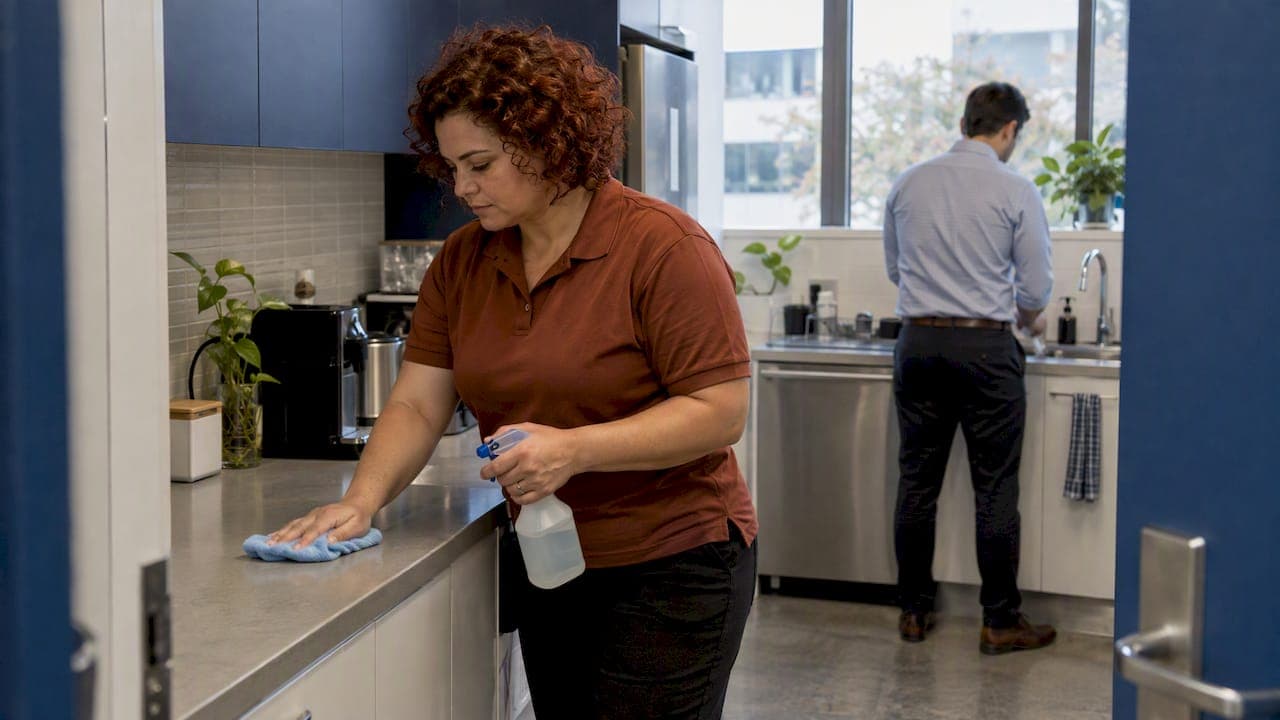
Day cleaning happens while the site is occupied. It may be a day porter who stays on site for a few hours, or a cleaner who visits at set times to service bathrooms, restock consumables, empty bins, wipe kitchens and high-touch surfaces, and respond to spills.
The difference is not just the clock. As industry experts quoted in Cleanlink point out, day cleaning forces a re-think of the workflow: you cannot simply move the night tasks into the day, because cleaners have to work around the people in the building.

Night cleaning: where it wins and where it falls short
Strengths
- Clear access. Empty floors mean vacuuming, mopping and surface work can be done without moving people or working around desks.
- Less disruption. Noisy equipment, wet floors and chemical smells are not an issue when nobody is there.
- Suits deep work. Tasks that need an area closed off, such as floor scrubbing or stripping, often still have to happen when the building is empty, even on sites that otherwise use day cleaners.
- Security-sensitive sites. Industry experts note night cleaning is often preferred for high-security or industrial facilities where extra people moving around in business hours is a problem. In Canberra, that can include offices handling sensitive material.
- A fresh start. Staff walk into a tidy office each morning.
Weaknesses
- Cleanliness decays during the day. A bathroom that was spotless at 6 am can be a problem by 11 am. Nobody is there to deal with it until tonight.
- Less supervision. Cleaners work unsupervised, so you rely on checklists, inspections and a provider you trust. A performance comparison published in Cleaning & Maintenance Management found day-shift cleanliness scored 75.2%, against 71.2% for mixed shifts, with higher productivity on the day shift. It is an older study (2010), so treat it as a pointer, not a verdict.
- Access and key management. Someone has to arrange alarms, keys and building access, and respond if something goes wrong.
- Worker welfare. Night work is harder on the people doing it. One trade article on day cleaning notes studies linking late-shift work to health risks and that managers can struggle to find quality night staff.
Day cleaning: where it wins and where it falls short
Strengths
- Responsive. Spills, empty soap dispensers and overflowing bins are handled when they happen, not eight hours later.
- Visible standards. Staff and visitors see the work being done. Experts say daytime cleaning increases professional visibility and gives immediate response to spills.
- Supervision and communication. You can point out a problem in person and get it fixed the same day.
- Potentially lower cost. The same industry source suggests day cleaning can be 15 to 25 percent more cost-efficient, driven by labour savings and lower energy use because lights aren't left on at night. That figure comes from an industry publication, not Canberra data, so test it against a real quote.
- Easier staffing. Daytime hours are simply more attractive to many workers.
Weaknesses
- Interruptions. Cleaners who work among occupants get chatted to, and that reduces productivity and can raise turnover unless you set clear expectations.
- Cultural shift. Your team needs to see a cleaner in the office as a benefit, not an intrusion. Experts recommend scheduling intensive tasks for low-traffic periods such as lunch breaks.
- Limits on the work. Strong chemicals, loud machinery and wet floors are a poor fit around people. Floor care and deep cleaning will still need quieter windows.
- Privacy. Cleaners are near desks and screens during working hours, which matters in legal, financial and government-adjacent offices.
Side-by-side comparison
| Factor | Day cleaning | Night cleaning |
|---|---|---|
| Responds to spills and mess | Same day | Next shift |
| Disruption to staff | Moderate, needs planning | Minimal |
| Floor care and deep cleans | Limited | Best suited |
| Supervision | Easy, in person | Relies on checklists and inspection |
| Security and privacy | More people on site in hours | Empty building, but access management needed |
| Energy use | Lights already on | Lights and sometimes air-conditioning run for cleaners |
| Staff welfare | Standard hours | Isolation and fatigue risks |
| Best for | Busy shared amenities, retail, strata, shared kitchens | Quiet offices, secure sites, heavy floor work |
What it costs: look beyond the shift
It's tempting to assume night cleaning is cheaper because the building is empty. It isn't that simple. In Australia, commercial cleaning rates in 2026 commonly run from $45 to $75 per hour per cleaner, with specialised work at $60 to $85 or more. Those are industry-wide figures and Canberra quotes vary with site size, access and scope.
Three things move the price more than the clock:
- Award loadings. Under the Cleaning Services Award, early-morning and night-shift work attracts separate loadings, and weekends and public holidays attract penalty rates. A provider working evenings or overnight carries those costs. Check current rates on the Fair Work site before you compare quotes.
- Scope and frequency. A daily 90-minute daytime service is a different job from a four-hour nightly clean. Compare what is actually included.
- Hidden costs. Lighting, heating or cooling for a night crew, key and alarm management, and re-cleans when something is missed in the middle of the day all add up.
Our guide to how often an office should be cleaned sets out frequency by office size and usage, which is the first lever on cost.
Safety and legal duties in the ACT
The shift you choose doesn't change your obligations. In the ACT, a person conducting a business or undertaking (PCBU) has a primary duty of care under the Work Health and Safety Act 2011 to ensure, so far as is reasonably practicable, the health and safety of workers they engage or direct. If you hire a cleaning contractor, ask how they manage their staff's safety on your premises, and make sure your site supports it.
Three practical points:
- Lone night workers. A cleaner working alone for hours may have an accident or health event that nobody notices until morning. Team-based cleaning or regular check-ins are the sort of system the duty of care points towards. Ask your provider what theirs is.
- Lighting and ventilation. The Work Health and Safety Regulation 2011 sets out duties about general workplace facilities, and the Managing the Work Environment and Facilities Code of Practice covers matters such as lighting and ventilation. These apply at 2 pm and at 2 am.
- Chemical exposure. The same code asks you to consider hazards such as contaminants and the facilities workers need. Daytime use of strong products around occupants needs particular care.
If you're unsure what applies to your workplace, WorkSafe ACT or a WHS adviser can confirm it for your specific site.
Which kind of site suits which shift
Night cleaning usually fits:
- Quiet professional offices with few visitors and light amenities use.
- Sites with secure areas or sensitive documents where fewer people on site in hours is a benefit.
- Premises where floors, carpets or hard surfaces need regular deep work that can't be done around people.
- Workplaces with noise-sensitive operations in the day.
Day cleaning usually fits:
- Shared kitchens, meeting rooms and busy bathrooms that need attention mid-day.
- Retail stores, where presentation affects sales. Our guide on meeting retail cleaning standards covers what auditors look for.
- Gyms, schools, childcare and medical-adjacent sites where hygiene can't wait until tonight.
- High-traffic strata common areas.
A hybrid usually fits:
- Mid-size offices that want visible daytime upkeep without losing deep cleaning. A day cleaner covers bathrooms, kitchens and reception at set times, and the after-hours clean handles floors, desks and rubbish.
If you do stay with after-hours work, planning matters. The same logic applies across trades: after-hours commercial painting shows how working out of hours avoids disruption but demands tight scheduling and access arrangements. For cleaning, our zero-disruption guide to after-hours office cleaning walks through the setup.
How to move from night to day cleaning without friction
If you're considering the switch, a gradual approach works best.
- Tell your staff first. Explain why: faster response and better presentation. Experts say the message that daytime presence is a benefit matters, not an imposition.
- Start small. Trial a two-hour mid-morning visit focused on bathrooms and kitchens before moving anything else.
- Set interaction rules. Agree that cleaners may be asked quick questions but not drawn into long conversations, so the job gets done and the cleaner isn't frustrated.
- Keep a deep-clean window. Floors, carpets and intensive tasks stay after hours or on weekends. Use our office cleaning checklist to divide the tasks into daily, weekly and periodic.
- Review after a month. Check complaints, cleanliness inspections and whether the visit times still suit the traffic pattern.
Our perspective
We clean homes and workplaces across Canberra and the ACT, and the question we hear most is whether to clean in the day or at night. Our honest answer is that it depends on what your building does between 9 and 5.

We don't push a single model. Our approach is custom-tailored plans and flexible scheduling, with no lock-in contracts, so a client can start with an after-hours clean, add a short daytime visit if the bathrooms and kitchen need it, and change the arrangement if it doesn't work. Our cleaners are police-checked and insured, and we use eco-friendly products, which also matters when people are working nearby during the day.
If you take one thing from this article, let it be this: decide by what needs doing and when it needs doing, not by habit. A site that has always been cleaned at night may be better served by a daytime top-up, and a site that tried day cleaning and found it disruptive may simply need the heavy tasks moved back after hours.
— Deng
Getting a plan that fits your site
If you'd like a schedule built around your office, shop or strata building, our commercial cleaning in Canberra page explains how we work, and our office cleaning service covers regular and one-off options. We don't publish prices for these services, so we quote against your actual floor area, frequency and timing. You can also see the full list of our services.
FAQ
Is day cleaning cheaper than night cleaning?
Often, but not always. One industry source puts day cleaning savings at 15 to 25 percent, helped by lower energy use and fewer shift loadings. Your own saving depends on scope, site size and how much deep work still has to happen after hours, so compare quotes for the same tasks.
Can I switch to day cleaning if my staff don't like the idea?
Yes, with preparation. Explain the benefits, start with a short trial on bathrooms and kitchens, and keep noisy or wet tasks for quiet times such as lunch breaks or after hours. If it still doesn't work, a hybrid model keeps most of the benefit.
Is night cleaning safe for cleaners?
It can be, if the risks are managed. Under the ACT Work Health and Safety Act 2011, businesses have a duty of care for the workers they engage. Lone workers need systems such as check-ins or team cleaning so a problem doesn't go unnoticed until morning.
Does day cleaning give better results?
It can for routine upkeep. A published shift comparison found slightly higher cleanliness scores and better productivity on day shifts, mainly because of supervision. For floors and deep cleans, an empty building still gives a better result.
Which is best for a small Canberra office?
Most small, quiet offices do well with a regular after-hours clean. If a shared kitchen or busy bathroom is the pain point, add a short daytime visit. Our office cleaning checklist helps you decide which tasks belong in which slot.
Sources
- Benefits and Tradeoffs of Day and Night Cleaning, Cleanlink
- Cleanlink: cleaning industry news and cost data
- Day Cleaning: Shedding Some Light On Cleaning, Cleanlink
- Performance comparison: Day shift vs. other cleaning shifts, Cleaning & Maintenance Management
- Work Health and Safety Act 2011 (ACT)
- Work Health and Safety Regulation 2011 (ACT)
- Managing the Work Environment and Facilities Code of Practice (ACT)
- Cleaning Services Award pay guide, RosterElf
- After Hours Commercial Painting, Sigma Painting