GECA cleaning certification is Australia's independent, ISO 14024 lifecycle ecolabel for cleaning products and services, issued by the not-for-profit Good Environmental Choice Australia. It verifies ingredients, packaging, manufacturing and performance against published standards, backed by independent third-party audits. For procurement, that means a documented, checkable claim instead of a marketing line, with real alignment to Green Star and WELL credits.
TL;DR:
- GECA certification verifies products and services against independent standards, with stricter criteria introduced in recent updates, especially for product ingredients and packaging.
- Certification involves a formal process including application, audit by an accredited provider, and a three-year re-assessment cycle, requiring proof of ongoing compliance.
- Certification confirms adherence to specific criteria but does not guarantee broader ethical practices like carbon footprint or labor conditions.
- Buyers should verify a licensee’s certification status through the GECA database, request official documentation, and ensure certificates are current before contracting.
- Operational practices such as documented procedures and staff training are also audited separately and can sometimes be evidenced without formal certification, especially for smaller contracts.
Table of Contents
- What is GECA certification and why does it matter in Australia?
- What do the GECA cleaning standards actually cover?
- How does the GECA certification process work?
- What does GECA certification deliver for procurement decisions?
- How do you verify a GECA licence before you sign a contract?
- A Canberra cleaner's view on putting GECA principles into practice
- Where to check GECA's official standards and process
- A straight opinion on where GECA fits in procurement
- Sources
- FAQ
What is GECA certification and why does it matter in Australia?
GECA is Australia's only not-for-profit, multi-sector ecolabel, and it sits within the Global Ecolabelling Network, the same peer group as international schemes like Blue Angel and the EU Ecolabel. It certifies more than 2,000 products and services across categories from cleaning to building materials, textiles and paper.
The standards are built on ISO 14024 lifecycle ecolabelling principles, developed with scientists and industry stakeholders rather than written internally by a single brand. That distinction matters for procurement, because it separates a genuine third-party ecolabel from a self-declared "eco" claim printed on packaging.
In practice, GECA certification gets used by:
- Facilities managers writing cleaning specifications for commercial buildings
- Sustainability managers tracking Green Star or WELL performance credits
- Government and corporate procurement teams needing auditable evidence for tender responses
- Specifiers and architects nominating approved product lists for new developments
For any of these roles, the value isn't the logo. It's what sits behind it: a standard, an audit, and a body you can contact if something doesn't add up.
What do the GECA cleaning standards actually cover?
GECA runs two distinct standards for the cleaning sector, and mixing them up is one of the more common procurement errors. Cleaning Products (CP gen 3.0) certifies the physical product: what's in the bottle, how it's packaged and how it performs. Cleaning Services (CS gen 3.0) certifies the operation: procedures, training and how a cleaning business runs day to day.
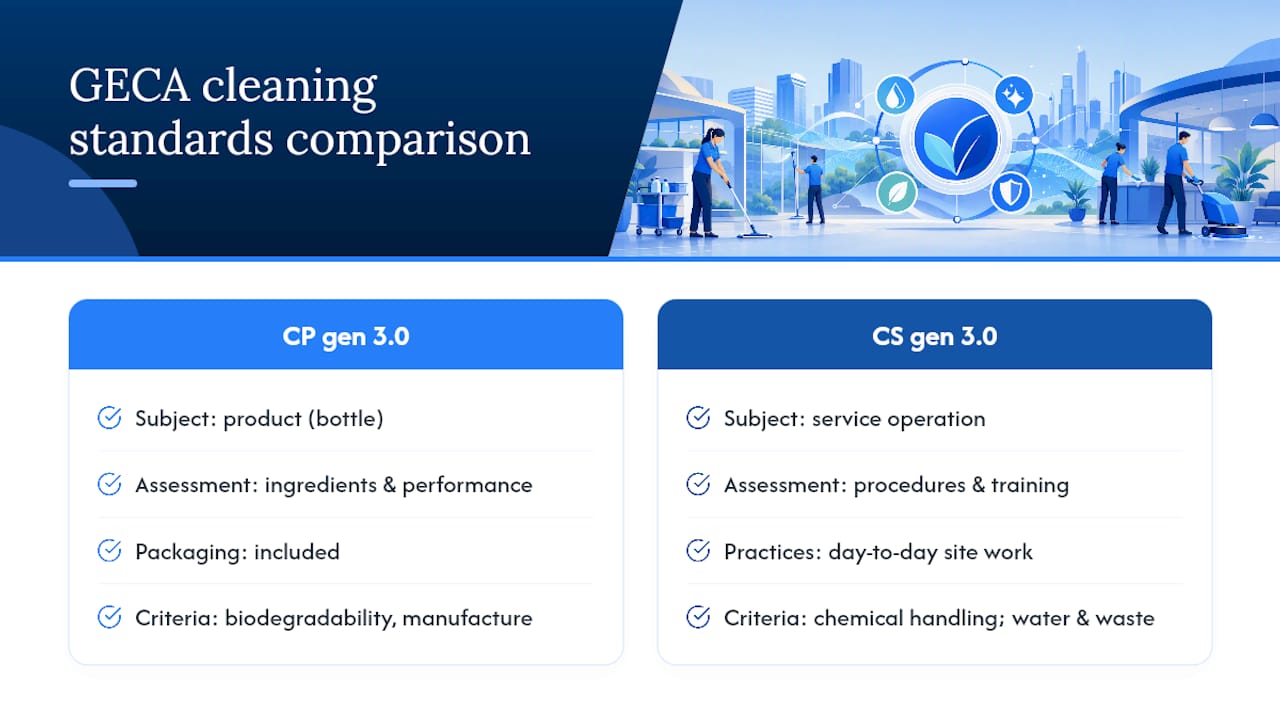
CP gen 3.0 sets eligible product categories and technical criteria covering ingredients, biodegradability, packaging and manufacture. One rule worth flagging for buyers in health, education and childcare settings: GECA's position is that products designed to directly impact air quality, such as airborne deodorisers and air fresheners, aren't allowed under the standard at all, regardless of other credentials.
CS gen 3.0 works differently. It requires documented cleaning procedures, regular staff training on chemical handling and equipment, and demonstrated efforts to cut water and waste use across the operation, not just on a single job.
A certified product is not a certified service, and vice versa. A supplier using GECA-certified chemicals hasn't automatically earned GECA certification for their cleaning service, because the service standard audits procedures and site practices separately from the products used. Ask which one you're actually being shown.
How does the GECA certification process work?
Buyers evaluating a supplier's claim, or suppliers considering certification themselves, follow a defined sequence rather than a one-off inspection.
- Pre-assessment. The applicant completes a survey against the relevant standard (CP or CS gen 3.0) to check eligibility before committing.
- Quote and Assurance Provider selection. GECA works through independent, accredited Assurance Providers who quote for the audit work.
- Application fee. A one-off $950 + GST application fee is paid to GECA itself, separate from the auditor's quote.
- Independent audit. The Assurance Provider conducts a documentation review and an on-site audit against the standard's criteria.
- Certification and licensing. Once approved, the business signs a licence agreement and receives access to GECA's logo and marketing toolkit.
- Re-assessment. Certification runs on a three-year cycle, with an annual licence fee in between.
Timelines vary, but if documentation is ready, audits typically run three to six months, and the full process must be completed within 12 months of accepting the Assurance Provider's quote.
Pro Tip: Don't take a supplier's word that they're "GECA certified." Ask for the licence agreement, the certificate number, and the exact scope it covers, then check the effective and expiry dates before you sign anything.
What does GECA certification deliver for procurement decisions?
The core value is verification, not vibes. GECA positions its model as a direct counter to greenwash, because claims sit behind a published standard and an independent audit rather than a supplier's own wording. That's the difference between "eco-friendly" on a label and a licence number you can look up.
For built-environment procurement, the practical benefits stack up:
- GECA-certified cleaning products can contribute toward Green Star Performance credits and relevant WELL Building Standard features.
- Third-party audit evidence gives sustainability managers something concrete to cite in tender responses and board reporting.
- The CP gen 3.0 update tightened prohibited substances, biodegradability testing and packaging rules, so certification issued under the newer standard carries stricter criteria than older certificates.
GECA has limits worth knowing. Certification confirms compliance with that specific standard's scope, not a blanket guarantee across every sustainability claim a supplier makes elsewhere. A GECA-certified glass cleaner tells you nothing about a supplier's carbon footprint or labour practices unless a separate standard covers those.
How do you verify a GECA licence before you sign a contract?
Verification takes minutes, and it should happen before a contract is signed, not after a complaint.
- Search the GECA database. GECA maintains a public listing of certified products and services; cross-check the supplier's exact product name or business name against it.
- Request the licence agreement. Ask for a copy showing the licensee's name, the standard (CP or CS gen 3.0), and the exact scope, including which sites, product ranges or service lines are covered.
- Ask for audit confirmation. A legitimate licensee can confirm the Assurance Provider's report and the on-site audit date without hesitation.
- Check the dates. Certification runs on a three-year cycle. A certificate outside that window, or missing an effective date altogether, is expired or was never formally issued.
Red flags to write into your RFI evaluation criteria: certificates with no visible expiry, marketing copy that says "GECA-approved ingredients" without naming an actual licence, and services claiming certification based solely on the products they use.
Pro Tip: Build a line into your contract template requiring "current GECA licence documentation, or equivalent third-party ISO 14024 ecolabel evidence, to be supplied on request throughout the contract term." That closes the loop if certification lapses mid-contract.
A Canberra cleaner's view on putting GECA principles into practice
Certification aside, the operational habits GECA audits for are ones any serious cleaning business should already have: documented chemical handling procedures, staff training records, equipment maintenance logs and a genuine plan to cut water and waste, not just a line in a brochure.
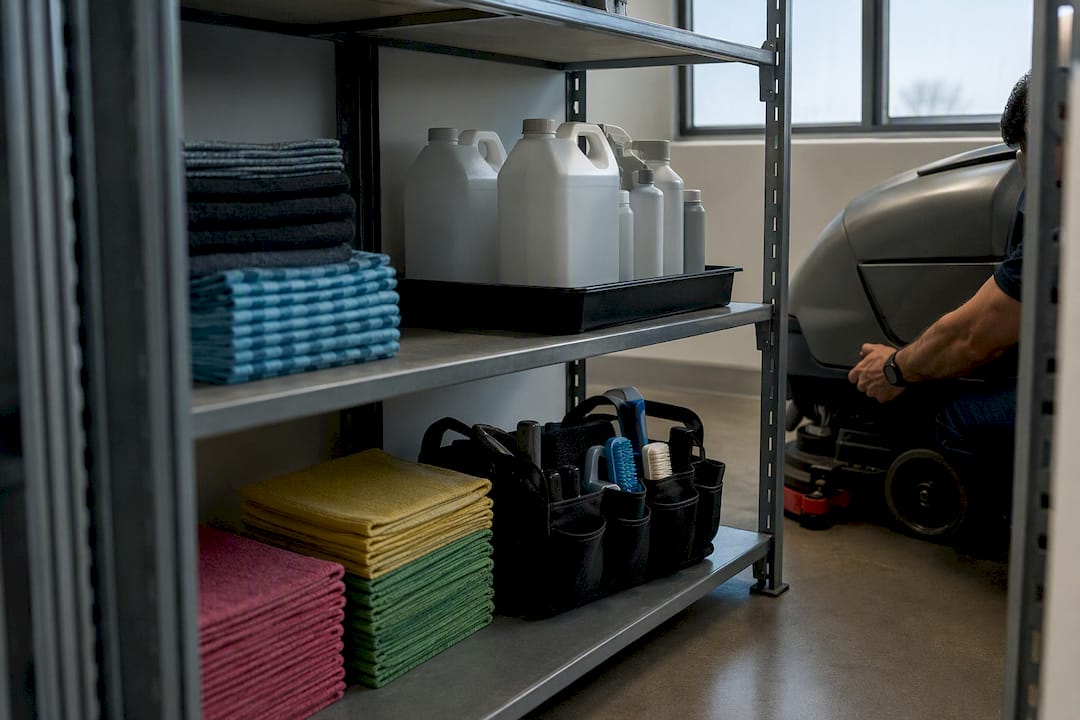
A local supplier can usually hand over training logs, cleaning schedules and product choices that map to GECA's criteria even without a formal licence. That's useful evidence for smaller contracts, where formal certification may not be commercially proportionate. For larger or reputation-sensitive contracts, a fully licensed GECA-certified service still gives you the strongest paper trail, because it's independently checked rather than self-reported.
Where to check GECA's official standards and process
For anyone verifying claims or scoping a tender, go to the source documents rather than a supplier's summary of them.
- GECA homepage — program overview, certified product search and general background.
- Certification process — fees, audit steps and re-assessment timing, straight from GECA.
- Cleaning Products standard (CP gen 3.0) — downloadable PDF covering categories, prohibited substances and packaging rules.
- Cleaning Services standard (CS gen 3.0) — downloadable PDF setting out training, procedure and waste requirements for service providers.
- Meet GECA's New Cleaning Products Standard — informational post explaining what changed in the gen 3.0 update and its relevance to Green Star and WELL.
If you're commissioning cleaning services in Canberra and want a provider that already runs on eco-friendly products and documented practice, ACT Cleaning by Demand's office cleaning service covers commercial contracts, while the end of lease cleaning service suits landlords and agents needing a reliable, chemical-conscious clean between tenancies. Every job runs on flexible scheduling with no lock-in contracts, so you're not stuck if your needs change.
A straight opinion on where GECA fits in procurement
Most sustainability marketing in the cleaning trade is designed to be checked once and forgotten. GECA is built to be checked repeatedly, and that's exactly why it's more useful than it looks at first glance. The three-year re-assessment cycle means a licence earned in 2023 has to be re-earned, not just renewed on paper.
Where I'd push back on how some procurement teams use it: treating a GECA logo as the finish line rather than the starting point. The standard tells you the product or service met specific criteria at a specific audit date, on a specific scope. It doesn't tell you the supplier handles complaints well, turns up on time, or manages a difficult building. Use GECA certification as a filter for credibility, then still do the ordinary due diligence you'd apply to any contractor.
The businesses that get the most value from GECA aren't the ones chasing the logo for a tender document. They're the ones already running training records, waste tracking and documented chemical procedures, who then find the certification confirms what they were doing anyway.
— Deng
Sources
- GECA | Good Environmental Choice Australia
- Certification Process — GECA | Good Environmental Choice Australia
- Cleaning Products (CPv3.0-2022) — GECA | Good Environmental Choice Australia
- Cleaning Services (CSv2.0-2021) — GECA | Good Environmental Choice Australia
- Meet GECA's New Cleaning Products Standard! — GECA
FAQ
What does "GECA certified" mean?
It means a product or service has passed an independent audit against a published GECA standard, ISO 14024 aligned, and holds a current licence within its three-year certification cycle. It does not mean every claim a supplier makes elsewhere is verified.
Which cleaning products are GECA approved?
Products certified under CP gen 3.0 appear on GECA's public database with their licence details. Airborne deodorisers and air fresheners are excluded from certification under this standard regardless of other formulation claims.
What are the best non-toxic cleaning products in Australia?
There's no single official "non-toxic" list, but GECA-certified products under CP gen 3.0 have passed independent testing on ingredients, biodegradability and packaging, which is the closest thing Australia has to a verified benchmark.
Is a GECA-certified product the same as a GECA-certified service?
No. Product certification covers what's in the bottle; service certification under CS gen 3.0 covers how the cleaning business operates, including training and procedures. A supplier can hold one without the other.
How much does GECA certification cost?
Applicants pay a one-off $950 + GST application fee to GECA, plus a separate quote from an independent Assurance Provider for the audit, followed by an annual licence fee across the three-year cycle.