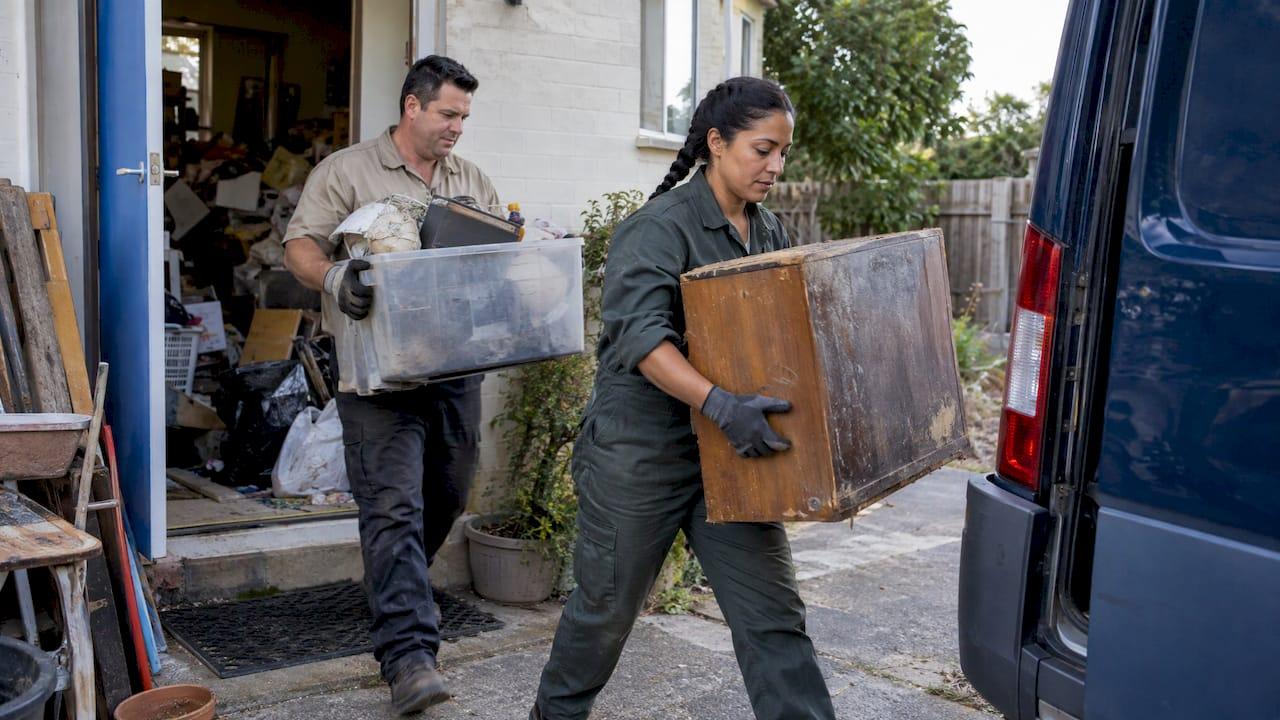
A hoarding cleanup in Canberra runs in stages: assessment, an agreement with the occupant, sorting, removal, deep cleaning and follow-up support. Each stage is paced around the person who lives in the home. The aim is a safe home, not an empty one. Below is what happens at each stage, what hazards change the plan, and where rubbish, recyclables and donations go in the ACT.
If you are arranging this for a parent, a sibling, a tenant or yourself, the order matters. A rushed one-day clear-out often causes distress and does not last. A planned, step-by-step job usually does.
TL;DR
- A proper hoarding cleanup starts with a visit to assess the clutter, the hazards and the person, not with a skip bin.
- A written agreement about what stays, goes or is donated protects the occupant and the cleaners.
- Biohazards, mould, pests, blocked exits and fire risks mean specialist handling and a faster, safety-first approach.
- ACT disposal has rules, and a hoarded home usually produces far more than the free bulky waste collection covers.
- Cleaning alone rarely holds. Plan follow-up support with a GP or support services to prevent recurrence.
Table of Contents
- The process at a glance
- Stage 1: The assessment visit
- Stage 2: Agreement and planning
- Stage 3: Sorting what stays and what goes
- Stage 4: Hazards that change the plan
- Stage 5: Removal and disposal under ACT rules
- Stage 6: The deep clean
- Stage 7: Follow-up so it does not return
- What to ask before you book
- Our perspective
- Talk to us about your property
- FAQ
- Sources
The process at a glance
| Stage | What happens | Who is usually involved |
|---|---|---|
| 1. Assessment | Home visit, safety check, access and volume review | Cleaner, occupant, family, sometimes health workers |
| 2. Agreement and planning | Written scope, priorities, schedule | Occupant, family, cleaning team |
| 3. Sorting | Keep, donate, recycle, discard, with valuables and documents found first | Occupant, helpers, cleaners |
| 4. Removal | Staged clearing and lawful disposal | Cleaning team |
| 5. Deep clean | Surfaces, kitchens, bathrooms, odour, floors | Cleaning team |
| 6. Follow-up | Maintenance plan, GP and support services | Occupant, family, health and support services |
Stage 1: The assessment visit
The first step is a visit to the property. Australian guidance on hoarding and squalor describes the assessment as looking at the degree of clutter or squalor, the risks, the person, any dependants, their capacity and their mental health (Catholic Healthcare key messages). That is broader than counting rooms and rubbish.
On the practical side, the assessor checks:
- whether exits, hallways and stairs are clear
- whether the kitchen and bathroom can be used
- signs of mould, pests, spoiled food or animal waste
- items stacked near heaters, stoves or power points
- the likely volume to be removed
Clinicians use validated tools to record severity, such as the Clutter Image Rating Scale or the Hoarding Rating Scale, and a peer-reviewed Australian review also recommends gathering safety information before a home visit (Managing hoarding and squalor, 2021). A cleaning company is not a clinician, but a good one takes photos, notes access problems and asks who else is involved in the person's care.
If children or vulnerable people live in or visit the home, clear stairs and walkways come first. Stair clutter safety guidance explains why trip hazards on stairs matter, and the same thinking applies to any hallway where someone could fall.
Why the person matters as much as the property
The same official guidance warns that focusing on the clutter alone, apart from the person, will not be effective, and that there is a high probability of an underlying hoarding disorder or a treatable cognitive or psychiatric condition (Catholic Healthcare). So the assessment is also the moment to ask whether a GP or mental health service should be involved before cleaning starts.
Stage 2: Agreement and planning
Once the scope is clear, the occupant, family and cleaners agree a plan. The person concerned should be central to decisions, and has the right to decline suggested actions where the situation is safe and the risk is minimal (Catholic Healthcare). The Australian review recommends a cleaning agreement made with the person, who is actively involved, to reduce trauma (Managing hoarding and squalor).
Put it in writing. A Western Australian Health Department toolkit notes that a written agreement identifying the items to be removed prevents later accusations that things were moved without permission or stolen (HSDS Toolkit). Although it is a WA document, the principle applies anywhere.
A workable plan covers:
- Which rooms come first, usually exits, kitchen and bathroom
- How many hours per session and how many sessions
- Who will be present, and who decides on contested items
- What happens to valuables, documents and sentimental items
- How rubbish, recycling and donations will be removed
- What support is in place afterwards
If several services are already involved, the official guidance suggests a joint planning meeting so physical health, mental health, capacity and dependants are all considered together (Catholic Healthcare).
Stage 3: Sorting what stays and what goes
Sorting is the slowest and most emotional stage. Industry guides commonly use four categories: keep, donate, recycle and discard. Short sessions of one to two hours on one small area at a time keep it manageable. Many Australian cleaners also add a search step first, looking for documents, cash, photos and valuables before bulk removal begins.
Tips that help:
- Start with items that carry little emotional weight, like obvious rubbish, expired food and empty packaging.
- Let the occupant handle sentimental items themselves, at their pace.
- Keep a clearly marked "decide later" box with an agreed limit, so sessions do not stall.
- Agree on a destination for donations before the day, so good items leave the home quickly.
For items worth selling or passing on, this storage unit cleanout plan offers a useful way to decide what to keep, sell, donate or dispose of. Selling can make letting go easier for some people, though never push it where the person wants to donate or discard.
Stage 4: Hazards that change the plan
Some situations take a hoarding job out of the "tidy up" category. Cleaning industry guidance lists these triggers for professional or specialist handling:
- strong odour, mould or biological contamination
- animal waste, sharps or bodily fluids
- pest infestations
- unsanitary kitchens or bathrooms
- fire or water damage, or structural concerns
- drug residue or unknown chemicals
- volume that needs industrial removal equipment
Safety concerns also override a slow, gentle pace. Blocked exits, excessive weight on floors, no usable kitchen or bathroom, and items stacked near heaters, stoves or outlets are reasons to act sooner, while still explaining each step to the person and keeping them involved.
Cleaners working in biohazard conditions need appropriate protective equipment and decontamination procedures, and hazardous waste must be transported and disposed of properly. Our guide to biohazard cleanup standards in Canberra covers the standards that apply.
If anyone is at immediate risk of suicide, self-harm or violence, or there is a fire or medical emergency, call 000 for police, ambulance or fire brigade (Catholic Healthcare).
When a council or tribunal is involved
Sometimes a council order or tribunal direction requires remediation, for example for a rental property. The WA toolkit notes that notices start an administrative process that can lead to court if the occupant does not comply (HSDS Toolkit). In the ACT, tenants and landlords with a deadline should talk to the cleaning team early, so the staged plan fits the timeline.
Stage 5: Removal and disposal under ACT rules
A hoarded home generates a lot of waste, and where it goes matters.
Bulky waste collection. All ACT residents can book one free bulky waste collection per financial year, for up to 2 cubic metres of items (Access Canberra). For most hoarding jobs that is a small part of the total, so a professional team usually organises larger loads.
Resource management centres. The ACT has two, at Flemington Road, Mitchell and Mugga Lane, Symonston, for items that do not belong in household wheelie bins (Access Canberra).
Reuse and donation. The ACT Government has said Goodies Junction will accept donations of furniture, electrical equipment, clothing, building materials and tools (ACT Government media release, 2024). The Canberra Times reported drop-offs at the Mitchell and Mugga Lane centres from 7:30am to 4:45pm, seven days a week (The Canberra Times). Check Access Canberra for current hours and accepted items before you load a vehicle.
Illegal dumping. The ACT Waste Management Strategy sets out penalties under the Litter Act 2004, including $1,000 for individuals and $5,000 for businesses for basic littering, with higher penalties for aggravated littering, and far higher ones for dumping illegal substances under the Dangerous Substances Act 2004 (ACT Waste Management Strategy 2011-2025). This is a good reason to use a cleaner who disposes of waste lawfully, particularly where chemicals, sharps or contaminated materials are involved.

Stage 6: The deep clean
With the volume gone, the real cleaning starts: degreasing and sanitising kitchens and bathrooms, washing walls and surfaces, treating odours, and steam cleaning carpets and upholstery where they can be saved. Floors and cupboards that have been hidden for years often show damage, so repairs may follow. If the property is being sold or handed back at the end of a lease, a final presale or bond clean can finish the job.
Stage 7: Follow-up so it does not return
The most important evidence in this field is also the least comfortable: one-off clean-ups on their own are not effective, and can cause great distress when the person is not involved (Catholic Healthcare). The Australian review says a one-off clean does not address excessive acquisition, and recommends an ongoing management plan with follow-up and support (Managing hoarding and squalor).
In practice, aftercare can include:
- a visit to the person's GP, who often has a long-term relationship with them and can help with detection and management
- case management or community support services
- regular home-visit support to keep key areas clear
- a maintenance plan and agreed check-in cleans
- peer or family support groups
Canberra Health Services describes a Community Recovery Service that offers recovery-focused clinical case management, with discharge planning that includes a handover to the GP and relapse prevention strategies (CHS Model of Care). A GP is the usual way to ask about referral. A 2024 Australian study of family members found strong interest in peer support, and found that family-centred programs helped people learn how to help, improve communication and set realistic expectations (ANZ Journal of Family Therapy, 2024).
If the occupant is willing, a regular cleaning schedule can be part of the maintenance plan. Ours has no lock-in contracts, so the frequency can be adjusted as needs change.
What to ask before you book
- Will the occupant be involved in decisions, and how is that agreed in writing?
- Are staff police-checked and is the company insured?
- How are biohazard materials and general waste disposed of?
- Can the job be staged over several visits?
- What happens to valuables and documents found during sorting?
- Is a quote available after an on-site assessment?
For budgeting, our hoarding cleanup cost guide explains what affects the price.
Our perspective
We treat a hoarding job as a safety project, not a clear-out. The home belongs to the person living in it, so we start by listening to what worries them and what they want to keep.
Our approach is designed around staged visits, a clear written scope and lawful disposal, because a job that the occupant understands and agrees to is far more likely to last. We use eco-friendly products, our cleaners are police-checked and insured, and there are no lock-in contracts, so families can pause or adjust the plan as circumstances change.
Where a property involves biohazards or a deadline from an agent or landlord, we plan the work in priority order: access and safety first, then volume, then deep cleaning. We back our work with a 100% satisfaction guarantee.
Deng
Talk to us about your property
ACT Cleaning by Demand provides hoarding and biohazard cleanup alongside deep cleaning, carpet and upholstery steam cleaning, end of lease cleaning and presale cleaning across Canberra and the ACT. Every job is tailored to the property and the people in it.
To discuss your situation, see our cleaning services or start at ACT Cleaning by Demand. If the property is a rental that needs a bond-back result after the hoarding is cleared, our end of lease cleaning is the follow-on step.
FAQ
How long does a hoarding cleanup in Canberra take?
It depends on the volume, the hazards and how many sessions the occupant can manage. A light case may take a day, while a severe one is usually staged over several visits. An on-site assessment is the only reliable way to estimate it.
Can the cleanup happen without the occupant's consent?
Ideally not. Official guidance puts the person at the centre of decisions and says they can decline suggested actions when the risk is minimal. Where there is serious danger, such as blocked exits or biohazards, health services or authorities may need to be involved.
Who removes the rubbish and where does it go?
The cleaning team arranges removal and disposal. General waste, recyclables and donations go to appropriate ACT facilities such as the Mitchell and Mugga Lane resource management centres. Illegal dumping carries heavy penalties under ACT law.
Will the clutter come back after a cleanup?
It can, especially after a one-off clean with no support. Official sources recommend a maintenance plan with GP involvement and ongoing support. A regular cleaning schedule can be part of that plan.
Sources
- Catholic Healthcare: Responding to hoarding and squalor, key messages
- Managing hoarding and squalor (NCBI, 2021)
- Access Canberra: Recycling and waste
- ACT Government media release on reusable facilities, 2024
- The Canberra Times: How will Goodies Junction work?
- ACT Waste Management Strategy 2011-2025
- Canberra Health Services: Model of Care
- ANZ Journal of Family Therapy, 2024 family study