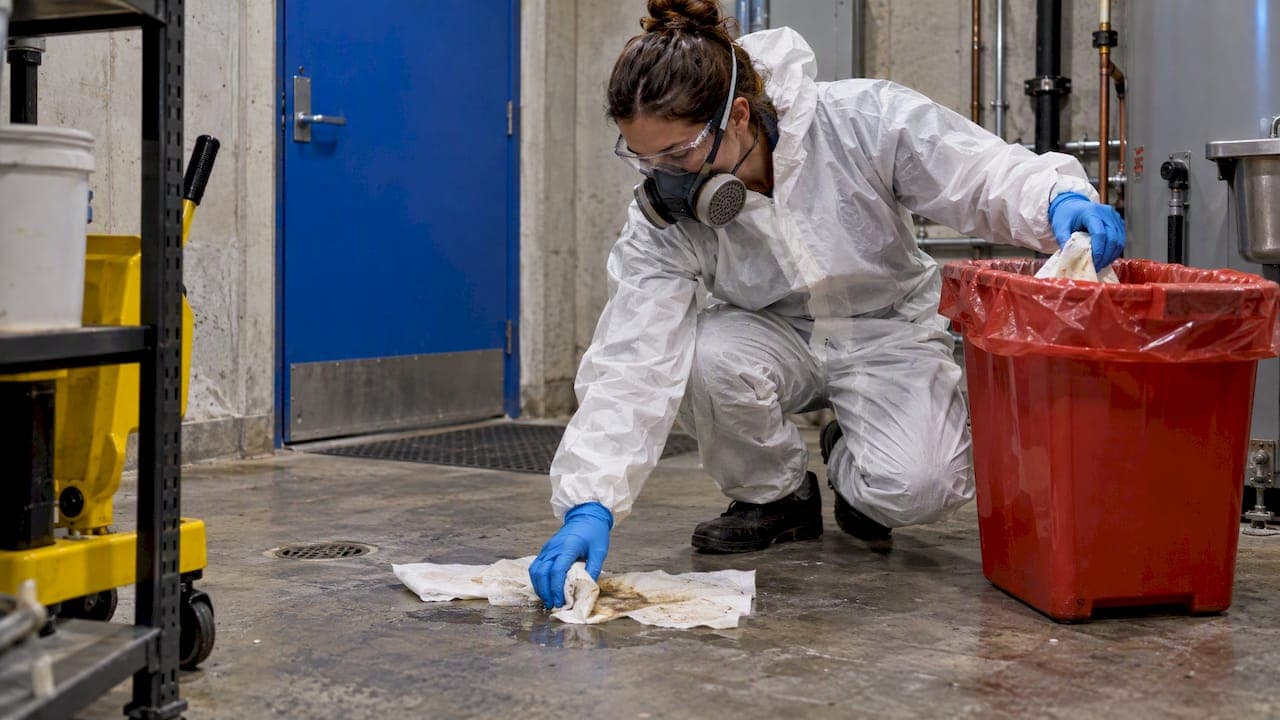
Biohazard cleanup in Canberra is not governed by one neat "biohazard standard". It sits across several layers: ACT work health and safety duties, the general environmental duty under the Environment Protection Act 1997, clinical waste rules administered through Access Canberra, and infection control principles used across ACT Health guidance. This guide sets out what each layer asks for, what a competent crew should be doing on your property, and the questions to put to any provider before you book.
It is written for property owners, landlords, tenants, strata managers, insurers' clients and businesses who have to arrange a cleanup after an unattended death, trauma, sewage backflow, needle finds or a hoarded property. It is not a DIY manual. Biohazard work puts people at risk, and the safest instruction for most situations is to keep out of the area and hire trained people.
TL;DR
- No single document defines "biohazard cleanup" in the ACT. Duties come from WHS law, environmental law, clinical waste licensing and infection control guidance.
- The business running the job (a PCBU in WHS language) must eliminate or minimise risks so far as reasonably practicable, provide PPE and training, and consult its workers.
- Anything that may be clinical waste has its own rules: a licence to transport it and storage, treatment and disposal in line with the Clinical Waste Manual 1991.
- Ask any provider about their safe work procedures, PPE, waste pathway and insurance in writing before work starts.
- We handle hoarding and biohazard cleanups in Canberra and the ACT with police-checked staff, and we will talk through your situation before anything is booked.
Table of Contents
- What biohazard cleanup actually covers
- The legal layers in the ACT
- What a proper job looks like on site
- Why you should not clean it yourself
- How to vet a Canberra biohazard cleaner
- Our perspective: what we see on Canberra jobs
- Hoarding, post-incident and insurer-related cleans with us
- Special situations to plan for
- Common mistakes
- FAQ
- Sources
What biohazard cleanup actually covers
Biohazard cleanup means removing and decontaminating material that can carry infection or cause harm: blood and body fluids, sewage, sharps such as needles, and the contaminated materials around them. In practice, the jobs Canberra property owners meet most often are:
- Unattended death or trauma scenes, where body fluids have soaked into flooring, mattresses or underlay.
- Sewage or grey-water overflow in a unit, townhouse or commercial building.
- Discarded needles and other sharps in rental properties, car parks or common areas.
- Hoarding and severe neglect, where waste, spoiled food, pests and sharps are mixed together.
- Post-incident cleans for insurers' clients, where a claim depends on the property being made safe and documented.
The common thread is that the cleaner cannot see every hazard. ACT guidance on infection control works on the principle that all blood and body substances should be treated as potential sources of infection, regardless of perceived risk. That 2006 ACT Health document was written for office practices and community services rather than cleaning companies, but the principle is the baseline a careful crew applies everywhere.
The legal layers in the ACT
Think of the rules as four layers. A good provider can tell you how they meet each one.
| Layer | What it asks | Where it comes from |
|---|---|---|
| Work health and safety | Eliminate or minimise risk, provide PPE and training, consult workers | WHS duties, as set out by Safe Work Australia and regulated in the ACT by WorkSafe ACT |
| Safe work procedures | Written procedures, displayed where the work happens | WorkSafe ACT guidance |
| Environmental duty | Take reasonable steps to prevent or minimise environmental harm | Environment Protection Act 1997 |
| Clinical waste | Licensed transport, controlled storage, treatment and disposal | Access Canberra and the Clinical Waste Manual 1991 |
Work health and safety duties
Under the model WHS framework, the person conducting a business or undertaking (PCBU) carries the main duty. Safe Work Australia explains that PCBUs must eliminate or minimise risks to workers and others so far as is reasonably practicable, provide suitable PPE and training, and consult workers. That consultation includes identifying which tasks may expose workers to biological hazards and listening to their practical suggestions.
Workers have duties too. They must take reasonable care for their own safety and follow reasonable instructions, including the proper use of the PPE they are given.
What this means for you as a client: a cleaning business that sends one person with a mop and a bucket to a trauma scene is not meeting the duty. You are entitled to ask who will attend, what training they hold, and what they will wear.

Safe work procedures
WorkSafe ACT states that safe work procedures for biohazard cleanup must be posted prominently at the site where the work is performed. If you are the property owner and you walk into a job in progress, you should be able to see them. If you cannot, ask why.
The environmental duty
The Environment Protection Act 1997 places a general environmental duty on individuals and businesses to take reasonable steps to prevent or minimise environmental harm. For biohazard work, the practical readings are simple: contaminated liquid does not go down a stormwater drain, contaminated materials do not go into a general skip, and chemicals are used and stored so they do not escape the site.
Clinical waste
This is the layer where mistakes are most expensive. Access Canberra states that businesses in the ACT must hold a licence to transport clinical waste, and that clinical waste must be stored, treated, moved and disposed of in accordance with the Clinical Waste Manual 1991. A cleaner who bags blood-soaked carpet and leaves it for your general rubbish collection is creating a problem you may later own.
Road transport adds another layer. WorkSafe ACT notes that dangerous goods transport laws and the ADG Code apply to road transport, and additional or alternative requirements may apply to potentially infectious material moved as clinical waste. In short, the waste pathway is regulated from the moment it leaves your property.
Inside the work area, the ACT Health guidelines specify that clinical waste is segregated at the source in colour-coded, labelled and secure containers.

What a proper job looks like on site
Standards are easier to judge when you can picture the work. A competent biohazard cleanup runs in a sequence.
- Assessment before entry. The crew identifies what is present, where, and how it could harm them or others. Hidden sharps are the classic surprise: WorkSafe ACT identifies sharps in unexpected places such as under mattresses or on top of furniture, which is why thorough inspection comes before cleaning.
- Controls and procedures. The area is restricted, safe work procedures are displayed, and each worker knows the plan.
- PPE on, and checked. WorkSafe ACT says PPE must be stored in a clean, accessible location and inspected regularly for damage or contamination. Torn gloves or a cracked respirator are not minor issues in this work.
- Removal of visible material. For small spills, WorkSafe ACT advises disposable towels to take up visible material, followed by disinfecting with a dilute bleach solution. Larger scenes, porous materials and contaminated furnishings generally need to be removed rather than cleaned.
- Sharps and waste. Needles go into a sharps container, never loose into a bag, and waste is segregated and labelled for its disposal pathway.
- Disinfection and deodorising. Surfaces are disinfected and the area is dried and aired. Odour that persists usually means contaminated material is still in the structure.
- Documentation. You should receive a clear record of what was done and how waste was handled, which also helps with insurers, property managers and agents.
If a worker is exposed
Exposure incidents need a set response. WorkSafe ACT's guidance is that after a potential biohazard exposure workers must seek immediate first aid, report the incident to a supervisor and seek medical attention, ideally within two hours. Ask a provider whether they have this process written down. It tells you a lot about how seriously they take the work.
Why you should not clean it yourself
Tenants, owners and family members often face a biohazard before they have had time to think. The advice most responsible sources agree on is to limit what you do. If you find a needle, WorkSafe ACT's advice is to place it in a sharps disposal container and contact the relevant authorities about disposal. For anything involving body fluids, sewage or hoarded waste, the risk is not just infection. It is also pathogens in porous materials, airborne particles, chemical misuse (bleach mixed with other products) and waste you may not be allowed to dispose of yourself.
If a person is in immediate danger or you suspect a crime scene, call emergency services first. Cleanup comes after police and other authorities have released the property. For a health concern after contact with blood or a needle, see a doctor promptly.
How to vet a Canberra biohazard cleaner
Search results for this topic are full of providers, from specialist trauma cleaners to interstate networks, and the pages often read alike. These questions separate them.
- Who is attending, and are they trained for this? Ask for the training relevant to biological hazards, not just a general cleaning certificate.
- Can I see your safe work procedure and risk assessment for my job? The procedures should be on site.
- What PPE will the crew use, and how is it checked?
- How will waste leave the property? Ask who transports it, whether the business or its contractor holds the clinical waste transport licence, and where it goes.
- Are you insured for this kind of work? Ask for the certificate, not a verbal yes.
- What documentation will I receive? Insurers and agents often want it.
- Will staff be police-checked? You are letting people into a private, often sensitive, space.
- How is the quote set? A written scope and a clear explanation of what is variable beat a vague number given over the phone.
A provider who answers these fully and without defensiveness is usually the one to trust. One who says "we just handle it" is not.
Our perspective: what we see on Canberra jobs
Most of the biohazard-adjacent calls we get are not dramatic. They are a landlord who has taken back a property after a tenancy and found it in a state they did not expect, a family dealing with a hoarded home before a sale or a move, a strata manager facing a sewage problem in a common area, or an insurer's client who needs a property made safe before repairs start. In all of them, the person ringing is stressed and wants to know two things: is it safe, and what happens next.
Our view is that the standard is simple even when the work is not. Treat every unknown as a hazard, use trained people with the right protection, keep waste on its proper pathway, and tell the client plainly what is being done. Cleaning that looks finished but leaves contaminated material in the structure is the outcome to avoid.
We built our service around plain terms: police-checked staff, insured cleaners, eco-friendly products where they are appropriate, flexible scheduling and no lock-in contracts. Where a job needs more than we should take on, we say so and point you to the right specialist rather than overpromise. For emergencies, we would rather you call early and get honest advice than wait until the problem has spread through a property.
— Deng
Hoarding, post-incident and insurer-related cleans with us
If you are dealing with a hoarded property, a post-incident clean or a property that has to be made safe for an insurer, we can assess the situation and tell you what is involved. Our services include emergency cleaning, insurer's client cleaning, one-off cleans and specialty work such as hoarding and biohazard cleanup, all across Canberra and the ACT. We do not publish fixed prices for these jobs because the scope depends entirely on what is on site, so we quote after we understand the situation.

See our full list of cleaning services and get in touch to talk through your property. If you manage a workplace or building, our commercial sanitisation service covers routine disinfection, and our commercial cleaning team can set up ongoing work. For end-of-tenancy situations where a property has been left in poor condition, our end of lease cleaning is a separate service with a bond-back guarantee.
Special situations to plan for
Rental properties and bond disputes
When a tenant leaves a property with biohazard contamination, the cleaning question quickly becomes a bond and liability question. Keep photographs, get the scope in writing, and keep the documentation the cleaner provides. Routine end-of-lease cleaning and biohazard remediation are different jobs and should be quoted separately.
Strata and commercial buildings
In shared buildings, the responsible body for common property needs to act quickly on sewage events or sharps finds, and has WHS duties toward the workers it engages. A provider who can show procedures, PPE and a waste pathway protects the owners corporation as well as the cleaner.
Offices and workplaces
If an incident happens at work, the business has its own duties as a PCBU toward staff who may be exposed. Isolate the area, stop people entering, and bring in a trained crew. Our guide to what to expect from office cleaning standards explains how routine cleaning and specialist work differ.
Short-stay and Airbnb properties
Hosts sometimes find needles, blood or serious soiling between guests. Do not handle sharps by hand. Close the booking window if needed, arrange a proper clean, and keep records. Our Airbnb cleaning service handles routine turnovers, and we can advise when a problem is beyond a standard turnover.
Common mistakes
- Assuming bleach and a mop is enough. Dilute bleach has a place in small spills, but porous materials often need removal, and bleach must never be mixed with other cleaning products.
- Putting contaminated material in general waste. Clinical waste has its own licensing and pathway.
- Paying on a vague quote. Insist on a written scope.
- Skipping the paperwork. Without records, insurer and agent conversations get harder.
- Letting the cleaner start before the property is released. Wait until authorities confirm you may proceed.
- Ignoring odour. Lingering smell is a signal, not a cosmetic issue.
FAQ
Is there a single biohazard cleaning standard in the ACT?
No single document covers it. Providers work within WHS duties, WorkSafe ACT guidance, the Environment Protection Act 1997 and clinical waste rules from Access Canberra. A good provider can explain how they meet each one for your job.
Does a biohazard cleaner need a licence in Canberra?
Businesses transporting clinical waste in the ACT need a licence for that transport, according to Access Canberra. Ask whether the cleaner holds it or uses a licensed contractor, and ask to see evidence.
What should I do if I find a needle on my property?
Do not pick it up with bare hands. WorkSafe ACT advises placing needles in a sharps disposal container and contacting the relevant authorities for disposal information. If anyone has been pricked or cut, get first aid and see a doctor promptly.
Can I clean up blood or body fluids myself?
For a very small spill, WorkSafe ACT advises disposable towels and a dilute bleach solution. Anything larger, anything soaked into porous materials, or any scene involving death, sewage or hoarding is a job for trained people with proper PPE and a waste pathway.
Who pays for biohazard cleanup?
It depends on the cause and the parties: the property owner, a tenant, a strata body or an insurer may be responsible. Check your policy and tenancy documents, keep records, and ask the cleaner for a written scope you can pass on.
Sources
- Environment Protection Act 1997 (ACT legislation)
- Biological hazards, WHS duties (Safe Work Australia)
- Biological hazards (Safe Work Australia)
- Safe work procedures (WorkSafe ACT)
- Biohazards (WorkSafe ACT)
- Personal protective equipment (WorkSafe ACT)
- Transport of dangerous goods (WorkSafe ACT)
- Clinical and hazardous waste (Access Canberra)
- Infection control guidelines (ACT Health, 2006)