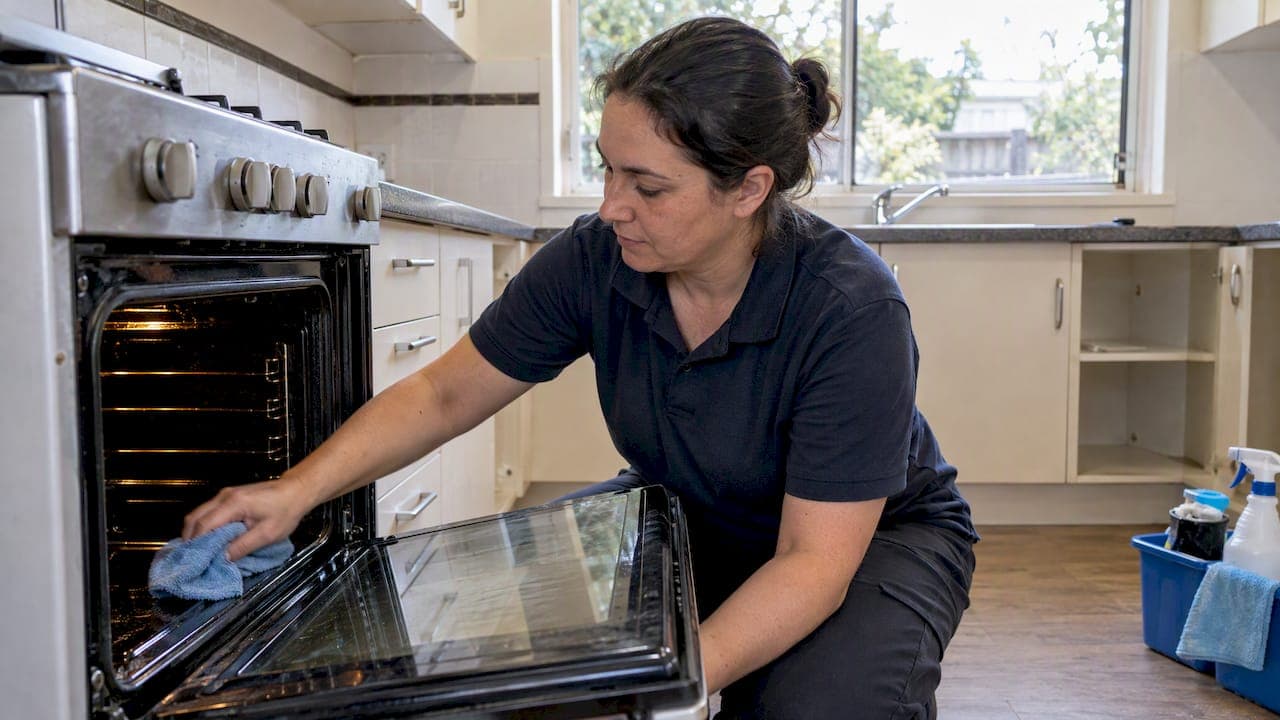
A bond clean covers every room you rented, from the inside of the oven to the tracks of the sliding doors, and it aims to return the property to the cleanliness recorded in your entry condition report. It does not cover repairs, pest control or pre-existing damage. Below is a room-by-room list of what is normally included, what sits outside the scope, and how to check your own clean against the standard the ACT actually uses.
TL;DR
- A bond clean is a top-to-bottom clean of the whole interior: kitchen, bathrooms, living areas, bedrooms, laundry, windows, floors, and usually balconies and garages.
- In the ACT the benchmark is the condition of the property at the start of the tenancy, less fair wear and tear. It is not "spotless" and there is no "6/10 rule" in the legislation.
- Cleaners can restore cleanliness only. Marks, damage and worn finishes that were there on day one, or that come from ordinary ageing, are not a cleaning job.
- Check your signed entry condition report before you book, and photograph the finished clean room by room.
- Ask any cleaner exactly what is in their checklist, whether carpets and windows are included, and what happens if the agent raises an issue.
Table of Contents
- What the ACT expects of you at the end of a tenancy
- Bond cleaning inclusions, room by room
- Quick-reference table: usually in, sometimes in, usually out
- What a bond clean does not cover
- Our perspective: a clean is only as good as the report behind it
- How to check a bond clean before the inspection
- Choosing a cleaner: what to ask before you book
- How our end-of-lease clean works
- Timing: when to book and when to clean
- FAQ
- Sources
What the ACT expects of you at the end of a tenancy
Before a checklist makes sense, you need the standard it is meant to meet. The ACT Government's Renting Book sets out that when you leave, the property should be in substantially the same state of cleanliness and repair as when you moved in, with fair wear and tear excepted. During the tenancy, the ACT Government also expects tenants to take care of the property and keep it reasonably clean.
Two things follow from that wording.
First, the comparison is with your entry condition report, not with a brand-new home. If the oven had baked-on grease when you moved in and the report says so, you are not required to leave it cleaner than that. That said, most tenants cannot prove how the oven looked unless the report and photos are detailed, so a professional clean to a high standard is the safer route.
Second, there is no numeric scoring system. You may have heard of a "6/10 rule" for cleaning houses. It is not a feature of ACT tenancy law. Cleanliness is judged against the initial report, which is why the report matters more than any generic checklist. We cover this in more depth in our piece on ACT tenant cleaning obligations and why spotless is the wrong standard.

Other states word their rules similarly. Queensland's Residential Tenancies Authority, for example, also points tenants back to their entry condition report and photos. If you are reading checklists written by Brisbane or Melbourne companies, the cleaning tasks translate well, but the legal framing is state-specific.
Bond cleaning inclusions, room by room
No two companies word their checklists identically, and the list below reflects what a thorough end-of-lease clean typically covers rather than a legal definition. Treat it as the benchmark to hold your cleaner, or your own effort, against.
Kitchen
The kitchen is where most disputes start, because grease and food residue show up under any inspector's torch.
- Oven: interior, racks, trays, door glass and seals wiped, burnt-on residue removed
- Cooktop: burners, drip trays, knobs and the surround degreased
- Rangehood: exterior, filters and underside cleaned or soaked
- Cupboards and drawers: emptied, wiped inside and out, including the tops where reachable
- Benchtops, splashback and sink: scrubbed, taps descaled and polished
- Dishwasher, if supplied: filter cleaned, interior and seals wiped
- Fridge, if supplied with the property: emptied, shelves and seals cleaned, defrosted if needed
- Floors: swept and mopped, including under the movable appliances
Bathrooms and toilets
- Shower screen, tiles and grout scrubbed, soap scum and limescale removed
- Bath and basin cleaned and polished, overflow and plug holes cleared
- Toilet: cistern, bowl, seat, hinges and the base
- Mirrors, tapware and vanity cupboards, inside and out
- Exhaust fan covers wiped
- Floors cleaned, including corners and edges
If your bathrooms are the main worry, we also offer standalone bathroom and toilet cleaning.
Bedrooms, living areas and hallways
- Built-in wardrobes: shelves, rails and tracks wiped
- Skirting boards, doors, door frames and architraves wiped down
- Light switches, power points and fittings spot cleaned
- Walls spot cleaned for scuffs and fingerprints where the paint allows it
- Ceiling fans and vents dusted or wiped
- Cobwebs removed from ceilings and corners
- Blinds and curtain tracks dusted or wiped
Windows, tracks and doors
- Interior glass cleaned, and exterior glass where it can be reached safely from the ground or balcony
- Window sills and tracks vacuumed and wiped
- Flyscreens brushed or washed
- Sliding door tracks cleared of dirt and grit
High or hard-to-reach windows, particularly in multi-storey apartments, are a common grey area. Ask about them before you book rather than after the agent's inspection.
Laundry
- Tub and taps scrubbed and descaled
- Cupboards wiped inside and out
- Lint removed from built-in dryers or vents, if fitted
- Floor and skirting cleaned
Floors and carpets
- Hard floors vacuumed and mopped, edges and corners included
- Carpets vacuumed throughout
- Carpets professionally steam cleaned, where the lease or the agent requires it
Carpet is the item most often argued over. Many landlords and agents ask for a professional steam clean as a condition of the final inspection. Check your lease, and if in doubt, keep the receipt: it is clear evidence of what you did. We offer carpet cleaning as a separate service or alongside an end-of-lease clean.
Outdoor areas and garage
- Balconies and patios swept, cobwebs removed, glass and rails wiped
- Garage swept, with cobwebs cleared and light oil marks spot cleaned where possible
- Entry areas, letterbox and bin area tidied
- Gardens: in a house with a yard, mowing, weeding and removing rubbish is often the tenant's job under the lease, but many cleaners do not include it
That last point matters. Garden tasks appear in some interstate checklists, including this Mackay guide, which lists yard work alongside cleaning. Whether a cleaning company covers them varies, so confirm what is in the quote.
Quick-reference table: usually in, sometimes in, usually out
| Item | Usually included | Check first | Usually not included |
|---|---|---|---|
| Oven, cooktop, rangehood | Yes | Heavy burnt-on build-up | Replacing worn parts |
| Bathroom scrubbing and descaling | Yes | Old mould staining in grout | Re-grouting or resealing |
| Internal windows and tracks | Yes | High or external-only glass | Window repair or tinting |
| Walls | Spot cleaning marks | Full wall washing | Repainting or patch repair |
| Carpet | Vacuum | Steam cleaning | Stain from permanent damage |
| Balcony and garage | Sweep, cobwebs | Pressure washing | Oil stain removal that needs resurfacing |
| Garden and lawn | Rarely | Mowing, weeding | Tree removal |
| Pest control | No | Flea treatment | Always a separate trade |
What a bond clean does not cover
This is where renters lose money, because they assume a cleaner can fix anything that looks bad.
- Damage and repairs. Holes in walls, cracked tiles, chipped benchtops, broken blinds and worn flooring are repairs. Cleaning cannot fix them.
- Fair wear and tear. Faded paint, worn carpet in a hallway and general ageing are not your responsibility under the ACT's standard, and they are not a cleaning job.
- Pre-existing marks. If it is in your entry report, it should not count against you. Attach your own photos to your records if the report was thin.
- Pest treatment. Fleas, cockroaches and similar problems need a pest controller. Some leases require flea treatment on exit, so read yours.
- Gardening and rubbish removal. Skip bins, tip runs and large garden work are separate jobs unless quoted.
- Mould from structural causes. Surface mould on grout can be cleaned. Mould from damp, leaks or poor ventilation is a property issue to raise with your landlord.
The ACT advice is practical: keep a copy of your signed condition report and photos of any pre-existing issues, because the report is what the dispute will be decided on. A cleaner restores cleanliness and cannot change what the report says.
Our perspective: a clean is only as good as the report behind it
We clean a lot of Canberra rentals, and the same pattern repeats. Tenants spend hours scrubbing things that were never an issue, then lose sleep over the one thing they cannot see: the entry report. Our advice is to start there.
Pull out the signed entry report and the move-in photos. Walk each room with it in hand. Note where the report is generous ("marks on wall", "carpet worn") and where it is silent. That tells you where the agent is likely to look hardest, and where you have a documented defence.
We also think "spotless" is the wrong promise. The honest promise is that the property matches its starting condition, less fair wear and tear. That is the standard we clean to, and it is the reason we back end-of-lease jobs with a bond-back guarantee and a 100% satisfaction guarantee. Our cleaners are police-checked and insured, we use eco-friendly products, and there are no lock-in contracts, because a one-off clean should be just that.
If an agent raises something after the clean, speak up quickly. We have set out how that works in our guide to the bond-back guarantee, and how to match a clean to the entry report in our inspection cleaning article.
— Deng
How to check a bond clean before the inspection
Whether you hire help or do it yourself, a short self-inspection catches most problems.
- Open the entry report. Mark every room where it records a defect, so you do not mistake it for a cleaning failure.
- Go in with a torch. Light across surfaces at a low angle: streaks on glass, grease on cupboard fronts and dust on skirting boards show up immediately.
- Open everything. Oven, drawers, wardrobes, dishwasher, the fridge, the laundry cupboard.
- Check the corners. Floor edges, shower grout, window tracks and the tops of doors.
- Look up. Cobwebs, fans, light fittings and rangehood.
- Photograph each room after cleaning, with date stamps, and keep your cleaning receipt.
- Return all keys and remotes and make sure no belongings are left behind.
For a printable version, see our end-of-lease cleaning checklist for Australian renters.
Choosing a cleaner: what to ask before you book
A checklist on a website means little if the job is rushed. Ask these questions and expect specific answers:
- Is the quote for the full property, and does it list the oven, windows, tracks and walls?
- Are carpets included, or priced separately?
- Are the cleaners police-checked and insured?
- What happens if the agent flags something after the clean, and how long do you have to report it?
- Is there a written guarantee, and what are its limits?
- Are there any lock-in contracts or cancellation fees?
It is also sensible to confirm that anyone working in your home is properly insured, a principle Access Canberra applies when it advises people to check a tradesperson is licensed and insured. For a longer set of questions, read 6 questions to vet a cleaner in Canberra.
How our end-of-lease clean works
Our end-of-lease and bond cleaning covers the rooms and tasks described above, tailored to the size and condition of your Canberra property. We build the plan around your entry report, schedule around your move-out date, and use eco-friendly products throughout. Carpet steam cleaning can be added, and the whole job is backed by our bond-back guarantee. There are no lock-in contracts.
Prices depend on the property, so we quote the job rather than publish a flat rate. You can see all our services or go straight to the end-of-lease booking page.
Timing: when to book and when to clean
Book as soon as you know your vacate date. End-of-month and school holiday weeks fill quickly in Canberra, when many leases turn over at once.
Clean after your belongings are out. Cleaning around furniture means missing the floors, the wardrobes and the inside of cupboards. Aim for the clean to finish a day or so before the final inspection, so there is time to fix anything that is flagged.
If you also need carpets done, schedule them last, once the rest of the cleaning is finished and foot traffic is over.

FAQ
Does a bond clean include carpet steam cleaning?
Not always. Some companies include it, others price it as an add-on, and some agents require a professional steam clean regardless. Check your lease and the quote, and keep the receipt as proof.
Is a bond clean the same as a regular clean?
No. A regular clean maintains a lived-in home, usually surfaces and floors. A bond clean is a detailed top-to-bottom clean that includes the oven, tracks, cupboards interiors, skirting, fans and windows, aimed at the final inspection.
Do I have to leave the property spotless in the ACT?
No. The ACT standard is the same state of cleanliness and repair as at the start of the tenancy, with fair wear and tear excepted. Your entry condition report is the reference point, so keep a signed copy.
Can a cleaner fix damage or marks that were already there?
No. Cleaning restores cleanliness, not paint, flooring or structural wear. Pre-existing damage should be documented in your entry report or your own move-in photos.
Are windows and walls part of a bond clean?
Usually yes for interior windows, sills and tracks, and for spot cleaning marks on walls. High external glass and full wall washing depend on the provider, so ask for them to be listed in your quote.
Sources
- The Renting Book, January 2026, ACT Government
- During a tenancy, ACT Government
- Cleaning, Residential Tenancies Authority Queensland
- Choosing a tradesperson, Access Canberra
- The bond clean checklist, Baileux