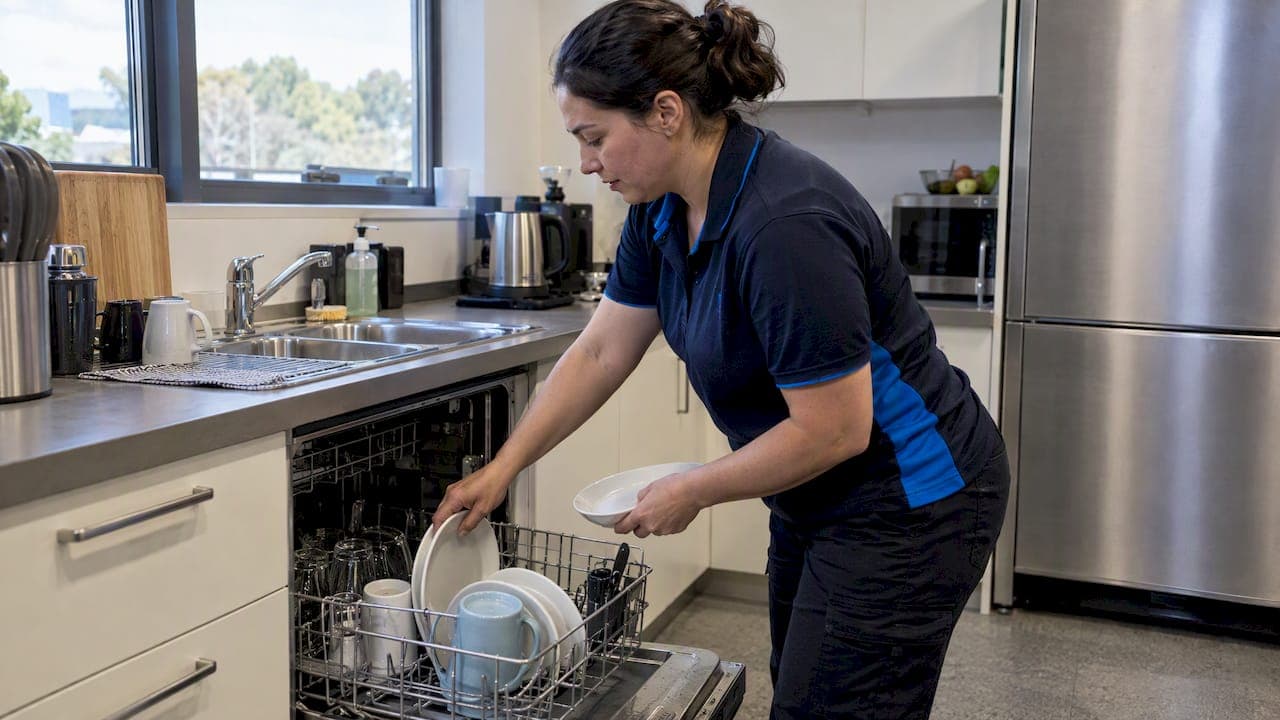
Every office kitchen should run on three rules: clean as you go, sanitise daily food-contact surfaces properly, and keep a written schedule with sign-offs. Food Standards Australia New Zealand sets the benchmark that surfaces must look, feel and smell clean, and that sanitising only works after a proper clean. Start today by posting a checklist and setting a fridge purge date.
TL;DR:
- Clean food contact surfaces in six steps: remove scraps, wash with detergent, rinse, sanitize, follow any required final rinse, and air dry.
- For chlorine sanitizers, use 100 ppm in cold water or 50 ppm in warm water, and discard diluted bleach after 24 hours.
- Record each task, frequency, owner, product, sign off, and review date; staff can handle daily basics while contractors take monthly deep cleans and specialist jobs.
- Set a fixed fridge purge day, give one day’s notice, discard unlabeled food then, and store ready to eat items above raw food.
Table of Contents
- A daily, weekly and monthly checklist by kitchen zone
- Kitchen rules and etiquette staff actually follow
- What clean and sanitary actually requires under food safety guidance
- Setting up a written cleaning schedule with sign-offs
- Fridge rules: labelling, storage and the purge policy
- Choosing cleaning products and keeping SDS accessible
- When to bring in a professional cleaner
- Waste management: recycling, composting and bin hygiene
- Managing shared utensils, crockery and cutlery hygiene
- Ventilation and mould prevention in the kitchen area
- Staff training on hygiene and kitchen use
- Why staff habits and professional cleans work better together
- How our office cleaning service supports your standards
- FAQ
- Sources
A daily, weekly and monthly checklist by kitchen zone
A shared kitchen stays usable when tasks are split by how often they need doing, not by who happens to notice the mess first. Copy this onto a rota or noticeboard and assign an owner to each frequency band.
Daily tasks:
- Wipe down benches, sinks and taps after each use.
- Disinfect microwave handles, fridge door handles and light switches.
- Empty bins and replace liners before they overflow.
- Spot-clean floor spills immediately, not at end of day.
Weekly tasks:
- Clean the microwave interior, including the roof and turntable.
- Clear and wipe down the fridge interior, including shelves and seals.
- Wipe cabinet faces and cupboard handles.
- Mop or vacuum the full kitchen floor.
- Clean the exteriors of coffee machines, kettles and toasters.
Monthly tasks:
- Clean range hood filters and ventilation grilles.
- Scrub floor grout and skirting edges.
- Pull out and clean behind major appliances.
- Deep-clean appliance interiors, including the dishwasher filter and oven if present.
- Steam-clean floor mats and rubber matting.
Grout work, range hood filters, behind-appliance cleaning and steam-cleaning mats usually need equipment most offices don't keep on hand, so these are the tasks worth handing to a contractor rather than a rostered staff member. Our complete office cleaning checklist breaks this down further if you want a version covering the rest of the office alongside the kitchen.
Kitchen rules and etiquette staff actually follow
A checklist only works if staff behaviour supports it between cleaning sessions. These rules turn the checklist into daily habits rather than a scramble.
- Clean as you go: wash or load your own dishes the same day, never leave them "for later".
- Label food with your name and the date; anything unlabelled gets removed on the next scheduled purge.
- Wipe spills immediately and tell the kitchen steward if something needs more than a quick wipe.
- Keep benches clear of personal items and store clean dishes separately from dirty ones.
- Assign a rotating steward or small roster so one person checks compliance each week, rather than leaving it to whoever's annoyed enough to act.
Pro Tip: Put the rules on a laminated card above the sink. Staff follow printed rules more consistently than verbal reminders that fade after the first week.
What clean and sanitary actually requires under food safety guidance
"Clean" and "sanitary" are different standards, and FSANZ treats them that way. Cleaning removes visible dirt and grease using detergent; sanitising destroys microorganisms, and it only works once cleaning has happened first, because leftover residue stops sanitisers from doing their job.
The official food safety standards guide sets out a six-step sequence for food-contact surfaces:
- Pre-clean to remove loose food scraps.
- Wash with detergent and hot water.
- Rinse to remove detergent residue.
- Sanitise using the correct product and concentration.
- Final rinse if the sanitiser label requires it.
- Air-dry rather than wiping with a cloth, which can reintroduce bacteria.
More than 5 million cases of food poisoning occur in Australia each year, and safe storage, handling and serving of food reduces that number, according to the Department of Health. A shared office kitchen that skips sanitising, or sanitises before properly cleaning, is one of the easy ways that risk climbs.
For chlorine-based sanitisers, the standards guide specifies 100 ppm in cold water or 50 ppm in warm water, and diluted bleach solutions should be discarded after 24 hours regardless of how much is left. Dishwashers can sanitise through heat, but only if they reach the manufacturer's specified temperature; a quick rinse cycle on a lukewarm setting does not sanitise, it only cleans. Record the product used, the dilution, the date and who did it, so there's a paper trail if a health question ever comes up.
Setting up a written cleaning schedule with sign-offs
A schedule only works as evidence of compliance if it's written down, assigned and checked off, not just understood informally. Build yours with six columns:
- Task: the specific job, not a vague category like "clean kitchen".
- Frequency: daily, weekly or monthly.
- Owner: the person or role responsible.
- Product used: the detergent or sanitiser applied.
- Evidence or sign-off: an initial, tick or photo confirming it happened.
- Review date: when a manager checks the whole schedule is still working.
Split responsibility clearly: staff handle clean-as-you-go basics, an office steward runs the daily and weekly checks, and contractors cover monthly deep cleans and anything requiring specialist equipment. A paper log on the fridge works for small teams; a shared spreadsheet or app suits larger offices with rotating staff. Our guide on how often an office should be cleaned has a sizing model if you're unsure how often to schedule based on headcount and usage.
Fridge rules: labelling, storage and the purge policy
Fridge mess is the fastest way an office kitchen starts to smell. Set a fixed purge day, communicate it a day ahead, and enforce it without exception.
- Label everything with name and date; unlabelled food gets binned on the next purge, no warnings.
- Store ready-to-eat food above raw items to avoid drips contaminating anything below.
- Keep shared condiments sealed and check use-by dates monthly.
- Remove perishable hot food from the fridge zone promptly if it has been left out.
- Post the purge schedule where the fridge is visible, not buried in an email chain.
Choosing cleaning products and keeping SDS accessible
Use food-grade sanitisers on food-contact surfaces and follow the manufacturer's dilution and dwell time exactly, since under- or over-diluting either wastes product or leaves surfaces under-sanitised.
- Store chemicals in clearly labelled containers in a dedicated, secure cupboard.
- Keep a Safety Data Sheet for every chemical on-site, in a kitchen-accessible folder or shared drive, never locked away.
- Never mix cleaning chemicals, and have the recommended gloves or PPE on hand.
- Discard diluted bleach solutions after 24 hours, as per the food safety standards guide.
When to bring in a professional cleaner
Some tasks are better scoped out than left to a rotating staff roster. Bring in professional help for monthly or quarterly deep cleans, range hood and vent servicing, grout and stone work, and any clean-up after a spill, pest sighting or contamination event.
- Ask any contractor for proof of food-safe cleaning experience and SDS handling procedures.
- Confirm they carry insurance and that staff have undergone relevant background checks.
- Agree how their visits slot into your written schedule, including who signs off on completion.
Waste management: recycling, composting and bin hygiene
Bin areas in office kitchens generate smells and pests faster than almost anything else, so the system needs to be obvious at a glance. Set up clearly labelled bins for general waste, recycling and, where your building supports it, food scraps for composting, with signage showing exactly what goes where.
Empty general waste and food scraps bins daily, since food residue left overnight attracts pests regardless of how clean the rest of the kitchen is. Recycling can run on a longer cycle, but rinse containers before binning them, since contaminated recycling often gets redirected to landfill at the sorting stage.
Line bins with bags rated for the volume generated, and wash bin interiors weekly with detergent, not just a spray and wipe, since residue builds up on the inside walls even with liners in place. If your office runs a composting arrangement, keep scraps in a sealed caddy and empty it before it starts attracting flies, with the timing depending on volume.

Assign bin duty to the same steward or roster covering the rest of the daily checklist, so it doesn't fall through the cracks between the cleaning company's visit and the next person who happens to notice.
Managing shared utensils, crockery and cutlery hygiene
Shared crockery and cutlery are some of the highest-risk items in an office kitchen because they move between person, sink, drying rack and cupboard with no single owner. Wash all shared items with detergent and hot water straight after use, then sanitise cutlery, plates and cups either through a dishwasher cycle that reaches the manufacturer's sanitising temperature or by hand using a food-grade sanitiser after washing.
Never let dishes air-dry stacked wet, since trapped moisture between plates supports bacterial growth; use a drying rack with airflow, or dry with a clean tea towel laundered daily rather than one left hanging for a week. Store clean crockery in a closed cupboard, not an open shelf exposed to dust and aerosol residue from cleaning sprays.
If the office supplies communal mugs or cutlery, run them through a dishwasher sanitising cycle rather than relying on hand-washing alone, since hand-washing with lukewarm water often cleans without properly sanitising. Chipped or cracked crockery should be thrown out rather than kept in rotation, as cracks harbour bacteria that normal washing can't reach.

Ventilation and mould prevention in the kitchen area
Mould in an office kitchen almost always starts with poor airflow around sinks, dishwashers and bins, combined with damp cloths or sponges left sitting out. Run exhaust fans or range hoods whenever the kitchen is in heavy use, and check that vents aren't blocked by furniture or stacked supplies.
Wipe down sink surrounds and splashbacks daily, since standing water around taps is one of the most common mould starting points in shared kitchens. Replace or sanitise sponges and dishcloths every few days rather than letting one sponge serve the whole week, and hang cloths to dry fully between uses instead of leaving them balled up in the sink.
Check under the sink and behind the fridge monthly for condensation or leaks, since these spots are easy to miss during daily cleaning but are where mould tends to establish first. If your kitchen has a window, open it during and after cooking or dishwashing to help clear humidity, and address any persistent damp smell immediately rather than masking it with air freshener.
Staff training on hygiene and kitchen use
A checklist and a schedule only work if everyone using the kitchen understands why the rules exist, not just that they exist. Run a short induction for new staff covering the clean-as-you-go expectation, the fridge labelling and purge policy, and where to find the Safety Data Sheets if they need to check a product.
Keep training practical rather than theoretical: show new staff where cleaning supplies are stored, how to run the dishwasher's sanitising cycle, and who to report a spill or breakage to. A practical walkthrough during onboarding works better than a written policy nobody reads.
Refresh the basics periodically, especially after any change to the schedule, the cleaning contractor or the fridge purge day, since inconsistent reminders are usually why office kitchens slip back into bad habits within a few months of a clean-up. Our article on office germ hotspots is a useful one to point new staff to, since it covers exactly which surfaces carry the most risk if they're skipped.
Why staff habits and professional cleans work better together
Daily habits keep a kitchen usable, but they rarely reach vents, grout or appliance interiors. Pairing staff routines with scheduled professional cleans closes that gap and keeps compliance records solid.
— Deng
How our office cleaning service supports your standards
We provide office cleaning that fits around your written checklist rather than replacing it: regular touch-ups, deeper cleans, and chemical use that respects your SDS folder and any eco-friendly product preferences.
- Regular or one-off visits scheduled around your existing roster.
- Deep cleans for vents, grout and appliance interiors that staff can't reasonably cover.
- No lock-in contracts.
Have a look at our office cleaning service page and request a quote to see how a scheduled clean fits around your current routine.
This article is general information, not a substitute for advice from a qualified doctor. Consult a qualified healthcare professional about your own circumstances before acting on anything here.
FAQ
What is the 20/10 rule for cleaning?
The 20/10 rule is a time-management habit that alternates cleaning with breaks until a space is done. It's a personal productivity technique rather than a formal food-safety or workplace standard, so it works alongside a written kitchen schedule rather than replacing one.
What are the 5 cleaning standards?
There's no single universally agreed "5 cleaning standards" framework specific to office kitchens; definitions vary by industry and context. The consistent principles that do apply, based on food safety guidance, are: visible cleanliness, proper sanitising after cleaning, correct product use, consistent scheduling and clear accountability for who did what.
What are 5 hygiene rules in the kitchen?
Core hygiene rules for a shared kitchen include washing hands before handling food, cleaning as you go rather than leaving dishes, labelling and dating stored food, sanitising food-contact surfaces after cleaning them, and keeping raw and ready-to-eat items stored separately. These align with the clean-then-sanitise sequence set out by FSANZ.
How often should an office kitchen be professionally cleaned?
Most offices benefit from a professional deep clean monthly or quarterly, covering vents, grout, appliance interiors and anything daily staff cleaning can't reach. Lighter touch-ups can run more often depending on headcount and kitchen usage, which our office cleaning bookings can be scheduled around.
Sources
- Cleaning and sanitising | Food Standards Australia New Zealand
- A GUIDE TO THE FOOD SAFETY STANDARDS FOURTH EDITION FEBRUARY 2023
- Food standards and safety | Australian Government Department of Health, Disability and Ageing
- Onesystem