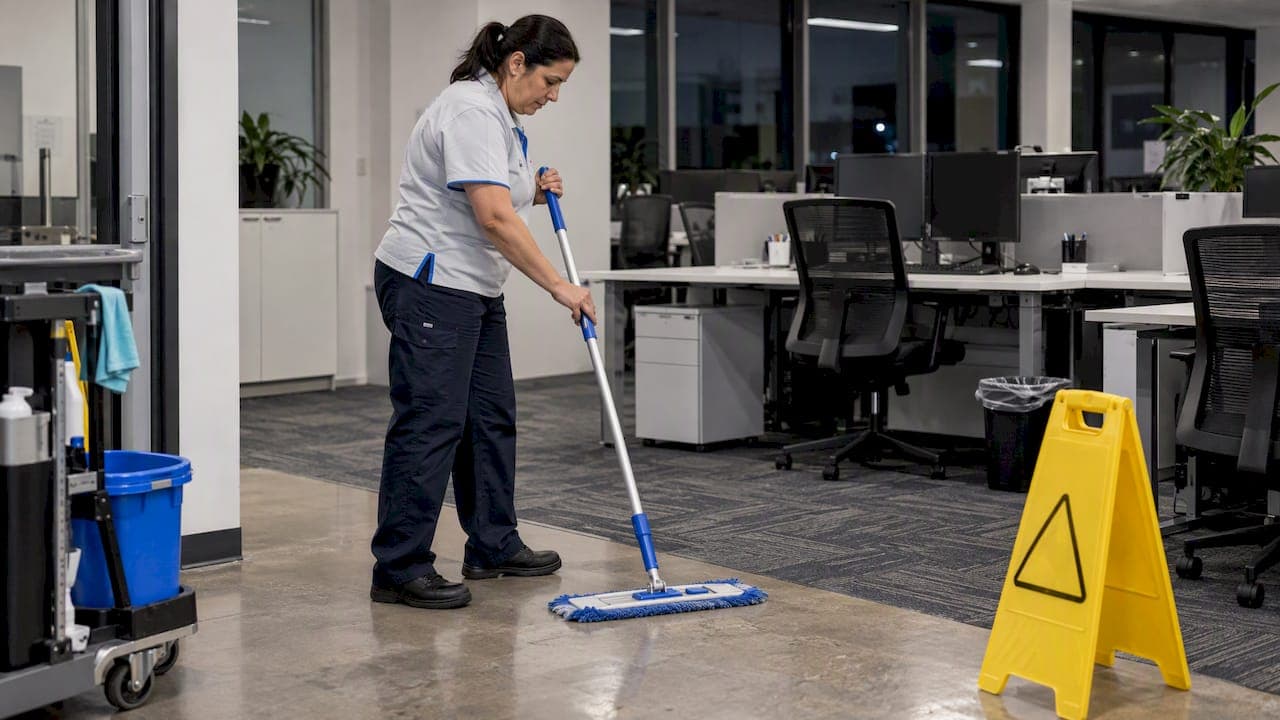
Australia has no single national standard that says how an office must be cleaned. What applies is work health and safety (WHS) law, supported by codes of practice, plus whatever your contract with a cleaning provider specifies. In practice, a good standard is a written list of outcomes and frequencies for each zone of your office, backed by safe chemical handling, trained staff and records you can check. This guide covers what the rules require, what a defensible specification looks like, and how to test a provider, with Canberra and the ACT in mind.
TL;DR
- No one Australian rulebook defines "clean" for a conventional office. Your duty comes from WHS law, and the Safe Work Australia model code is the main reference for facilities.
- Cleaning is a safety control, not just appearance. Toilets, kitchens and walkways need frequencies matched to use, sometimes more than daily.
- Chemicals need a current safety data sheet (SDS) on hand. "Eco-friendly" on the label does not remove that duty.
- Write your standard by zone, with frequencies, outcomes, exclusions and records. Do not rely on a vague "commercial grade" promise.
- Construction dust, suspected asbestos and biohazards are outside an ordinary office routine and need a separate assessment.
Table of Contents
- Is there an official office cleaning standard in Australia?
- What the WHS code expects from a clean office
- Chemicals: the part most offices miss
- Writing a standard you can enforce
- When it is not ordinary office cleaning
- Perspective: what we see in Canberra offices
- How to check a provider before you sign
- Office cleaning from ACT Cleaning by Demand
- FAQ
- Sources
Is there an official office cleaning standard in Australia?
Not in the sense many people expect. You will not find one document that sets how many times a desk must be wiped. Several sources fill the gap:
- WHS legislation. The person conducting a business or undertaking (PCBU) must keep the workplace, including facilities, safe and healthy. In the ACT this sits under the territory's WHS framework, and WorkSafe ACT is the regulator.
- Codes of practice. Safe Work Australia's model code on managing the work environment and facilities (December 2025) is the practical guide. The ACT version is published on the ACT legislation register.
- Awards and employment law. These govern what cleaners are paid and how they are engaged, not how clean your office must be.
- Your contract. This is where the real, enforceable standard lives for most offices.
One trap: you may see the ACT Health infection-control guideline mentioned online. The guideline applies to businesses doing skin-penetration or infection-risk procedures. It is not the legal standard for an ordinary Canberra office.
What the WHS code expects from a clean office
The model code treats cleanliness as part of keeping facilities safe. It asks PCBUs to monitor the work environment and maintain it, which in practical terms means:
- spills dealt with immediately
- walkways kept clear
- waste removed regularly
- toilets and hand-washing facilities kept hygienic
- soap and toilet paper replenished
- damaged furniture, plumbing, air-conditioning and lighting repaired promptly
The code also says cleaning schedules should account for shift work and how many workers use the facilities. High-use areas such as kitchens, dining areas, toilets, urinals, hand basins and showers need a frequency based on use and contamination risk, which may be more often than daily.
That last point shapes everything else. A ten-person office with one toilet and a twenty-person floor sharing a kitchen with a hot-desking team do not need the same routine. For a size-and-usage breakdown, see our guide on how often an office should be cleaned.
Cleaning prevents slips and trips
Housekeeping is a hazard control. Wet floors after mopping, uncollected cardboard and trailing cables all cause falls. A good provider uses signage, cleans in sections and schedules wet work outside peak hours. Footwear also plays a role for staff who work on hard, wet floors: this overview of anti-slip shoes and slip-resistance testing explains the ratings, though it is a UK source, so check Australian requirements for your site.
Chemicals: the part most offices miss
Cleaning products are chemicals, and some are hazardous chemicals under WHS law. WorkSafe ACT's guidance sets out what applies in the territory:
- Obtain the current Australian SDS before a product is used.
- Keep it readily accessible to workers and others likely to be exposed.
- Maintain an up-to-date chemical register where required.
- In the ACT, hazardous chemicals are regulated under Part 7.1 of the Work Health and Safety Regulation 2011.
A hazardous chemicals register is simply a list of hazardous chemicals at the workplace with the current SDS for each.
Two details matter for office managers:
- Chemicals stored on your premises. Even when external cleaners use the products, you as the office PCBU may need the register and current SDS, while the cleaning business keeps its duties to train workers and provide chemical information. Settle who holds what before the first clean.
- The consumer-product exception. It can apply only where a product is used in small amounts, consistently with household use and incidentally to the work. Do not assume it covers commercial cleaning quantities.
For most offices, storage will sit well below the thresholds that trigger notification. If hazardous chemicals exceed a Schedule 11 manifest quantity, WorkSafe ACT requires notification and the related manifest and emergency-plan arrangements. That is a conditional rule, not one for ordinary small-scale storage.
"Eco-friendly" is not a compliance status
Green products are a good choice, and substitution is part of the WHS hierarchy of controls. But Safe Work Australia's hazardous chemicals guidance is clear that duties follow the hazard. A product used for sustainability reasons still needs correct labelling, accessible SDS information, suitable storage and worker training if it falls within the hazardous-chemical requirements. Ask for the SDS, not just the marketing.

Writing a standard you can enforce
A task list is a start, not a standard. Queensland Government sustainable procurement guidance for cleaning services is written for public buildings, but it is a useful benchmark for any facility manager. It recommends asking providers for documented procedures covering:
- chemical dilution and storage
- suitable products
- equipment inspection and maintenance
- training
- quality assurance
- hazard controls
- accident reporting
- record keeping
- waste disposal
It also recommends evidence of Fair Work Act compliance and award coverage, and mentions ISO 14001 as one example of formal environmental-management evidence. Treat these as procurement benchmarks, not a legal requirement for every small cleaning business. A smaller local provider may meet the intent with clear documents even without a certificate.
The underlying point is that quality assurance is a management system: documented procedures, communicated to staff, checked by inspection, with reports and records. That is what makes a standard repeatable.
A zone-by-zone specification
Split your office into zones and set an outcome and a frequency for each. The frequencies below are a starting template to adapt, not a regulatory requirement.
| Zone | Outcome to specify | Starting frequency to consider |
|---|---|---|
| Toilets and hand basins | Sanitary, odour-free, soap and paper stocked, no visible soiling | Daily, with a mid-day check if heavily used |
| Kitchen and dining area | Benches, sink, appliance exteriors and tables clear of residue; bins emptied | Daily |
| Entry, corridors, walkways | Clear, dry, no trip hazards | Daily |
| Desks and workstations | Surfaces dust-free; clutter-free desks cleaned, personal items not moved | Weekly or as agreed |
| High-touch points (switches, handles, lift buttons) | Disinfected with a suitable product | Daily to several times weekly |
| Meeting rooms | Tables wiped, bins emptied, floor vacuumed | After use or per schedule |
| Floors | Vacuumed or mopped; spot spills dealt with | Per traffic |
| Windows, vents, high dust | Detailed clean | Monthly to quarterly |
For a fuller task list, our office cleaning checklist from daily to annual goes into more detail, and the office germ hotspots guide shows which surfaces to prioritise. Kitchens attract the most disputes, so we wrote a separate piece on office kitchen cleaning standards and compliance records.
What else the contract should say
- Inclusions and exclusions. Say whether you want fridge cleaning, internal windows, carpet extraction or equipment wiping.
- Hours. After-hours work reduces disruption but changes access, security and lone-worker arrangements. We cover this in our after-hours office cleaning scheduling guide.
- Inspection and sign-off. Name who checks, how often, and how defects are reported and fixed.
- Incident reporting. Spills, injuries, damage and near misses should be recorded and sent to you.
- Chemicals. State who supplies products, where SDS are kept, and who maintains the register.
- Notice and exit. Agree how either side ends the arrangement.
When it is not ordinary office cleaning
A generic checklist does not cover every site. WorkSafe Victoria warns that cleaning work can involve chemical and equipment hazards, so site-specific risk assessment matters, especially for kitchens, toilets, wet floors, machinery, heights, dust, biohazards and construction sites.
The ACT has a clear example. WorkSafe ACT's list of prosecutions includes a case where a high-pressure hose was used to clean a corrugated asbestos sheet roof, spreading contamination and requiring remedial action. The lesson for fit-outs and post-construction cleans: treat suspected asbestos, heavy dust or contaminated debris as a stop-and-escalate matter, never as routine dirt. A competent provider will define exclusions before work begins and tell you if something needs a licensed specialist.
Perspective: what we see in Canberra offices
Most disputes we hear about are not about effort. They come from an unwritten standard: the manager expected the fridge cleaned, the cleaner assumed it was out of scope. So we push clients to define outcomes by zone, not to buy hours of cleaning.

We also think "eco-friendly" should be a starting point for conversation, not the end of it. Our cleaners are police-checked and insured, we use eco-friendly products, and we offer custom-tailored plans with no lock-in contracts. But the product's label is not the safety system. Training, SDS access, and a plan for what the cleaner does when they find something unusual are what protect your staff.
Our advice is to ask any provider, including us, to show you how they handle chemicals, how they record problems and what they will not do. If the answers are vague, the standard will be too.
— Deng
How to check a provider before you sign
- Ask for the documents. Procedures for chemicals, training, incident reporting and quality checks.
- Ask for evidence of employment compliance. The Fair Work Ombudsman's Cleaning Services Award pay guide, published 24 June 2026, shows adult full-time minimums of $27.08 (Level 1), $27.97 (Level 2) and $29.45 (Level 3) an hour from the first full pay period on or after 1 July 2026. Penalty rates, allowances and other rules also apply, so use this to sense-check a quote that looks unusually low, not as a price list.
- Check insurance and police checks. Offices with after-hours access should insist on both.
- Walk the site together. Agree zones, exclusions and access before the first clean.
- Run a trial period. Review the first month against your zone table and adjust.
- Keep a log. Dates of inspections, defects raised and fixes made are your evidence if something goes wrong.
Office cleaning from ACT Cleaning by Demand
If you want the zone-by-zone approach set up for you, our office cleaning service is built around a plan tailored to your premises, with flexible scheduling and no lock-in contracts. You can also see everything we offer on our services page, including post-construction and strata cleaning.
FAQ
Is there a legal minimum cleaning frequency for offices in Australia?
No fixed frequency is set for offices. The WHS model code instead expects facilities to be kept hygienic and schedules to reflect the number of workers and the risk of contamination. High-use areas such as toilets and kitchens may need cleaning more than daily.
Do Canberra offices have different rules from the rest of Australia?
The ACT applies its own WHS framework, regulated by WorkSafe ACT, and has its own version of the facilities code. The principles match the national model, but hazardous chemical duties refer to the ACT's Work Health and Safety Regulation 2011.
Who is responsible for safety data sheets when contractors clean my office?
Both parties have a role. The cleaning business must train its workers and provide chemical information, and you may need the register and current SDS if products are kept on your premises. Agree this in the contract.
Does ISO certification prove a cleaner meets the standard?
Not by itself. Queensland procurement guidance cites ISO 14001 as one example of environmental-management evidence, but it is not a universal legal requirement. Documented procedures, training records and references are equally useful tests.
Sources
- Safe Work Australia, Model Code of Practice: Managing the work environment and facilities (December 2025)
- ACT legislation register, Work Environment and Facilities Code of Practice
- ACT Health, Infection control guidelines for office practices and other community based services
- WorkSafe ACT, Hazardous chemicals
- Safe Work Australia, Hazardous chemicals register fact sheet
- WorkSafe ACT, Manifest quantity workplace notifications
- Safe Work Australia, Hazardous chemicals
- Queensland Government, Sustainable procurement guide: Cleaning services
- WorkSafe Victoria
- WorkSafe ACT, List of prosecutions
- Fair Work Ombudsman, Cleaning Services Award pay guide